State of Affairs with Steve Adubato
Jennifer Sellitti; Michellene Davis, Esq.
Season 10 Episode 14 | 26m 46sVideo has Closed Captions
Jennifer Sellitti; Michellene Davis, Esq.
NJ Public Defender Jennifer Sellitti joins Steve Adubato to discuss New Jersey's holistic representation pilot program and how it helps individuals navigate the justice system and reintegrate into the community. Steve Adubato is joined by Michellene Davis, Esq., President & CEO of National Medical Fellowships, to explore the healthcare workforce shortage and what it means for the future of care.
Problems playing video? | Closed Captioning Feedback
Problems playing video? | Closed Captioning Feedback
State of Affairs with Steve Adubato is a local public television program presented by NJ PBS
State of Affairs with Steve Adubato
Jennifer Sellitti; Michellene Davis, Esq.
Season 10 Episode 14 | 26m 46sVideo has Closed Captions
NJ Public Defender Jennifer Sellitti joins Steve Adubato to discuss New Jersey's holistic representation pilot program and how it helps individuals navigate the justice system and reintegrate into the community. Steve Adubato is joined by Michellene Davis, Esq., President & CEO of National Medical Fellowships, to explore the healthcare workforce shortage and what it means for the future of care.
Problems playing video? | Closed Captioning Feedback
Where to Watch State of Affairs with Steve Adubato
State of Affairs with Steve Adubato is available to stream on pbs.org and the PBS app.
Providing Support for PBS.org
Learn Moreabout PBS online sponsorship- [Narrator] Funding for this edition of State of Affairs with Steve Adubato has been provided by EJI, Excellence in Medicine Awards.
A New Jersey health foundation program.
PSE&G.
Powering progress.
The New Jersey Education Association.
NJ Best, New Jersey’s five-two-nine college savings plan.
New Jersey Sharing Network.
Englewood Health.
Myron and Elaine Adler private foundation, in support of the Adler Aphasia Center.
Delta Dental of New Jersey.
We love to see smiles.
And by NJM Insurance Group.
Serving New Jersey’s drivers, homeowners and business owners for more than 100 years.
Promotional support provided by Insider NJ.
And by NJBIA.
We put business at the center.
[INSPRATIONAL MUSIC] - Hey, everyone, Steve Adubato.
We kick off the program talking about important legal matters, particularly for those who can't afford lawyers and need representation, with Jennifer Sellitti.
She is New Jersey's public defender.
Jennifer, great to have you with us.
- Thank you for having me.
- We put up the website right now for your office.
Tell everyone what the Office of the Public Defender is and why it's so important.
- The Office of the Public Defender represents people across the state who are accused of indictable offenses, and also represents people in child welfare and mental health proceedings.
We are an organization of 1300 people, part of New Jersey's state government, and that makes us the largest criminal defense firm in the state of New Jersey.
- Now, the lawyers who work in your office, how would you describe them?
Why do they go there and why do they stay?
- I think they go there because there is a calling to represent people who need us the most, people who cannot afford representation, people charged with serious offenses.
And we find our lawyers are extremely passionate, extremely intelligent, and extremely eager to represent people in court, and to challenge the evidence against them in court, to try cases, and to get the best results we can for the people that we serve.
- We're going to talk in a moment about this concept of holistic representation, which is a term I was not familiar with until we prepped for this interview.
But tell folks, explain to folks that there are, in many ways, two systems of justice.
Not an opinion, but it largely has to do with your financial capabilities to afford excellent representation or not.
- Yeah, so I do think that, to some extent, there are two systems of justice in this country.
I think in New Jersey, we are very fortunate, because we are one of the few statewide public defender systems across the country, which means that we can bring a lot of resources to bear for the people we serve, forensic resources, experts, investigators, the things that our clients need to defend their cases in court.
We do, however, find the same systemic challenges that exist, challenges that have to do with discriminatory policies, that have to do with poverty, that have to do with the mental health system in this country.
So all of those things we are dealing with as we represent people day in and day out in courtrooms across the state.
- What is holistic representation?
- So holistic representation is a new form of representation that really means looking at the whole person and what they need, instead of just the case in isolation.
So typically, when I started lawyering, I would represent people.
I would be focused on the legal challenges in their case, their motions, their trials, the day-to-day things that you think about when you think about what a criminal defense lawyer does.
Over time, one of the things that I realized is, many people are coming to us because of challenges with mental health, lack of opportunity, jobs, things like that.
So what holistic defense does, it allows us to pair our lawyers with an advocate, and to have that advocate immediately start connecting the people that we serve to the services that we need that are going to make them successful regardless of how their case ends.
- Yeah, you call them advocates.
What kinds of skills and tools are we talking about that these advocates need to be able to provide those services?
- So many are social workers, some are coming from, graduating from college and going into social work, or maybe going onto law school.
And I'm really proud to say that many of our advocates have been system impacted themselves.
We have a number of advocates who have been formerly incarcerated, that have had their own struggles in life, have had family members that have gone through the justice system.
And that makes them particularly adept at communicating with the people that we serve, and really helping to understand and connect with the people we serve in a way that many of our lawyers cannot.
- Talk about the impact of this kind of representation.
- So what this kind of representation does is really sets people up for success in the future.
We have found that about one in four of our clients in this program were unhoused, about six in 10 had mental health diagnoses, and about four in five had challenges with job opportunities.
And by being able to connect people to those things, we're making them far more successful, both on pretrial and on probation.
We're deferring people from state prison sentences into probation and other forms of rehabilitation without posing a danger to the public.
And I think that's the important thing.
Most people who go to county jail or go to prison are eventually going to come out.
What we are trying to do is to make sure that people have the services that they need so that when they come back out, they're better neighbors and better able to contribute to their communities.
So that means we're both making the public safe and improving the lives of the people we serve.
- Jennifer, talk about this, the economics of this.
Obviously everything you're talking about costs a lot of money.
The money's not private, it is all taxpayer money.
Given the expansion of your office through this holistic defense, holistic representation, it's not just a concept, it's a practice.
That means more tax dollars.
Are taxes being raised to pay for this?
And if not, where would that money be coming from?
Particularly at a time when, in our interview with Governor Sherrill, people can check out our website, SteveAdubato.org, the governor talked about the incredibly tight fiscal times we're living in.
So where's that money coming from?
- So I want to be clear that we see this only as a savings to the taxpayers.
We think this will save taxpayer money.
It costs $75,000 a year to keep somebody in state prison.
We are finding, we have a three county pilot going.
We are trying to expand this program to 21 counties.
- What counties?
What counties?
- It's Atlantic, Monmouth, and Hudson County are our three pilots.
- Why those counties?
If there are 21 counties, 18 are not included, why is that?
- Well, we started, many times, in order to sort of prove a concept, you have to start with a pilot and then prove that the program works.
We have seen our service connections increase by over 400% in those counties.
And we have seen people saving, on average, about 2.2 years of state prison with no increase in the amount of recidivism.
When you think about those numbers, you think about $150,000 a person if we save two years of state prison.
- Okay, real quick on this.
Assemblyman Gary Schaer from Passaic County has introduced legislation, as I understand it, if I'm wrong, correct me, to expand this holistic representation practice statewide in 21 counties.
Where is that legislation and what are the odds that it would be passed into law?
- So the legislation is pending right now.
We have a number of.
- Pending in committee?
- It has not gone to committee yet, no.
- So pending pre, not even up on a docket or an agenda for the Assembly Judiciary Committee?
- Correct.
It was introduced.
We've got a number of sponsors signed onto it, but so far it has not been listed for committee.
- If it doesn't pass, what does that mean?
If it doesn't get a hearing and if it doesn't get voted on, what would that mean?
- It means that we continue with our three county pilot.
It means that we attempt to expand using the resources that we have and continue to prove out the concept.
I am confident that, over time, when people start to look at these numbers, they are going to realize that this program pays for itself very, very quickly.
- Jennifer Sellitti, New Jersey Public Defender.
Jennifer, thank you so much for joining us.
We'll follow this and have you back in the future.
- Thank you so much, I really appreciate it.
- You got it.
Stay with us, we'll be right back.
(grand music) - [Announcer] To see more State of Affairs with Steve Adubato programs, find us online and follow us on social media.
- We are honored to once again be joined by our good friend and colleague, Michellene Davis, President and CEO of National Medical Fellowships.
Good to see you, Michellene.
- It's better seeing you, my friend.
- And also let me say that Michellene Davis is the vice chair of our board of trustees at our not-for-profit production company.
Michellene, the website for National Medical Fellowships is up.
Tell folks what it is and why it matters now more than ever.
- Oh my goodness.
Thank you so much for that.
Steve, National Medical Fellowships has, for the last 80 years, been addressing the physician shortage.
It is that thing that people are feeling right now.
This crisis is not coming, it is already here.
And so NMF has been really working to remove the financial structural barriers by providing scholarships, financial aid to students who are in medical school in order to assist them on making it through medical school.
We also, of course, give them a fantastic community to be a part of, mentorship, networking, programmatic and professional development, just to ensure that they make it through and remain in the profession.
- Now, your organization does all it can as a not-for-profit.
We are as well, as you well know.
But you never can solve the entire problem and the crisis as you described.
Describe the crisis.
I'm reading a section on the piece from NJ.com.
New Jersey already has one of the worst primary care shortages in the country, according to the New Jersey Healthcare Quality Institute, great organization.
The state only has 17 primary care physicians per 100,000 residents, among the lowest concentration in the nation, and a fraction of what is needed.
How the heck, Michellene, did we get to this point, and how do we close that gap?
- Hmm, so much of this really is a multifaceted background.
But what I will tell you is that there are really two primary things that, for me, really stand out.
One, you know, there is a GME cap that is a cap on the number of residency slots across the country.
It is not set- - Graduate medical... Sorry for interrupting.
GME, graduate medical education.
That's okay- - Yeah, graduate medical education.
Well, that's why I said residency slots, right?
And so it is once you complete medical school, there's this fantastic day, it is Match Day, you find out where you have matched across the country and into what specialty.
One of the issues there, my friend, is that there was a GME cap that was placed by Congress, right, back in the '90s.
And, as a result of that, that cap makes certain that the number of residency slots available remains at a certain level, right?
It is the level that lots of national organizations have been advocating needs to be increased for some time.
That being said, it has not been.
And so it continues to be there.
But in addition to that, another aspect that has led to the exact statement that you just gave, that data point, has a lot to do with the expense of medical education, right?
It is so expensive that when individuals graduate, they oftentimes go into specialty instead of primary care because the primary care pay rate is lower, right?
And so you just talked about the fact that there are only 17 per 100,000 residents.
That is, in fact, not just an issue, that is at a crisis level, Steve.
- Is it worse?
Now, those statistics, I mean, just imagine we're talking about 17 primary care physicians per 100,000 residents.
Is it worse in minority communities?
- So, my friend, I will tell you this, that, you know, in fact, it is, but this is a topic that affects individuals no matter where you live.
I don't care whether or not it is Melbourne and Short Hills, or whether or not it is Camden or Absegami.
It runs the gamut and affects you at every level.
And this is what's interesting.
If folks do not believe that they are feeling it at the crisis level, I need them to think about this, that about 10 or 20 years ago when they called to get a physician's appointment, when they called to get their doctor's appointment, they were given it, you know, in relatively short stead.
Now, you can call to get an appointment.
I called once in February, and I received the date of October 27th, and that, my friend, stuck with me.
Yes, my primary care physician is a friend.
She's a friend, and I could not get in to see her until October.
- So your organization doing all you can to promote minority professionals going into the field of medicine.
But let me ask you this.
From the straight economics that you just laid out going into the specialties, do you blame, there's no other way to say this, do you blame a medical professional, a doctor who says, "I'm gonna go where I need to go to make money 'cause I have to pay these medical school bills, plus I got to make a living for my family?"
You don't blame them for that.
So how do we change the economic incentives?
- Yeah, so, Steve, let me say this, two things.
One, my organization actually welcomes all comers.
It is based on income eligibility, right?
And so if you have eligibility based on your income, if you are from a community that is at a lower economic state, and then if in fact you have a demonstrated track record of a commitment to community health, we welcome you in.
So I just want to make certain that I clarify that.
The additional aspect- - Got that.
- Yeah, yeah, but I will tell you this- - Thanks for that clarification.
That clarification is important.
- You got it.
But I will also tell you, though, that we tend to garner and attract students to apply for our scholarships who are already dedicated to community health and well-being, right?
That's that demonstrated track record.
And through recent research that we've done, just analyzing our own alumni database, we have found that upwards of 70% of them, right, literally choose to serve in communities that are at a particular, they are socially vulnerable communities, right?
And so, as a result of that, we are undoubtedly really rushing in when others are rushing out in that regard.
But this is what I will say when you say, you know, well, certainly, we do not fault them, absolutely positively not.
And I will tell you this, that for a long time, the parameters of the system actually attempted, worked to try to incentivize individuals to serve in communities, right, that are really high in the social vulnerability index.
And unfortunately, recently, as a result of what I call the "Love Letter to America," which was H.R.
1, we've seen some shifts there, some shifts that, my friend, are going to affect everyone no matter where they are.
And people may think that they will not, but they will, right?
And so why do I say that?
I say that because that which other folks call it the big, beautiful bill did some really tricky things in medical education.
First of all, our typical scholar is oftentimes first-generation medical school, first-generation college, first-generation some high school graduate, right?
So if you are in that position, there is a high likelihood that your family cannot support your educational pursuits.
So you're already graduating from undergrad with a significant level of debt.
Then when we look at medical school, which, as you know, ranges between, oh my gosh, 70 to, you know, $200,000 worth of debt.
We are seeing individuals graduate from medical school with a debt load of upwards of $600,000.
What would that person, what would you expect that person to choose in order to be able to make up for that debt and attempt to thrive in a profession, right?
I'm likely going to look at, so what actually, right, pays the most and also aligns with my values.
There's a likelihood that I'm going to go into orthopedic surgery.
There's a likelihood that I'm going to, right, choose to go into dermatology.
These specialties pay higher than a primary care physician.
Wow.
- Right, right?
And, Steve, if you permit me to, I'd love to talk to you about, right, some of the key aspects of the impact on medical education that was literally in H.R.
1, right?
So we saw literally the elimination of what was referred to as Grad PLUS loans.
These were loans that were really special because of the fact that they were so incredibly low interest.
They've now gone away.
Then we literally had caps on the ability to borrow from the federal loans, which, again, are very low interest.
So if we see that now it's capped at $50,000 per year with a lifetime limit of $200,000 for a professional school.
Medical school is the highest, most expensive professional school education there is.
We just walked through, right, what that debt burden can be.
So what we know about that is that when we have that cap, individuals who are, have this undeniable will to aid their, you know, humankind, their neighbor, their friend, and literally pursue medical education, they're being driven now into higher private debt because they still have to make up for that loan shortage, right, because now it's capped.
So that means that they're going to be driven into privatized loans, which have much higher interest rates.
I'm not telling you anything that you don't know.
But it adds to that debt burden.
And so then we also have significant changes to the public service loan forgiveness and deferment benefits program, right?
This used to permit individuals to go and serve in underserved area and have loan forgiveness.
- Michellene, let me follow up on this.
What you just described is a complex, multifaceted crisis problem that did not happen overnight.
And you, you also make it clear that H.R., House Resolution 1, the big, beautiful blah, blah, blah, blah, blah, whatever people choose to call it, the impact and the implications of it that may or may not be the intent of those who create it.
Who knows?
It's irrelevant because the reality is what you just described.
What do you believe it will take in terms of the political, social, cultural will to begin to turn this around?
Or is this the track we're on?
I will tell you that right now, the American Medical Association warns that these high educational costs are already the primary barrier to medical school, right?
They've already indicated that these restrictions will exacerbate the projected shortfall significantly.
We are right now at a time when we are incredibly divided as a society, which breaks my heart.
But when you ask me what it will take, it will literally take the understanding that we are all intricately interwoven.
This is not something that is going to bother those folks over there.
Americans are living longer, but we are living sicker.
Steve, who will care for us regardless of socioeconomic or religious or cultural or ethnic differences, regardless of all of that?
Who will care for you when you are at the age?
Of course, you won't look that old, but nevertheless, at the age where you need to have significant management of chronic health conditions.
Who will care for those that we love?
- To what degree does this political, cultural, human divide, the polarization that's going on?
Are you with them?
Are you with blue, red, MAGA, not MAGA, whatever?
What has that done, that polarization as it relates to the trust/mistrust in public health, information about vaccines, information about best practices, information about the things you're talking about, that's not political, but it hasn't always been this way?
Or has it, and I missed it?
- So I will say this.
I think that everything that we are seeing right now was always actually there.
It is just bubbling up to the top, my friend.
It now has a microphone rather than a whisper campaign.
And so we are seeing it and feeling it, and unfortunately so are our physicians and our clinical research scientists, and our medical students, right?
We see talented students every day who have the passion and ability to serve in community, but they face significant financial barriers to entering the profession.
One of the additional barriers that they're facing right now really is this lack of a trust and belief in science, right, right?
So we're saying, "Oh my, we have hit crisis status on our physician shortage.
Please come into a profession that is being questioned, that is being challenged every day by influencers."
Listen, I'm not anti-influencer.
I just want you to have a background in science, perhaps a degree in medicine, right, in order to tell me what to take, what to do, and to be listened to- - And by the way, excuse me for interrupting, Michellene, it's not just physicians, but nurses as well.
- Oh, absolutely.
Listen, have you taken a look at the rate at which nurses are leaving their profession?
You got it, you got it.
So the shortage is being exacerbated, and this is a health care workforce shortage.
In two primary ways, yes, we do not have enough books going in to the professions.
But, my friend, we have individuals who are electing to leave the profession way before the age of retirement.
- Wow.
- Burnout of this workforce is significant.
And what you've just described is one of the reasons and the rationales as to why.
When you enter a space- - Who would want to be in a profession where people don't respect what you do.
You're saying you're following best medical science, and people are like, "No, I'm not with that."
- Right, listen- - And I think you're the enemy.
- So that part, right?
'Cause it's one thing to say, "Well, I looked it up on Google, and this is what my (indistinct) say."
It's another one to say, "No, I don't trust you because we have a medical degree."
It's another one to say, "Right, well, I don't trust that science."
That is a difficult thing to come to, right?
And the fact that there's already a backup against it.
My friend, if we do not get on the same page as an understanding that your well-being is connected to my well-being and that we better get in this together, we will unfortunately all perish apart.
- And by the way, check out the interview that we did with Dr.
Perry Halkitis, who Michellene knows well- - My dear friend- - From the Rutgers School of Public Health.
Perry's been studying public health for years.
In that interview, he talks about what we learned during COVID, and also he goes all the way back to the HIV/AIDS crisis as well.
Michellene, we just got 20, 30 seconds.
You remain optimistic because you're a person of God and person of the church.
Are you optimistic about this?
- Listen, I have an audacity of hope.
And I have it because every single day I get to deal with medical students and those who are hoping to become physicians and see and hear from them not just the passion to do so, but Steve, the absolute brilliance.
NMF is going to continue doing what we've done for the last 80 years.
We're going to continue addressing the physician shortage by bringing the best and the brightest to its forefront.
- Michellene Davis, President and CEO of National Medical Fellowships.
Thank you my friend, appreciate it.
- Thank you.
- I'm Steve Adubato.
That is a very smart professional.
We'll see you next time.
- [Narrator] State of Affairs with Steve Adubato is a production of the Caucus Educational Corporation.
Funding has been provided by EJI, Excellence in Medicine Awards.
A New Jersey health foundation program.
PSE&G.
The New Jersey Education Association.
NJ Best, New Jersey’s five-two-nine college savings plan.
New Jersey Sharing Network.
Englewood Health.
The Adler Aphasia Center.
Delta Dental of New Jersey.
And by NJM Insurance Group.
Promotional support provided by Insider NJ.
And by NJBIA.
Hey, kids, PBS Kids and Delta Dental want you to have a healthy smile.
So here are some tips for you to remember.
Number one, eat plenty of crunchy fruits and vegetables.
Number two, brush your teeth after eating sugary snacks or drinking sodas.
And number three, drink lots of water to wash away food particles.
When your teeth are happy, all of you is happy.
From PBS Kids and Delta Dental.
Have a healthy smile.
 New
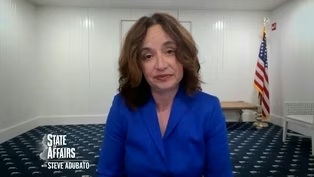
NewExploring New Jersey's holistic representation pilot program
Video has Closed Captions
Clip: S10 Ep14 | 9m 15s | Exploring New Jersey's holistic representation pilot program (9m 15s)
 New
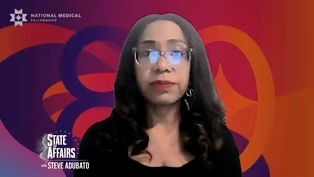
NewNational Medical Fellowships examines healthcare shortage
Video has Closed Captions
Clip: S10 Ep14 | 17m 13s | National Medical Fellowships examines healthcare shortage (17m 13s)
Providing Support for PBS.org
Learn Moreabout PBS online sponsorship New Episode
- News and Public Affairs

Top journalists deliver compelling original analysis of the hour's headlines.
 New Episode
- News and Public Affairs

Today's top journalists discuss Washington's current political events and public affairs.

 New Episode
 New Episode
 New Episode
 New Episode
 New Episode
 New Episode
 New Episode
 New Episode
Support for PBS provided by:
State of Affairs with Steve Adubato is a local public television program presented by NJ PBS