State of Affairs with Steve Adubato
Exploring New Jersey's holistic representation pilot program
Clip: Season 10 Episode 14 | 9m 15sVideo has Closed Captions
Exploring New Jersey's holistic representation pilot program
New Jersey Public Defender Jennifer Sellitti joins Steve Adubato to discuss New Jersey's "holistic representation" pilot program and how it helps individuals navigate the justice system and reintegrate into the community.
Problems playing video? | Closed Captioning Feedback
Problems playing video? | Closed Captioning Feedback
State of Affairs with Steve Adubato is a local public television program presented by NJ PBS
State of Affairs with Steve Adubato
Exploring New Jersey's holistic representation pilot program
Clip: Season 10 Episode 14 | 9m 15sVideo has Closed Captions
New Jersey Public Defender Jennifer Sellitti joins Steve Adubato to discuss New Jersey's "holistic representation" pilot program and how it helps individuals navigate the justice system and reintegrate into the community.
Problems playing video? | Closed Captioning Feedback
Where to Watch State of Affairs with Steve Adubato
State of Affairs with Steve Adubato is available to stream on pbs.org and the PBS app.
Providing Support for PBS.org
Learn Moreabout PBS online sponsorship[INSPRATIONAL MUSIC STING] - Hey, everyone, Steve Adubato.
We kick off the program talking about important legal matters, particularly for those who can't afford lawyers and need representation, with Jennifer Sellitti.
She is New Jersey's public defender.
Jennifer, great to have you with us.
- Thank you for having me.
- We put up the website right now for your office.
Tell everyone what the Office of the Public Defender is and why it's so important.
- The Office of the Public Defender represents people across the state who are accused of indictable offenses, and also represents people in child welfare and mental health proceedings.
We are an organization of 1300 people, part of New Jersey's state government, and that makes us the largest criminal defense firm in the state of New Jersey.
- Now, the lawyers who work in your office, how would you describe them?
Why do they go there and why do they stay?
- I think they go there because there is a calling to represent people who need us the most, people who cannot afford representation, people charged with serious offenses.
And we find our lawyers are extremely passionate, extremely intelligent, and extremely eager to represent people in court, and to challenge the evidence against them in court, to try cases, and to get the best results we can for the people that we serve.
- We're going to talk in a moment about this concept of holistic representation, which is a term I was not familiar with until we prepped for this interview.
But tell folks, explain to folks that there are, in many ways, two systems of justice.
Not an opinion, but it largely has to do with your financial capabilities to afford excellent representation or not.
- Yeah, so I do think that, to some extent, there are two systems of justice in this country.
I think in New Jersey, we are very fortunate, because we are one of the few statewide public defender systems across the country, which means that we can bring a lot of resources to bear for the people we serve, forensic resources, experts, investigators, the things that our clients need to defend their cases in court.
We do, however, find the same systemic challenges that exist, challenges that have to do with discriminatory policies, that have to do with poverty, that have to do with the mental health system in this country.
So all of those things we are dealing with as we represent people day in and day out in courtrooms across the state.
- What is holistic representation?
- So holistic representation is a new form of representation that really means looking at the whole person and what they need, instead of just the case in isolation.
So typically, when I started lawyering, I would represent people.
I would be focused on the legal challenges in their case, their motions, their trials, the day-to-day things that you think about when you think about what a criminal defense lawyer does.
Over time, one of the things that I realized is, many people are coming to us because of challenges with mental health, lack of opportunity, jobs, things like that.
So what holistic defense does, it allows us to pair our lawyers with an advocate, and to have that advocate immediately start connecting the people that we serve to the services that we need that are going to make them successful regardless of how their case ends.
- Yeah, you call them advocates.
What kinds of skills and tools are we talking about that these advocates need to be able to provide those services?
- So many are social workers, some are coming from, graduating from college and going into social work, or maybe going onto law school.
And I'm really proud to say that many of our advocates have been system impacted themselves.
We have a number of advocates who have been formerly incarcerated, that have had their own struggles in life, have had family members that have gone through the justice system.
And that makes them particularly adept at communicating with the people that we serve, and really helping to understand and connect with the people we serve in a way that many of our lawyers cannot.
- Talk about the impact of this kind of representation.
- So what this kind of representation does is really sets people up for success in the future.
We have found that about one in four of our clients in this program were unhoused, about six in 10 had mental health diagnoses, and about four in five had challenges with job opportunities.
And by being able to connect people to those things, we're making them far more successful, both on pretrial and on probation.
We're deferring people from state prison sentences into probation and other forms of rehabilitation without posing a danger to the public.
And I think that's the important thing.
Most people who go to county jail or go to prison are eventually going to come out.
What we are trying to do is to make sure that people have the services that they need so that when they come back out, they're better neighbors and better able to contribute to their communities.
So that means we're both making the public safe and improving the lives of the people we serve.
- Jennifer, talk about this, the economics of this.
Obviously everything you're talking about costs a lot of money.
The money's not private, it is all taxpayer money.
Given the expansion of your office through this holistic defense, holistic representation, it's not just a concept, it's a practice.
That means more tax dollars.
Are taxes being raised to pay for this?
And if not, where would that money be coming from?
Particularly at a time when, in our interview with Governor Sherrill, people can check out our website, SteveAdubato.org, the governor talked about the incredibly tight fiscal times we're living in.
So where's that money coming from?
- So I want to be clear that we see this only as a savings to the taxpayers.
We think this will save taxpayer money.
It costs $75,000 a year to keep somebody in state prison.
We are finding, we have a three county pilot going.
We are trying to expand this program to 21 counties.
- What counties?
What counties?
- It's Atlantic, Monmouth, and Hudson County are our three pilots.
- Why those counties?
If there are 21 counties, 18 are not included, why is that?
- Well, we started, many times, in order to sort of prove a concept, you have to start with a pilot and then prove that the program works.
We have seen our service connections increase by over 400% in those counties.
And we have seen people saving, on average, about 2.2 years of state prison with no increase in the amount of recidivism.
When you think about those numbers, you think about $150,000 a person if we save two years of state prison.
- Okay, real quick on this.
Assemblyman Gary Schaer from Passaic County has introduced legislation, as I understand it, if I'm wrong, correct me, to expand this holistic representation practice statewide in 21 counties.
Where is that legislation and what are the odds that it would be passed into law?
- So the legislation is pending right now.
We have a number of.
- Pending in committee?
- It has not gone to committee yet, no.
- So pending pre, not even up on a docket or an agenda for the Assembly Judiciary Committee?
- Correct.
It was introduced.
We've got a number of sponsors signed onto it, but so far it has not been listed for committee.
- If it doesn't pass, what does that mean?
If it doesn't get a hearing and if it doesn't get voted on, what would that mean?
- It means that we continue with our three county pilot.
It means that we attempt to expand using the resources that we have and continue to prove out the concept.
I am confident that, over time, when people start to look at these numbers, they are going to realize that this program pays for itself very, very quickly.
- Jennifer Sellitti, New Jersey Public Defender.
Jennifer, thank you so much for joining us.
We'll follow this and have you back in the future.
- Thank you so much, I really appreciate it.
- You got it.
Stay with us, we'll be right back.
- [Narrator] State of Affairs with Steve Adubato is a production of the Caucus Educational Corporation.
Funding has been provided by EJI, Excellence in Medicine Awards.
A New Jersey health foundation program.
PSE&G.
The New Jersey Education Association.
NJ Best, New Jersey’s five-two-nine college savings plan.
New Jersey Sharing Network.
Englewood Health.
The Adler Aphasia Center.
Delta Dental of New Jersey.
And by NJM Insurance Group.
Promotional support provided by Insider NJ.
And by NJBIA.
Hey, kids, PBS Kids and Delta Dental want you to have a healthy smile.
So here are some tips for you to remember.
Number one, eat plenty of crunchy fruits and vegetables.
Number two, brush your teeth after eating sugary snacks or drinking sodas.
And number three, drink lots of water to wash away food particles.
When your teeth are happy, all of you is happy.
From PBS Kids and Delta Dental.
Have a healthy smile.
 New
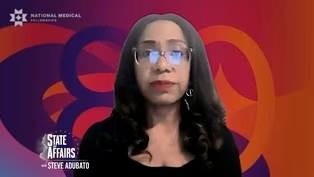
NewNational Medical Fellowships examines healthcare shortage
Video has Closed Captions
Clip: S10 Ep14 | 17m 13s | National Medical Fellowships examines healthcare shortage (17m 13s)
Providing Support for PBS.org
Learn Moreabout PBS online sponsorship New Episode
- News and Public Affairs

Top journalists deliver compelling original analysis of the hour's headlines.
 New Episode
- News and Public Affairs

Today's top journalists discuss Washington's current political events and public affairs.

 New Episode
 New Episode
 New Episode
 New Episode
 New Episode
 New Episode
 New Episode
 New Episode
Support for PBS provided by:
State of Affairs with Steve Adubato is a local public television program presented by NJ PBS