
U.S. officials reveal key terms of agreement to end Iran war
Clip: 6/17/2026 | 4m 39sVideo has Closed Captions
U.S. officials reveal key terms of agreement to end Iran war
The Trump administration shared new details about the agreement struck between the U.S. and Iran, which aims to end the war, open the Strait of Hormuz and begin further negotiations. But it's not a done deal yet, and Trump made renewed threats to "bomb the hell" out of Iran if they don't abide by the deal. White House correspondent Liz Landers reports.
Problems playing video? | Closed Captioning Feedback
Problems playing video? | Closed Captioning Feedback
Major corporate funding for the PBS News Hour is provided by BDO, BNSF, Consumer Cellular, American Cruise Lines, and Raymond James. Funding for the PBS NewsHour Weekend is provided by...
U.S. officials reveal key terms of agreement to end Iran war
Clip: 6/17/2026 | 4m 39sVideo has Closed Captions
The Trump administration shared new details about the agreement struck between the U.S. and Iran, which aims to end the war, open the Strait of Hormuz and begin further negotiations. But it's not a done deal yet, and Trump made renewed threats to "bomb the hell" out of Iran if they don't abide by the deal. White House correspondent Liz Landers reports.
Problems playing video? | Closed Captioning Feedback
Where to Watch PBS News Hour
PBS News Hour is available to stream on pbs.org and the PBS app.
Providing Support for PBS.org
Learn Moreabout PBS online sponsorshipAMNA NAWAZ: Welcome to the "News Hour."
The Trump administration today shared new details about the agreement struck between the U.S.
and Iran, which aims to end the war, open the Strait of Hormuz, and begin further negotiations on the most difficult details.
Even as a senior U.S.
official provided the exact language of the document to reporters, President Trump on his final day in France made renewed threats to -- quote -- "bomb the hell out of Iran" if it doesn't abide by the deal.
Our White House correspondent Liz Landers begins our coverage.
LIZ LANDERS: After days of secrecy, senior U.S.
officials finally released the terms that make up the memorandum of understanding between the U.S.
and Iran.
The draft begins with a provision that the U.S.
and Iran and their allies will - - quote -- "declare the immediate and permanent termination of military operations on all fronts" and ensure the -- quote -- "territorial integrity and sovereignty" of Lebanon.
The U.S.
will also fully end its naval blockade in the Strait of Hormuz within 30 days and Iran will restore traffic to prewar levels.
In addition, Iran will allow commercial ships to pass through the Strait of Hormuz with no charge for 60 days.
Then, Iran and Oman will decide future administration of the strait.
When it comes to financial relief for Iran, the U.S.
and regional partners will develop a $300 billion reconstruction and economic development fund for Iran.
On nuclear weapons, Iran would agree not to procure them and adhere to a new minimum standard for downblending on site of Tehran's stockpiled enriched uranium.
Finally, the memorandum allows for Iran to immediately after the signing export crude oil and petroleum products without sanctions.
The U.S.
officials read the deal aloud paragraph by paragraph on a press call that began midway through President Trump's press conference capping off the G7 summit in France.
DONALD TRUMP, President of the United States: The past two days have provided a chance to discuss the details of this historic agreement with many of our closest friends and allies.
LIZ LANDERS: Throughout his press conference, Trump himself offered few specifics about the actual terms of the deal, leaving that to briefers on the call.
But he did say the draft had been sent to Israel and in the same breath took a swipe at Prime Minister Benjamin Netanyahu for his conduct in Lebanon, where relentless fighting and Israeli strikes have killed 4,000 people and displaced more than a million since early March.
DONALD TRUMP: In all fairness to Bibi Netanyahu, who happens to be a good man, gets a little excited sometimes.
He's been an amazing prime minister who we have a little dispute over Lebanon.
I say, you can do a little softer touch, Bibi.
You don't have to knock down a building every time somebody walks into it that's from Hezbollah.
But it's been an amazing partnership.
But he will say, we're the big partner and he's the very small partner.
And that's true.
LIZ LANDERS: Trump affirmed that nuclear talks would begin immediately and was asked about Iran's claim that their nuclear program is civilian in nature and if that would be acceptable going forward.
DONALD TRUMP: Well, I've said to them always, I say, look, you have probably the third largest oil reserves in the world.
What the hell do you need nuclear for?
You need nuclear for some electricity?
So -- so I've always felt that way.
So we've been pretty tough on that.
It's also -- it is a little hard, though, when you say that somebody wants it, other people have it, other adjoining states have it, and you're not letting them have it for purposes of electricity or things like that.
It's always a little tough.
You have to use a little common sense.
Please.
LIZ LANDERS: Meantime, the cease-fire has been shaky since announced on Sunday.
A U.S.
source tells PBS News that Iran has continued to fire drones at commercial ships in the Strait of Hormuz in the last few days, and the U.S.
military has shot them down.
But the president said that Iran could maintain their ballistic missile program, a major point of criticism from Hawks of the 2015 Obama-led Iran deal.
DONALD TRUMP: I'm saying that, if other countries have them, it's a little bit unfair for them not to have some.
A ballistic missile is not the same thing as what we're talking about when we talk nuclear.
But if Saudi Arabia and Qatar and they all have some, I would say, in relative proportion, I think it's OK.
That's what I mean.
LIZ LANDERS: While Vice President J.D.
Vance has taken on a larger role in negotiating the cease-fire and is expected to attend the signing on Friday in Switzerland, the president joked that Vance may take the fall if the deal sours.
DONALD TRUMP: I like that idea, sure.
This way, if it works out, I'm going to take the credit.
If it doesn't work out, I'm blaming J.D.
LIZ LANDERS: For the PBS "News Hour," I'm Liz Landers.
GOP strategist breaks down Trump’s pressure on Congress
Video has Closed Captions
Trump wants 'control of everything,' GOP strategist says as Congress faces pressure (4m 57s)
Mideast experts on U.S.-Iran deal and who came out ahead
Video has Closed Captions
Middle East experts weigh terms of U.S.-Iran deal and who came out ahead (8m 3s)
New book explores impact of racial inequality in medicine
Video has Closed Captions
'The Price of Exclusion' explores lasting impact of racial inequality in medicine (8m 25s)

Pregnancy complication reshapes woman’s view of abortion
Video has Closed Captions
How a pregnancy complication reshaped an Arkansas woman’s view of abortion bans (8m 13s)
Trump stalls confirmation of national intelligence nominee
Video has Closed Captions
Trump stalls confirmation process of his own national intelligence nominee (5m 26s)
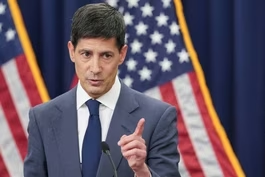
What Warsh’s first meeting as Fed chair signals
Video has Closed Captions
What Warsh’s first meeting as Fed chair signals (6m 51s)
Providing Support for PBS.org
Learn Moreabout PBS online sponsorship New Episode
- News and Public Affairs

Today's top journalists discuss Washington's current political events and public affairs.

- News and Public Affairs

FRONTLINE is investigative journalism that questions, explains and changes our world.
 New Episode
 New Episode
 New Episode
 New Episode
 New Episode
 New Episode

 New Episode
 New Episode
Support for PBS provided by:
Major corporate funding for the PBS News Hour is provided by BDO, BNSF, Consumer Cellular, American Cruise Lines, and Raymond James. Funding for the PBS NewsHour Weekend is provided by...