
How 'Trump accounts' for children work, and who will benefit
Clip: 12/23/2025 | 8m 32sVideo has Closed Captions
How 'Trump accounts' for children work, and who will benefit most
You may have heard about new savings and investment accounts for children known as "Trump accounts." They got a big boost from a philanthropic donation that's among the largest ever delivered directly to Americans. The accounts are expected to open next May. The question is, can they deliver the benefits over the long haul that are being promoted? Economics correspondent Paul Solman dug into that.
Problems playing video? | Closed Captioning Feedback
Problems playing video? | Closed Captioning Feedback
Major corporate funding for the PBS News Hour is provided by BDO, BNSF, Consumer Cellular, American Cruise Lines, and Raymond James. Funding for the PBS NewsHour Weekend is provided by...
How 'Trump accounts' for children work, and who will benefit
Clip: 12/23/2025 | 8m 32sVideo has Closed Captions
You may have heard about new savings and investment accounts for children known as "Trump accounts." They got a big boost from a philanthropic donation that's among the largest ever delivered directly to Americans. The accounts are expected to open next May. The question is, can they deliver the benefits over the long haul that are being promoted? Economics correspondent Paul Solman dug into that.
Problems playing video? | Closed Captioning Feedback
How to Watch PBS News Hour
PBS News Hour is available to stream on pbs.org and the free PBS App, available on iPhone, Apple TV, Android TV, Android smartphones, Amazon Fire TV, Amazon Fire Tablet, Roku, Samsung Smart TV, and Vizio.
Providing Support for PBS.org
Learn Moreabout PBS online sponsorshipWILLIAM BRANGHAM: You may have heard in# the last couple of weeks about these new## savings and investment accounts for kids known# as Trump Accounts.
They recently got a big boost## from a philanthropic donation that's among the# largest ever delivered directly to Americans.
The accounts are now available and the accounts# are first expected to open next May.
And the## question is, can they deliver the benefits# over the long haul that are being promoted?
Our economics correspondent, Paul# Solman, dug into that question.
DONALD TRUMP, President of the United# States: Trump Accounts will be the first,## I guess you could say, real trust# funds for every American child.
PAUL SOLMAN: To which tech# billionaire Michael Dell added: MICHAEL DELL, CEO, Dell: We believe# the smartest investment that we can## make is an investment in children.
PAUL SOLMAN: So what exactly are## these so-called Trump Accounts?
Part of# this year's One Big Beautiful Bill Act,## they're tax-advantaged savings accounts available# for every American child up to the age of 18,## and parents can put in up to $5,000 annually.
For kids born between 2025 and 2028,# Uncle Sam salts away $1,000 no matter## what parents do.
And all parents have to# do is opt in through a tax form.
Moreover,## other philanthropists, employers and states# are invited to add to the accounts as well.
Susan and husband Michael Dell are the first## philanthropic contributors of# many, Brad Gerstner thinks.
BRAD GERSTNER, Entrepreneur:# Moms and dads adding five,## 10 bucks a week, kids saving a little money in# the summertime.
Philanthro.. states like the state of Texas have said# they're going to add $1,000 to these accounts.
PAUL SOLMAN: Silicon Valley entrepreneur# Brad Gerstner helped make the idea a reality.
BRAD GERSTNER: The objective here is to get# the 70 percent Americans who feel left out## and left behind by capitalism into the game,# to make everybody a capitalist from birth,## sharing in the great upside# of the American economy.
WOMAN: U.S.
savings bonds,# now watch how they grow.
PAUL SOLMAN: Now, putting money# away for a kid was pretty common## back when folks like me and Teresa# Ghilarducci were babes in the woods.
TERESA GHILARDUCCI, Economist:# I used my own example of what## happened when my grandmother# gave me a little baby bond.
PAUL SOLMAN: She eventually became a prominent# economist, a left-wing one, who's long promoted## something like government trust funds from# birth.
She even wrote a proposal for them.
TERESA GHILARDUCCI: Along with Kevin Hassett,## who's on the other side of# me on the political spectrum.
PAUL SOLMAN: Kevin Hassett, President# Trump's top economic adviser.
Given## her politics, how could she pair up with him?
TERESA GHILARDUCCI: We came# together as economists,## and we know that wealth gives# people security and power.
PAUL SOLMAN: She and Hassett,# despite their different politics,## have now been meeting with Brad Gerstner.
That comes as no surprise to# early-wealth-building expert Ray Boshara.
RAY BOSHARA, Aspen Institute: I have been# working on this idea for 20 years and it's## been bipartisan over those 20 years.
It's# important to remember that the bottom half## of the population owns only 2.5 percent of the# nation's wealth and only 1 percent of stocks## and bonds.
We have a long way to go to build# wealth for the bottom half of the population.
Trump Accounts, designed properly, can do that.
PAUL SOLMAN: Designed properly.
But that's only# the first problem, says policy expert Amy Matsui.
AMY MATSUI, National Women's Law Center: We# already have extremely significant wealth## gaps by income, by race, by gender.
And# the way that this policy is structured,## it's not going to narrow them.
It# has the potential to widen them.
PAUL SOLMAN: How so?
AMY MATSUI: Because the practical .. that are very well off will benefit# much more than anybody in the bottom## 90 percent.
Most families will not be able to# contribute the $5,000 for the tax advantage.
A family who's been able to steadily# contribute the maximum would have almost## $200,000 in assets.
And, in contrast, a# family that has the $1,000 and has the## 6 percent rate of return may have something# more along the lines of $2,000 or $3,000.
PAUL SOLMAN: But Teresa# Ghilarducci remains hopeful.
TERESA GHILARDUCCI: The Trump# Accounts surely can be restructured.
PAUL SOLMAN: But here's a# real question: Will they be?
TERESA GHILARDUCCI: The technocrats around# populist policies would absolutely endorse## a tweak of these accounts so they don't just# serve the top 1 percent or top 10 percent.
PAUL SOLMAN: Her tweak of choice, eliminates# tax advantage for families earning over## $250,000 per year to make the program# more progressive.
She expects Brad## Gerstner will be sympathetic.# And to listen to him, he may be.
BRAD GERSTNER: I started this when my oldest# child was 13 years old coming out of COVID-19,## 2021.
And I showed them the custodial accounts# that I had opened at birth and added to over the## years.
And they had compounded into a fair# bit of money.
And my oldest son, Lincoln,## said to me: "Dad, this is incredible.
But what# about all the other kids who don't have these?"
And that really was the conversation around## our dinner table that led to# the birth of Invest America.
PAUL SOLMAN: And now here's another problem,## a teenager and money.
What happens when he or# she turns 18 and suddenly there's a windfall?
TERESA GHILARDUCCI: I used to be a Boy Scout# counselor for the Personal Finance Merit Badge.## And I talked to many teenage boys over the years# about their finances.
I bet that 90 percent of## the teenagers that you talk to will say that# they would buy a car or somehow fix their car.
PAUL SOLMAN: What did she# do with the grandma bond?
TERESA GHILARDUCCI: The bond that my grandmother# gave me was cashed in to pay our back rent.
BRAD GERSTNER: As a father of a 17-year-old and# a 14-year-old, I think about that all the time.
PAUL SOLMAN: And so the new law tries# to address the problem, he says.
BRAD GERSTNER: At 18, kids can use up# to 25 percent of this to buy a home,## start a business, go to college.
If they# don't use the money for that purpose,## it automatically rolls into an IRA and is subject# to the IRA rules.
So, yes, you can take it out,## but it will be subject to a stiff penalty# if you take it out at that point in time.
PAUL SOLMAN: But college?
That# isn't for most Americans, right?
TERESA GHILARDUCCI: Two-thirds of people# don't go to college.
And so if they take## the money out to buy a car, they have to pay a# penalty.
So you're actually penalizing people## who don't go right from high school to# college.
And so that has to be changed.
BRAD GERSTNER: They can use this money# to go to a trade school.
They can use## this money to study a profession that# isn't a typical four-year education,## community college, to start a small business.
PAUL SOLMAN: OK, but what about# this potential final snag?
AMY MATSUI: Trust in government# agencies is pretty low.
And for## families who don't have a lot of financial# literacy or a portfolio of their own,## they may be unwilling or reluctant to take# the steps to open accounts for their children,## even if they could receive that $1,000# of seed money from the government.
PAUL SOLMAN: Brad Gerstner says# he's keenly aware of the problem.
BRAD GERSTNER: Failure for me would be if we had# a bunch of accounts that were not claimed by the## bottom third of the economic ladder.
We have# to make sure that we make it seamless for these## people to know about the accounts, to get excited# about the accounts and to claim the accounts.
PAUL SOLMAN: So what's the bottom line right# now?
Pitfalls galore.
But these accounts are,## says longtime proponent Ray Boshara: RAY BOSHARA: The down payment on a big idea# that can and should be improved over time.## And it's important to look at history here.# Social Security, one of our most successful## social policies, started out largely# excluding women and minorities.
But,## today, it's one of the most inclusive,# successful programs that we have.
TERESA GHILARDUCCI: These Trump Accounts,# since they are completely wide open for## an 18-year-old to spend, will not achieve# the goals that right now President Trump## and Michael and Susan Dell say they# want it to achieve.
It needs reform.
PAUL SOLMAN: But better than nothing?
TERESA GHILARDUCCI: Better than nothing.
PAUL SOLMAN: And if reforms do happen# in myriad ways and if money pours in## from myriad sources, potentially much better.
For the "PBS News Hour," Paul Solman.
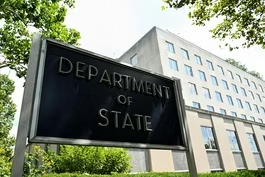
How diplomat recall fits into Trump's foreign policy shift
Video has Closed Captions
Clip: 12/23/2025 | 7m 28s | How recall of career diplomats fits into Trump's foreign policy shift (7m 28s)
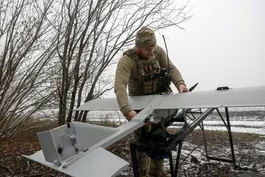
Inside look at Ukraine's high-profile drone strikes
Video has Closed Captions
Clip: 12/23/2025 | 5m 39s | Inside the Ukrainian drone unit responsible for high-profile strikes (5m 39s)
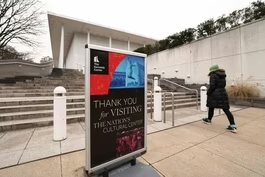
Kennedy Center renaming highlights Trump's reshaping of D.C.
Video has Closed Captions
Clip: 12/23/2025 | 6m 52s | Kennedy Center renaming highlights Trump's reshaping of Washington in his image (6m 52s)
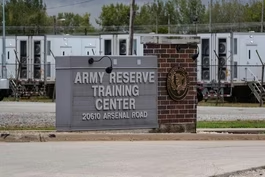
News Wrap: Guard deployment to Chicago blocked for now
Video has Closed Captions
Clip: 12/23/2025 | 4m 30s | News Wrap: Supreme Court blocks National Guard deployment to Chicago for now (4m 30s)
Reiner deaths renew talks for families facing mental illness
Video has Closed Captions
Clip: 12/23/2025 | 8m 56s | Reiner deaths renew conversations for families struggling with mental illness, addiction (8m 56s)
Rhode Island town says it inspired 'It's a Wonderful Life'
Video has Closed Captions
Clip: 12/23/2025 | 5m 22s | How a small town in Rhode Island is connected to 'It's a Wonderful Life' (5m 22s)
Where Trump is mentioned in latest Epstein files release
Video has Closed Captions
Clip: 12/23/2025 | 4m 50s | What the latest Epstein files release reveals, and where Trump is mentioned (4m 50s)
Providing Support for PBS.org
Learn Moreabout PBS online sponsorship
- News and Public Affairs

FRONTLINE is investigative journalism that questions, explains and changes our world.

- News and Public Affairs

Amanpour and Company features conversations with leaders and decision makers.










Support for PBS provided by:
Major corporate funding for the PBS News Hour is provided by BDO, BNSF, Consumer Cellular, American Cruise Lines, and Raymond James. Funding for the PBS NewsHour Weekend is provided by...