
Trump's treatment of allies has net positive, Heinrichs says
Clip: 8/19/2026 | 8m 37sVideo has Closed Captions
Trump's tough treatment of allies has a 'net positive,' Rebeccah Heinrichs says
On Wednesday, President Trump reiterated how good his relationship is with North Korean dictator Kim Jong Un. The president also spoke again of his displeasure with joint military exercises the U.S. is conducting with South Korea, which Trump already ordered scaled back. Amna Nawaz discussed the president's relationships with U.S. allies with Rebeccah Heinrichs of the Hudson Institute.
Problems playing video? | Closed Captioning Feedback
Problems playing video? | Closed Captioning Feedback
Major corporate funding for the PBS News Hour is provided by BDO, BNSF, Consumer Cellular, American Cruise Lines, and Raymond James. Funding for the PBS NewsHour Weekend is provided by...
Trump's treatment of allies has net positive, Heinrichs says
Clip: 8/19/2026 | 8m 37sVideo has Closed Captions
On Wednesday, President Trump reiterated how good his relationship is with North Korean dictator Kim Jong Un. The president also spoke again of his displeasure with joint military exercises the U.S. is conducting with South Korea, which Trump already ordered scaled back. Amna Nawaz discussed the president's relationships with U.S. allies with Rebeccah Heinrichs of the Hudson Institute.
Problems playing video? | Closed Captioning Feedback
Where to Watch PBS News Hour
PBS News Hour is available to stream on pbs.org and the PBS app.
Providing Support for PBS.org
Learn Moreabout PBS online sponsorshipAMNA NAWAZ: President Trump said today he would meet with North Korean leader Kim Jong-un soon and reiterated how good his relationship is with the dictator.
The president also spoke again of his displeasure with joint military exercises the U.S.
is conducting with South Korea, which Mr.
Trump already ordered scale back.
DONALD TRUMP, President of the United States: I didn't like the fact that we're doing these massive military exercises really against North Korea.
It was an exercise against North Korea, when I'm friendly with him.
And I was not happy when South Korea said, no, they're not interested in helping us with the Hormuz Strait, and yet they get 60 percent of their oil from the Hormuz Strait.
I said, would you like to help us?
He said, no, thank you.
I said, that's nice.
AMNA NAWAZ: But, in North Korea, Kim Jong-un's powerful sister said she was not aware of any communication between Trump and her brother.
In a statement, she said the president's call to reduce drills with South Korea was -- quote -- "unworthy of comment" and called the drills themselves provocative.
And she described the relationship between her brother and the U.S.
president as excellent.
Last night, we spoke to a former Navy admiral about President Trump's treatment of historic allies.
Today, we get a different view.
Rebeccah Heinrichs was a foreign policy adviser to a Republican member of Congress.
She's now a senior fellow at the Hudson Institute.
Welcome back.
Thanks for being here.
REBECCAH HEINRICHS, The Hudson Institute: Thank you.
Good to be here.
AMNA NAWAZ: Let's just start with what the president said today.
At the same time he's criticizing a U.S.
ally in South Korea, he says he's friendly with the leader of their adversary, North Korea.
Why do that?
What do you take away from those statements?
REBECCAH HEINRICHS: Well, so, first of all, if you just listen, the president's clearly frustrated that South Korea is unwilling to help get the Strait of Hormuz open and to counter the Iranians.
But, of course, the North Koreans have been the ones who have been providing missile capabilities, component parts to the Iranians, and really they have done that since the 1980s.
And these military drills that the president is worried about, they're there to help the United States with South Korea to become better integrated, to make sure that we increase our readiness.
So they're not there to be provocative.
They're there to deter North Korea.
So I think this is just an example of President Trump expressing some frustration on the Iran file, but he really does -- doesn't have this right here.
And I suspect that at some point he probably will reverse this and get back to a full-scale military drills, which is what we need.
AMNA NAWAZ: In the meantime, does this hurt a historic alliance, one the U.S.
needs in the region?
REBECCAH HEINRICHS: Well, I think we should take it in context.
So it certainly doesn't help.
But just not even two weeks ago, the president signed a new directive that would permit allies to help the United States do things like build ships.
I mean, the United States needs to go fast on building certain military capabilities, and we do not yet have the manufacturing here at home to do that.
But we do collectively with our allies.
And South Korea in particular is better suited to produce American ships.
And so even just less than two weeks ago, we had this great news that the United States was going to be collaborating more with South Korea.
So there's other good things.
I mean, the undersecretary of war for policy, Elbridge Colby, back in January called South Korea a model ally because of their defense investments.
So I think there are political, military reasons why I think that the alliance is going to withstand this.
AMNA NAWAZ: There's what the president does, as you point out, and what other members of the administration say.
But when it comes to what the president has to say, arguably the most powerful voice in the country, does criticizing that kind of ally, does that create a strategic wedge in the region, an opening for China to exploit those kinds of partnerships?
REBECCAH HEINRICHS: Well, I do think that it's -- I mean, I think that the president should -- it would be better if he kept his criticisms private and not make them public.
I do think that people understand that this is the way the president talks and is frustrated, and so I think that they take that into account when evaluating this.
But, again, if you look at just with the capabilities that are being developed, the closer relationship between the United States and South Korea on whole, even during the Trump administration... AMNA NAWAZ: Yes.
REBECCAH HEINRICHS: ... I think that it has a really -- really net positive, I think, for the alliance.
AMNA NAWAZ: You mentioned his frustration with the Iran file.
Just when you take a step back and you look at the frustration the president has expressed with American allies for not joining in the effort, I'm sure you have heard from the allies themselves they weren't consulted on the war, they didn't support the war.
Do you agree with his pressure campaign on those allies?
REBECCAH HEINRICHS: On the allies in particular to help with the opening the Strait of Hormuz.
I think that, at this point, I do believe that, to have a longer-lasting Strait of Hormuz that's open to international commerce, that we do need an international coalition.
So -- and I think that the allies would benefit from that greatly.
I do understand, however, why the allies would be reluctant to do so now.
They were not consulted to go into this conflict.
And I think that the president hasn't made it easy because of tariffs, et cetera, leading up to this.
And then there's other things like the threats to Greenland.
However, it's in the allies' interests.
And if you talk to the allies, they will say they're not unhappy that the IRGC has been significantly degraded.
The ballistic missile program in Iran directly threatened the Europeans.
And so they have benefited from this operation.
AMNA NAWAZ: There's the pressure campaign, and then there's overt threats, right?
We have seen the president come out and threatened to bomb Oman, a Gulf ally for the U.S., who've been mediating negotiations with the Iranians.
That was over his frustration over their negotiations with Tehran to manage the reopening of the Strait of Hormuz.
But that kind of language, threatening to bomb a U.S.
ally, what do you make of that?
REBECCAH HEINRICHS: Yes, I mean, the president, I think, is using rhetoric that's unhelpful there.
We should not threaten to use military force against allies.
And I think that that came out of, again, frustration because the president has said that we're not going to permit, we, the United States, is not going to permit any tolling in the strait.
And credible reporting indicates that the Omanis may have been getting a little bit soft and perhaps agreeing with the Iranians of some percentage.
They wouldn't call it tolling.
They would call it fees, something to that effect.
And so I think that that is why the president lashed out there to make sure that there would be no tolling at all in the Strait of Hormuz.
AMNA NAWAZ: If you take a step further back, we have now seen in recent days the president threaten an Asian ally, a Gulf ally, a North American ally, our neighbor to the north with those 50 percent tariffs against Canada, which the president now says they are close to a deal.
We will see what happens.
There are those who say there are times when the president seems to be tougher on U.S.
allies than he does on their adversaries.
Do you agree with that?
REBECCAH HEINRICHS: Well, no, I mean, look, again, if we look at what's happened just over capability-wise, just look at the status of these alliances.
You can say, I -- it's not the way I would do it.
I would not use the kind of rhetoric towards our allies that the president does.
But the effect has been that the United States is now receiving something like 30 percent of exports from our alliances across the alliances, significantly higher than it was even five years ago, and taking imports significantly fewer from China.
So, the United States is growing in our capabilities, our integration, especially militarily, across the alliances, which is the only way the United States is going to be able to deter what I see as a cold war and a growing collaboration between China, Russia, North Korea, and Iran.
The United States cannot do this by ourselves.
We can only do it collectively with our economies and our militaries, with our alliances.
Do I think that the president's rhetoric reflects that?
I don't, but I think that the effect of what he has done has been to grow the defense industrial bases and further integrated our military capabilities, and that's a good thing.
AMNA NAWAZ: In the minute or so we have left, I want to put to you what we heard from our guest last night, a retired rear admiral, who said that there's a risk to that kind of transactional approach and that that risk far exceeds any benefit from the kinds of concessions and deals that you just laid out that happened in the short term.
Do you share that concern?
REBECCAH HEINRICHS: I think we just don't know.
I mean, I understand that side of the argument, and it may be true.
I think that we're going to have to see it bear out.
But the truth of the matter is, the United States needs our allies.
They're not a burden for the United States, on net.
Again, we need what the South Koreans can provide us in terms of shipbuilding capabilities.
And so we need these things.
And the allies need the United States.
There is no other alternative to the United States for these allies at this point.
That's the Europeans, the Gulf states, and it's certainly our Asian allies as well.
If you look any direction, you have got the Russians, the Chinese, the North Koreans, and the Iranians.
And so the United States has had crises before with our allies in the past historically.
I think we're going through some bumpy times, but, on net, I think it's going to be OK.
AMNA NAWAZ: Rebeccah Heinrichs from the Hudson Institute, thank you so much for being here.
REBECCAH HEINRICHS: Good to be here.
Thanks.
 New
NewNews Wrap: Trump pauses his 50% tariffs on Canadian imports
Video has Closed Captions
News Wrap: Trump pauses his 50% tariffs on Canadian imports (6m 19s)
 New
NewRoad trip explores parallels between Gilded Age and today
Video has Closed Captions
Historian's American road trip examines parallels between the Gilded Age and today (10m 3s)
 New
NewSeeing double at the Twins Days Festival in Ohio
Video has Closed Captions
Seeing double at the Twins Days Festival in Ohio (5m 5s)
 New
NewTakeaways from the Florida and Alaska primaries
Video has Closed Captions
What the Florida and Alaska primary results mean for November (7m 46s)
 New
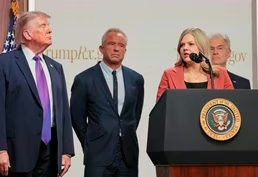
NewWhat to know about Dr. Heidi Overton, Trump's pick for FDA
Video has Closed Captions
What to know about Dr. Heidi Overton, Trump's pick to lead the FDA (5m 56s)
 New
NewWhy states say Meta designed addictive features for children
Video has Closed Captions
Why states claim Meta designed addictive features for children (5m 53s)
Providing Support for PBS.org
Learn Moreabout PBS online sponsorship New Episode
- News and Public Affairs

Today's top journalists discuss Washington's current political events and public affairs.

- News and Public Affairs

FRONTLINE is investigative journalism that questions, explains and changes our world.
 New Episode
 New Episode
 New Episode
 New Episode
 New Episode
 New Episode

Support for PBS provided by:
Major corporate funding for the PBS News Hour is provided by BDO, BNSF, Consumer Cellular, American Cruise Lines, and Raymond James. Funding for the PBS NewsHour Weekend is provided by...