
Sitting down with Detroit Mayor Mary Sheffield and author Desiree Cooper
Season 54 Episode 24 | 26m 46sVideo has Closed Captions
Mary Sheffield discusses her family’s legacy and more, and Desiree Cooper discusses her new book.
Detroit Mayor Mary Sheffield sits down for a conversation about her history-making election, the importance of leadership and her focus on children and teens in the city. Plus, former Detroit journalist Desiree Cooper talks about her new book titled, “Black Summers: Growing up in the Urban Outdoors.”
Problems playing video? | Closed Captioning Feedback
Problems playing video? | Closed Captioning Feedback
American Black Journal is a local public television program presented by Detroit PBS
Sitting down with Detroit Mayor Mary Sheffield and author Desiree Cooper
Season 54 Episode 24 | 26m 46sVideo has Closed Captions
Detroit Mayor Mary Sheffield sits down for a conversation about her history-making election, the importance of leadership and her focus on children and teens in the city. Plus, former Detroit journalist Desiree Cooper talks about her new book titled, “Black Summers: Growing up in the Urban Outdoors.”
Problems playing video? | Closed Captioning Feedback
Where to Watch American Black Journal
American Black Journal is available to stream on pbs.org and the PBS app.
Providing Support for PBS.org
Learn Moreabout PBS online sponsorship- Just ahead on "American Black Journal," Detroit Mayor Mary Sheffield sits down for a conversation about her history-making election, the importance of leadership, and her focus on children and teens here in the city.
Plus, former Detroit journalist Desiree Cooper is here to talk about her new book, "Black Summers: Growing Up in The Urban Outdoors."
Stay where you are.
"American Black Journal" starts right now.
(upbeat music) - [Narrator 1] Across our Masco family of companies, our goal is to deliver better living possibilities and make positive changes in the neighborhoods where we live, work, and do business.
Masco.
A Michigan company since 1929.
- [Narrator 2] Support also provided by The Cynthia & Edsel Ford Fund for Journalism at Detroit PBS.
- [Narrator 3] The DTE Foundation is a proud sponsor of Detroit PBS.
Through our giving, we are committed to meeting the needs of the communities we serve statewide to help ensure a bright and thriving future for all.
Learn more at DTEFoundation.com.
- [Narrator 4] Also brought to you by Nissan Foundation.
And viewers like you.
Thank you.
(upbeat music) - Welcome to "American Black Journal."
I'm your host, Stephen Henderson.
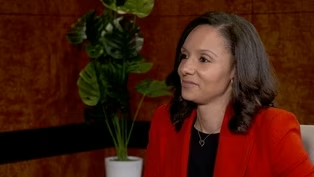
Detroit Mayor Mary Sheffield is marking six months in office after making history as the first woman elected to the city's top job.
I sat down with Mayor Sheffield recently to talk about her family's legacy in the city for an upcoming Detroit PBS special, titled, "Destination Detroit."
We also talked about the people who inspired her political career, the importance of leadership, and her priorities for the city.
Madam Mayor, thanks very much for joining us.
And congratulations on all your early success.
It's been really interesting to watch how this all unfolds.
So I'm gonna start here.
You know, things like history, and legacy, and story mean different things to us in Detroit than they do in other cities where I've lived.
They have a stronger residents with us here.
And your presence in this office calls on those things in a different way than we have seen for a really long time in Detroit.
Decades, in fact.
And I think anyone can go and read about your history or about your legacy.
But I really would love to have you talk about how those things kind of visit with you every day now that you're in this role.
Just little things that remind you, I guess, of the weight of those things and their importance.
- My own personal legacy continues to push me, and shape me, and mold me into who I am today.
As you know, I come from civil rights, labor leaders who were unapologetic about investing in people and standing up for social justice and civil rights.
And, I mean, it really is what motivated me to run for office, and to stand up, and to fight, and to lead the way in which I do, which I think is a fresh, a breath air in the sense that it's about people.
It's about neighborhoods.
It's about the most vulnerable in our city.
About social justice.
And I think that's needed in such a critical time in Detroit.
So, I mean, I think about Coleman Young, and Erma Henderson, and Maryann Mahaffey.
I mean, all of these legendary leaders.
Joanne Watson, had she not got up and decided not to run, I would not have even been able to sit down.
- Well, that's, you know, I forgot about that.
- [Sheffield] To run for office.
- That she steps aside.
- Yes.
And then I ran in the exact same seat that she would've run for for city council.
So, I mean, they continue to inspire me and to remind me that during these very critical times, we have to always stand up and be bold and speak, especially at just a critical time that we are in the history of our country.
- You were a city council president.
- [Sheffield] Yeah.
- And in a leadership role, obviously, there.
This is a bigger leadership role.
How do you get people to think more about everyone moving together to a better place?
- I mean, I do think it takes leadership.
I mean, we had, you know, transformational, inspirational leaders in Coleman Young and Martin Luther King.
And so, like, even my grandfather's generation.
We need more leaders that can inspire and empower, especially our young people to see that they also have to step up in political offices.
We'll want to be a part of social change.
So I think it takes leadership.
And it really takes everyone playing their role in stepping up as well.
- Yeah.
What do you say to folks who say, "Look, it's my turn."
(laughs) That's a common kind of point of view here.
"It's my turn.
I wanna do this."
How do you get 'em to think about, okay, well, maybe it's your turn.
But maybe it's our turn instead.
- Yeah, I mean, I think, you know, when I think back to Coleman Young days, I've read a lot and I've heard a lot about how, even if someone wanted to run for office, and it maybe wasn't the right time where they didn't have the best chance, they will find something for that person to do to cultivate the gifts so that they can still serve in different capacities.
And so I would say, again, it's always something to do.
It doesn't always have to be political office.
It can be a board.
It can be a commission.
It can be other ways that you can serve and give.
But I think we have to be more strategic in how we are electing people to office to have a greater impact on the overall political power in Detroit, the state, and in the country, to be quite honest.
- You have had a real focus, in the early part of your administration, on young people here in Detroit.
Things like Rx Kids, which I think is a phenomenal program.
And, now, we have that citywide in Detroit.
This idea of supporting every pregnant woman in a way that will lead to the sort of successful first year of her child.
And sort of on from there.
You've also talked a lot about older young people.
You know, teenagers and things.
That seems to me, again, to call back to that history and that legacy because that's the future.
And that's what we've gotta kind of invest in.
- No, I agree.
And then, as the youngest ever elected to city council at 26, I feel like it's the obligation and a duty for me to invest and to represent for our young people.
And so it comes from our legacy.
But I think also, again, making history as the youngest person on city council, I just feel like it's a duty of mine to invest and to support our young people.
And I have to be honest.
I mean, our young people are looking for, right, attention and support and investment in a way that we haven't seen before.
And so I'm very proud of the approach that this administration has taken.
Incorporating young people in all of our policies and programs and ensuring that we're investing directly in them.
- Yeah.
You've also had this real focus on, you know, social service and social safety net, I think, in the city, which has been really tattered for a long time.
Partially because of, you know, funding challenges.
But also because of priority.
- [Sheffield] Priority.
- You know, what matters the most to the people in charge.
Talk about how you're trying to, I guess, sew that back together in a more supportive way than what we- - Yeah, and I think some of it is funding.
But, as you mentioned, some of it is priorities.
And I say that because this budget that we presented to council that was passed, another balanced budget, $3 billion budget, it was a shifting priorities to take care of the most vulnerable and to support social services.
And we were able to do it.
And so it goes back to how you want to prioritize things.
But I believe that, you know, in order for Detroit to really rise, in order for us to continue the momentum and the growth, we have to start investing in people.
Building our middle class.
Raising the incomes of Detroiters.
In order for Detroit to reach its next step, we have to invest in and raise the incomes of the most vulnerable in our city.
And so I'm very passionate about that.
Because, again, we don't wanna grow a city where most of our residents don't benefit.
- Don't have any real stake in it.
- We want to them to benefit from it as well.
Yes, yeah.
- Yeah, yeah.
That reminds me what you were just saying of that labor legacy that you have in your family.
And, of course, that we have in this city.
You know, Detroit would not be what it is without labor and the role that labor played.
I'm looking for places where, for you, that calls directly to you.
- As you mentioned, I come from labor.
Labor is in my blood.
And, you know, having a strong middle class is about labor.
And I think all of the work that I do, policies and programs, are about how do we invest in people and build our middle class with good quality jobs in our city.
And so it comes from the history of my family and what I know.
That's what I was taught.
That's what I was molded to believe.
And so it's a very, very important thing to me.
We created, for the first time ever, a new position, which is a labor liaison director.
And that person is consistently building relationships with all of our labor unions as well.
- Yeah, yeah.
Challenges.
I mean, it's early.
And, you know, I think you need time to figure out where things are and what you want to do.
But the kind of things that you see that will push us in the next couple of years to do these things and to refocus the way that you have on the things that call to that legacy.
- Yeah.
I mean, some of the challenges for me is, you know, Detroit is such a big city from a demographic standpoint.
Geographic standpoint, I should say.
And our population, right, is not there to meet kind of the demand of services.
I would say, you know, property tax reform or educational system is difficult to try to crack because the mayor doesn't control the school system.
But it directly impacts the quality of life and the ability for families to wanna stay and to move to Detroit.
And some of these things are systemic.
I mean, going back to generations and decades ago, that really put us in a position, in a lot of ways, I feel, like, to fail.
Like, for Detroit to fail, right?
Insurance, redlining.
I mean, all of these things are not easy fixes.
But they are challenges that I'm excited to try to take on as much as possible to try to fix.
- Your family comes here from Georgia and settles, as you said, in Black Bottom.
- [Sheffield] Black bottom.
- Which is then destroyed.
Partially by the freeway.
But also just by development and gentrification.
We're talking about now.
What to do with that history and maybe how to clean it up.
I mean, I don't think we're quite there.
But I wonder how that resonates with you in this office now.
The mayor can have some influence, probably a lot, over how that goes and how much we do to sort of fix what got broken there.
I wonder what that means to you.
- Yeah, it means a lot.
As you mentioned, my grandfather migrated to the Black Bottom.
And just understanding the history of Black Bottom and what it meant for, you know, African Americans as far as wealth, and business, and ownership, and entertainment.
I mean, that was a place where they settled.
And whatever happens on that site, we are definitely having conversations around ensuring that there's access for, you know, legacy Detroiters and that Black Detroiters really actually have a participation and access to that site for sure.
- Do you think we can repair that?
I mean, that's kind of the central question, is how do you fix what was done to all of those families?
- I think generations, right, have been impacted by it.
I don't think you can ever fix it.
But I think there's ways to try to repair and to right the wrong of what happened at Black Bottom, in general.
But I think it was so much harm caused.
I mean, generational wealth.
Businesses stripped from people.
- [Henderson] All of it wiped out.
- Yeah, all of it wiped out.
I don't think you can ever fix it.
But I think there's ways to take steps to at least right the wrongs and to acknowledge the harm that was caused.
- Yeah.
My grandfather and your grandfather were friends.
And they worked together at the UAW.
And I've seen pictures of them.
Not just here.
With Walter Reuther and other folks.
But I've seen pictures of them in the White House.
- [Sheffield] Oh, yeah.
- With presidents and in other places.
I mean, I've seen pictures of 'em in Africa together, spreading that message about the importance of labor, but also the importance of the African American role in labor, which develops here in Detroit.
- Yeah.
No, I completely agree.
I've seen pictures.
And my father has told me many stories of how my grandfather was not just a local leader.
He was national.
He had national prominence.
And he was known all over the nation, to be quite honest, about his work.
I mean, my father mentioned stories where he would go to the White House and swim in, I think, Lyndon's pool or something, he always tells a story about.
But, yes.
My grandfather was a national leader who was, I think, fight for civil rights.
And inclusion of African Americans in labor was instrumental and touch more than just Detroit, but also around the nation as well.
- Yeah.
And Mayor Sheffield reflects on her grandfather's influence in Detroit's labor movement in the special "Destination Detroit," airing on June 22nd at 9:00 PM.
The hour-long documentary explores the rich histories of people who helped shape southeast Michigan.
Detroit PBS invited residents to share stories of how their families came to the area and the lives they built here.
Here's a preview.
- [Reporter] Detroit's iconic train station.
Full of history.
American history.
Some called it the Ellis Island of the Midwest.
- My family came to Detroit via my grandmother.
- [Reporter] People sharing their migration stories.
- She came from Natchez, Mississippi.
She came on train.
- [Reporter] Everybody comes from somewhere.
But why come here?
Watch "Destination Detroit."
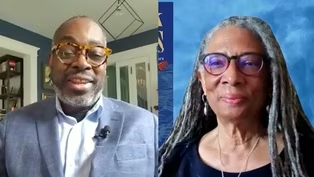
(upbeat music) - A new book titled "Black Summers: Growing Up in The Urban Outdoors" features a collection of stories, poems, and drawings by Detroiters about their summer experiences here in the city.
The anthology explores the struggles, the joy, and the resilience of African Americans navigating summer fun in Detroit's public spaces.
Yours truly is one of the contributors.
The editor of the anthology is award-winning author and journalist Desiree Cooper.
I am pleased to have her as our guest here on "American Black Journal."
Desiree, it's always great to see you.
Welcome back to the show.
- It's so good to see you.
Thanks for having me.
- Yeah.
So I, of course, love this anthology.
And you and I have talked about it now for a very long time.
But I don't think I know the answer to the question about how you came up with this as an idea.
This idea of summer.
Summer in Detroit.
And the experiences that we, as African Americans, have that are very distinct from other folks here in Detroit in the summers.
What sort of piqued your curiosity here about this subject?
- Yeah, so the book is dedicated to the memory of Sarah Elizabeth Ray.
And she was the woman that not many Detroiters know about.
She integrated the Bob-Lo boats.
So that iconic summer experience for Detroiters.
The Bob-Lo boat.
People remember being there with family.
With people from all walks of life.
It being integrated.
Well, it wasn't always the case.
And, in 1948, she won a US Supreme Court decision that opened up the Bob-Lo boat for everyone.
And so, part of me, I had been doing a lot of work around her history and telling her story.
And I just sort of had this question of, you know, what if she was around now, you know?
How would she feel about the liberties and the freedoms that we are experiencing now, compared to 1948?
Well, I shouldn't say now because it's a little precarious now.
- Right, we're not sure.
(laughs) We're not sure right now.
(laughs) - But to my point.
Or would she say, wow, I would've thought we would've come further.
Or I would've thought things would be much more different.
And so I said, why not ask current Detroiters about what their core summer memories are or experiences are and how it's shaped by race.
- Yeah.
- Still today.
- Yeah, yeah.
One of the things about this collection that I think is really important to note is, like, all things Black, it represents this incredible breadth of experience, of emotion, of thought and understanding.
It's not one thing.
It's not many things.
It's all things.
And there's something, I think, kind of intrinsic about the African American experience and noting that it is all things, rather than, you know, a set of things, or one thing, which I think it too often gets reduced to that.
- Right.
And I did, you know, I reached out and got writers, who were 16 teenagers when they started.
This was a three-year project.
So people aged out of those groups during the process.
And I think the oldest writer was 74 at the time when they offered the essay.
So I purposely tried to get a range in terms of that, in terms of geography.
And I will agree with you that everyone brought their own lives to the table, right?
But at the same time, there is the specter of race that is common.
And then their reactions were individual, you know.
And how it played out for them in their lives is individual.
So one of my hopes was exactly as you're saying.
And that is that, across the nation, people can read a book like this and find themselves in it.
No matter who they are.
They can remember bike riding in the summer, or the pools in the summer, or the fishing in the summer.
But there's also going to be aspects of it that they'll say, "I never thought of."
Or that they will feel validated that their summer experiences, which haven't really been widely portrayed or are not part of the usual nostalgia around summer, are included in these pages.
- Yeah, yeah.
The aspect of memory here, I think, is also really key.
The way that, for us, as African Americans, memory plays a different role, often, in our lives in terms of how we come to the places we are or how we think of the world.
That's another theme that I think is so strong in the book.
- Stephen, when I came to you and I said, I have this idea, and I'm wondering if you would be willing to contribute, you did not hesitate.
And you know what you said to me?
You said, "I have a story that I've always wanted to tell and I've never told."
So get the book and hear the story that Stephen has been holding in.
But I will tell you this much about that story.
That it explores what racial trauma does to a person, especially when they meet it out of nowhere as a child.
And I do feel that, in this day and age, when we have now sort of been re-traumatized in real time with Black Lives Matter, with, you know, the protest in Minnesota, and ICE, we're horrified by these things.
And many people are saying, "I can't watch anymore.
I feel traumatized."
Well, dial it back, right, to the pre-Civil Rights era, or before the rebellion in Detroit, or during the rebellion in Detroit.
And one thing that I realized is that Detroit had a trauma that we have not quite, we don't talk about it as trauma, first of all.
And so, of course, it hasn't healed.
- Right, right.
- So there may be an aspect of that too.
And I appreciate you sharing a story that really helps us open that up.
- Yeah, yeah.
I mean, without spoiling the chance for people to read it, I mean, I will say that it's a story about the first time I was made aware of the history of racism and discrimination in this country.
And I was a very small child.
And I think that's a very common experience, of course, for African Americans.
And I had never told that story before.
You're right.
And I think that's also common.
That, for a lot of us, it's just a story we carry with us in our minds and in our hearts, but that we don't necessarily share with the world.
- I think that's part of what I was trying to bring out in every essay.
And that is, our brains will take these experiences and either forget them, downplay them.
And we have had a survival instinct, as a people, to hold onto the joy.
To hold onto the happy.
To hold onto the fun.
And so that's definitely in the essays.
But it's a moment where we can bring to the fore, also, the pain that co-existed, you know.
So it's not a Pollyanna collection of, wee, you know, we had a good time.
You know, one thing I purposely did not want was writers that would say, we played until the streetlights went off, or came on.
Or everybody in the neighborhood got along.
And everybody parented us, you know.
Blah, blah, blah.
Okay, you know, that is our nostalgia.
And it's true.
It's true.
But it's a truth that we prefer to put forward, versus the true existence, you know, of what was, so.
- Yeah, yeah.
Complication is, of course, always part of truth.
So I wanna talk about the cover.
'Cause everyone I've run into who's seen the book or heard about it is raving about the cover.
Talk about that image and how you chose it.
- Well, I do want people to understand that this is a Detroit production through and through.
- All the way, right.
- It's out of Wayne State University Press.
All of the contributors have either been raised in Detroit or currently still live in Detroit.
And the cover is from Detroit artist, Senghor Reid, who gave us permission to use his artwork as a basis for the cover.
And you wouldn't believe when you see the whole artwork.
You'd have to Google it.
It's called "Make Way for Tomorrow."
And it's like a collage of images around a pool with Black family having a great time.
And so we isolated this one image.
The designer did.
The designer, Crystal Marshall, also Black, isolated that image.
Because, man, either that kid is being thrown into a pool or that kid is jumping in with huge abandon.
And isn't that sort of like the joy and then the scariness, the wow, you know, that can really paint our experiences in the summertime.
- Yeah, yeah.
No, it's a great cover.
I have, of course, a little card of it here at the house.
So people have been asking me about it for several months now.
So, now, they have the answer.
All right, Desiree Cooper, wonderful work here with the book.
Not just because I'm in it.
But the whole thing, of course.
- It's more wonderful because you were able to participate.
And we're happy about that.
- Yeah.
But thanks so much for joining us here on "American Black Journal."
- Thank you.
- That'll do it for us this week.
You can find out more about our guests at americanblackjournal.org.
And you can connect with us anytime on social media.
Take care.
And we'll see you next time.
(upbeat music) - [Narrator 1] Across our Masco family of companies, our goal is to deliver better living possibilities and make positive changes in the neighborhoods where we live, work, and do business.
Masco.
A Michigan company since 1929.
- [Narrator 2] Support also provided by the Cynthia & Edsel Ford Fund for Journalism at Detroit PBS.
- [Narrator 3] The DTE Foundation is a proud sponsor of Detroit PBS.
Through our giving, we are committed to meeting the needs of the communities we serve statewide to help ensure a bright and thriving future for all.
Learn more at DTEFoundation.com.
- [Narrator 4] Also brought to you by Nissan Foundation.
And viewers like you.
Thank you.
(relaxing music)
 New
NewAuthor Desiree Cooper on her new book, “Black Summers: Growing up in the Urban Outdoors”
Video has Closed Captions
Clip: S54 Ep24 | 11m 8s | The anthology explores the struggles and joys of African Americans navigating summer fun in Detroit. (11m 8s)
 New
NewDetroit Mayor Mary Sheffield on her family’s legacy, her priorities for the city and more
Video has Closed Captions
Clip: S54 Ep24 | 13m 11s | Mary Sheffield is marking six months in office after making history as the city’s first woman mayor. (13m 11s)
Providing Support for PBS.org
Learn Moreabout PBS online sponsorship New Episode
- News and Public Affairs

Top journalists deliver compelling original analysis of the hour's headlines.
 New Episode
- News and Public Affairs

Today's top journalists discuss Washington's current political events and public affairs.


 New Episode
 New Episode
 New Episode
 New Episode
 New Episode
 New Episode
 New Episode
Support for PBS provided by:
American Black Journal is a local public television program presented by Detroit PBS