
July 29, 2026 - PBS News Hour full episode
7/29/2026 | 56m 45sVideo has Closed Captions
July 29, 2026 - PBS News Hour full episode
July 29, 2026 - PBS News Hour full episode
Problems playing video? | Closed Captioning Feedback
Problems playing video? | Closed Captioning Feedback
Major corporate funding for the PBS News Hour is provided by BDO, BNSF, Consumer Cellular, American Cruise Lines, and Raymond James. Funding for the PBS NewsHour Weekend is provided by...
July 29, 2026 - PBS News Hour full episode
7/29/2026 | 56m 45sVideo has Closed Captions
July 29, 2026 - PBS News Hour full episode
Problems playing video? | Closed Captioning Feedback
Where to Watch PBS News Hour
PBS News Hour is available to stream on pbs.org and the PBS app.
Providing Support for PBS.org
Learn Moreabout PBS online sponsorshipAMNA NAWAZ: Good evening.
I'm Amna Nawaz.
GEOFF BENNETT: And I'm Geoff Bennett.
On the "News Hour" tonight: Dr.
Anthony Fauci pleads the Fifth at a congressional hearing on the origins of the COVID virus.
AMNA NAWAZ: The U.S.
and Saudi Arabia strike Iran-backed militias who they accuse of targeting oil facilities.
Could the latest attacks further widen the conflict?
GEOFF BENNETT: And a look at why more single women are buying homes than ever before, outpacing single men.
MAYA DANTZLER, Homeowner: I'm two years out of school.
I'm making good money now.
And I want to just generate some more wealth.
(BREAK) GEOFF BENNETT: Welcome to the "News Hour."
A stunning moment on Capitol Hill today.
Dr.
Anthony Fauci, the face of America's COVID response, refused to answer questions before a Senate committee, repeatedly invoking his Fifth Amendment rights.
The hearing chaired by Republican Senator Rand Paul was meant to probe the origins of COVID-19 and whether Fauci misled Congress and the public.
Fauci called Paul's pursuit of him an unhinged obsession.
AMNA NAWAZ: Fauci helped to lead the White House response for Presidents Trump and Biden and is now retired from government service.
But he appeared today under congressional subpoena.
He then took the Fifth more than 100 times to protect himself from self-incrimination.
Ali Rogan begins our coverage with this report.
SEN.
RAND PAUL (R-KY): The American people deserve.
ALI ROGIN: Answers Senator Rand Paul pledged to extract from his witness about the origins of the COVID-19 pandemic.
The Kentucky Republican is chair of the Senate Homeland Security and Governmental Affairs Committee and subpoenaed Dr.
Anthony Fauci to testify after he refused to do so voluntarily.
SEN.
RAND PAUL: The whole truth and nothing but the truth, so help you God.
ALI ROGIN: In his opening statement, Senator Paul accused Dr.
Fauci of a cover-up as the pandemic unfolded.
He said Fauci's private writings show he suspected the virus originated in a lab in Wuhan, China, where researchers were studying bat coronaviruses.
But in public, Fauci said it started with animal-to-human contact with a live animal market near the lab playing a critical intermediary role.
SEN.
RAND PAUL: Publicly, Anthony Fauci promoted the theory that the virus arose naturally, while, privately, he was well aware of a mountain of evidence suggesting the virus originated in the lab.
ALI ROGIN: Senator Paul has been investigating Dr.
Fauci for years and has repeatedly argued for criminal charges.
He holds Fauci responsible for funding research that Paul says unleashed the virus and killed so many Americans.
Several government agencies, including the Department of Energy and the CIA, now favor the lab leak theory with varying degrees of confidence.
However, a 2023 intelligence assessment maintains that several key agencies are divided over the true origin of the pandemic.
Many scientists disagree with the lab leak theory as well, and the precise answer to the origins of COVID-19 has not been and may never be definitively settled.
SEN.
RAND PAUL: Your own words demonstrate that you understood the influence you exercised.
ALI ROGIN: Paul also argued that Fauci pushed federal and local leaders to enforce lockdowns.
He cited notes Fauci kept on a government computer, which read like diary entries, sections of which Paul obtained and released days ago.
SEN.
RAND PAUL: You argue that you did not personally issue every lockdown order, close every school, or impose every mandate.
But officials across the country invoked your authority to justify these decisions.
ALI ROGIN: In the diary, Fauci says he advised New York City Mayor Bill de Blasio in favor of a shelter-in-place order.
Ultimately, state and local officials made those decisions.
In his opening remarks, Fauci defended a record of congressional cooperation.
DR.
ANTHONY FAUCI, Former Chief Medical Adviser to President Biden: I have appeared multiple times for hearings in the Senate and the House, usually under oath, and sat for several days-long transcribed sworn interviews answering questions about the very issues that are now the subject of this hearing.
ALI ROGIN: But he said that cooperation would not continue today, his first sworn testimony since former President Joe Biden preemptively pardoned him on his last day in office.
DR.
ANTHONY FAUCI: Although it pains me to do so because of the respect I have for the legislative branch of government and my decades-long record.
Of cooperating with Congress, under the advice of my attorneys, I will invoke my right under the Fifth Amendment of the Constitution.
ALI ROGIN: It didn't stop Republicans on the committee from asking questions.
SEN.
RON JOHNSON (R-WI): Were you told that senior FDA officials were given dozens, shown dozens of safety signals associated with the COVID injection?
DR.
ANTHONY FAUCI: On the advice of counsel, I respectfully decline to answer.
SEN.
JOSH HAWLEY (R-MO): What color tie are you wearing?
DR.
ANTHONY FAUCI: On the advice of counsel, I respectfully decline to answer.
ALI ROGIN: Another set of unanswered questions, whether the National Institutes of Health funded a controversial type of research at the Wuhan lab.
At issue are so-called gain of function studies, which test lab-enhanced viruses to see how they react in the real world, and whether the NIH was funding that work before the outbreak.
Fauci denies this.
SEN.
RAND PAUL: The decision to fund dangerous gain of function research in Wuhan, China, will likely go down in history as perhaps one of the worst public health decisions.
SEN.
GARY PETERS (D-MI): What makes today's hearing particularly disappointing... ALI ROGIN: For their part, Democrats defended Dr.
Fauci and dismissed today's hearing as a waste of time.
SEN.
GARY PETERS: One-sided investigations designed to validate predetermined conclusions do not serve the American people, who sent us to actually undercover the truth and solve problems.
SEN.
RAND PAUL: You are not recognized.
ALI ROGIN: At one point, Dr.
Fauci's lawyer tried to interject to defend his client.
ALI ROGIN: Senator Paul refused to recognize him, and the lawyer was ejected from the hearing.
Fauci's decision to invoke his Fifth Amendment privilege raises questions as to whether he could be charged over that.
Former federal prosecutor Jessica Roth says anyone can assert their Fifth Amendment right if they believe they could be prosecuted.
JESSICA ROTH, Former Federal Prosecutor: Now, Fauci, based on the statements that Senator Paul and has made that make it clear that he is very much interested in prosecuting Mr.
Fauci based on his past conduct, may reasonably anticipate that his testimony before this panel could be used in an effort to investigate future lines of inquiry and subject him to a prosecution for perjury based on his prior statements.
ALI ROGIN: Today, Senator Paul said he intends to seek contempt of Congress charges for Fauci, and that he has secured a vote next week.
For the "PBS News Hour," I'm Ali Rogin.
AMNA NAWAZ: For more on today's hearing, Dr.
Fauci and his legacy, we're joined by Katherine Wu, staff writer with "The Atlantic."
Her latest piece, "The Unmaking of Anthony Fauci," focuses on all of this and how Fauci's career brought him to this moment.
Katie, welcome back to the "News Hour."
Thanks for joining us.
KATHERINE J. WU, Staff Writer, "The Atlantic": Thanks so much for having me again.
AMNA NAWAZ: I want to start with this debate over the origins of COVID-19, which Dr.
Fauci was asked about repeatedly today, and I know that you have covered.
As Ali has just reported, there are now government agencies that support this lab leak theory, the idea that the virus originated from a lab in China.
But there's still a real divide, including scientists who don't agree with that theory.
So, in all your reporting, has that consensus changed over time?
And where does that leave us in the way of answers today?
KATHERINE J. WU: I'd say among scientists, especially virologists and evolutionary biologists, who are going to be among the most qualified to weigh in on this matter, the consensus has largely been the same for the past few years, that the preponderance of evidence that we have so far points to a natural origin, that this virus spilled over from a wild animal and to the human population, as so many other pathogens that we know about have.
That's not definitive, exactly as you point out.
There is still open debate on this and people will continue to litigate this for, I think, a very long time yet.
But at least among scientists, that's where the consensus stands.
AMNA NAWAZ: I know you were following along with today's hearing.
So what did you make of the fact that Dr.
Fauci invoked his Fifth Amendment rights over 100 times?
Did you expect that to happen?
KATHERINE J. WU: It always sounds strange to say this, but I think I did, largely because it really speaks to the amount of danger that he is under.
I mean, he has been threatened so repeatedly with prosecution.
It was ultimately a defense mechanism.
And that's what the Fifth Amendment is there for, right, to protect people from dubious claims and to protect them from undue harm.
He was doing that because he had been threatened with this very, very real and repeated attack from his political opponents at this point.
And so he is no longer covered by the presidential pardon that Joe Biden issued him at the start of 2025 and only covered him up until the date the pardon was issued, anything that he could have said in this testimony could have been construed as a lie, and someone might have gone after him in an attempt to make him perjure himself.
AMNA NAWAZ: You detail in your latest piece really well the arc of his entire career, what made him the public health leader that he is, but also the campaign, as you describe it, against him after President Trump retook office.
What was that campaign like?
What did that entail?
KATHERINE J. WU: I think a very apt word for it at this point is petty.
I mean, one of the first things that Trump did in his second term was to strip Fauci of his federally sponsored security detail, which he had had for, gosh, almost five years at that point for very legitimate reasons.
He and his family have continued to receive very serious, very detailed death threats from people who have been unhappy with him.
Trump's officials went on to tear down a mural with Fauci's face.
They went on to fire some of his closest colleagues at the National Institutes of Health.
They even ousted his wife, who was not even at the department that he ran.
I think there have just been some very targeted personal attacks, to the point where many of his colleagues and former colleagues have said it seems like essentially everything Tony Fauci touched, they have attempted to dismantle, destroy, or obliterate so that there is no legacy left.
AMNA NAWAZ: You also laid out in your piece how he was able to navigate over the course of his career both the scientific world and also the political world.
What did you hear from people who worked with him along the way and what they thought of him?
KATHERINE J. WU: Right.
I think Fauci is maybe the nation's most consummate nonpolitical scientist.
And he has described himself this way.
I think, for a very long time, for decades, even, starting especially in the '80s, as he came to widespread recognition for his work on HIV/AIDS, he was really using his allegiance to the facts, him speaking for science, really just sticking to the evidence as almost cover or a compass to navigate the sort of maze that is Washington politics.
If he stuck to the facts, he stuck to the science, who can argue with that?
Shouldn't that be kind of a bipartisan interest?
And it was for a very, very, very long time.
He served under half-a-dozen presidential administrations, and presidents from both sides of the aisle loved him.
He was incredibly successful.
I think it speaks to his shrewdness, his very clear political strategy of ironically remaining statedly unpolitical.
But that did start to break down once COVID hit under Trump's first administration.
AMNA NAWAZ: You also write about the man for whom legacy seems to be very important.
And, as we mentioned, your piece is titled "The Unmaking of Anthony Fauci."
So, what do the last few years and also today's hearing mean for his legacy?
KATHERINE J. WU: Right.
I think we're talking about two sides of the same coin here.
A man who became such a public fixation means that he was viewed by some as an undisputed hero and to others an undisputed villain.
There's been very little in between in recent years.
And so for all the praise that was heaped on him during the early days of the pandemic for kind of being our savior or the anti-Trump or the person who is speaking truth in the middle of chaos, there was also immense criticism for all of the pandemic policies that people considered controversial or worried were harmful.
And so blame has really been heaped on him.
He's become a scapegoat.
He's become not just the face of the pandemic response, but the face of the idea that COVID may have started as a lab leak.
People desperately want someone to blame.
They desperately want to hold someone culpable, and he has become that person.
AMNA NAWAZ: All right, that is Katherine Wu, staff writer with "The Atlantic," joining us tonight.
Katie, good to see you.
Thank you so much.
KATHERINE J. WU: Thank you so much for having me.
AMNA NAWAZ: The brief pause in the war with Iran appears to be over.
The U.S.
has launched its first airstrikes since last weekend.
And, tonight, President Trump used blunt language to threaten Iran with further strikes in response to new Iranian attacks on a U.S.
base in Jordan.
GEOFF BENNETT: And the war appears to be spreading with a new explosion reported in Egypt today and joint U.S.-Saudi strikes on Iraq.
Nick Schifrin has our report.
NICK SCHIFRIN: In Iraq's Nineveh province, the aftermath of an airstrike and a sign of war widening across borders.
Joint U.S.-Saudi strikes targeting Iranian-backed militia groups turn what the U.S.
says were militia bases into crushed concrete.
They target Iraqi militias known as Popular Mobilization Forces that the U.S.
says has been responsible for more than 30 drone attacks in the past three days, including on key Saudi oil facilities.
Today, the militia said the strikes killed 20.
Mourners chanted "Death to America."
DONALD TRUMP, President of the United States: It's a great honor to have the prime minister of Iraq with us.
NICK SCHIFRIN: Iraq's new prime minister is balancing U.S.
demands to disarm the militias with deep Iranian influence in Iraq.
And, today, the Iraqi government said it would -- quote -- "confront any violation of Iraq's sovereignty and prevent any source from using Iraqi territory to threaten neighboring states."
But it was Iran last night that threatened neighboring states even before the U.S.-Saudi strikes.
Iran released video of what it said were missiles targeting U.S.
bases in Jordan.
Usually, Iran calls these launches a response to U.S.
strikes, but it called these offensive and preemptive.
The U.S.
says they cause no damage.
But, this afternoon, President Trump vowed to respond.
DONALD TRUMP: So, we had five rockets shot going 8,500 miles an hour, and all five rockets were knocked down to the ground.
But they nevertheless took a shot.
So it's our turn.
NICK SCHIFRIN: This morning he went further, telling FOX News -- quote -- "We're going to beat the effing S. out of them."
The war is also spreading from Yemen.
Houthi rebels, which also received weapons and support from Iran, have attacked Saudi Arabia, downing a Saudi drone.
And, overnight, they attacked another Saudi ship and threatened to begin tolling in the Bab al-Mandab 1,300 miles southwest of the Strait of Hormuz and the gateway to the Red Sea.
It all makes for a complicated map, U.S.
and Israeli strikes into Iran, Iranian strikes on ships and on the U.S.'
Gulf allies, and now militia strikes from Iraq and Saudi and U.S.
strikes into Iraq, and the Houthis in Saudi Arabia trading attacks.
And, late today, a new strike in a new country, Egypt, an American-owned gas storage tanker on fire that President Trump suggested today was also caused by an Iranian-backed group.
Energy experts tell me tonight that the explosion in Egypt is very significant, because if it proves to be a drone strike, it signals Iran and its allies could be targeting a third shipping choke point, the Suez Canal.
The incident took place at the Port of Damietta just West of the Suez.
Of course, Iran already has a choke hold on the Strait of Hormuz.
And as we just reported, the Houthis are threatening the Bab al-Mandab.
And so, in total, if the Suez is threatened, that cuts off 20 percent of the world's energy supplies.
Amna, as one expert put it to me, this takes the war in Iran to a new level.
It is also the first apparent incident in the Mediterranean.
And it could threaten Egypt's both energy supply and economy, which is heavily dependent on the Suez.
AMNA NAWAZ: Separately, Nick and I are covering what we're learning about how some in the region could possibly respond to President Trump's threats to potentially escalate the war in Iran.
NICK SCHIFRIN: Yes, absolutely.
"PBS News Hour" has learned tonight that Khalid bin Salman, Saudi Arabia's defense minister, also Crown Prince Mohammed bin Salman's younger brother, is meeting at the White House.
Saudi Arabia is concerned that President Trump could escalate the war with Iran and is being urged to escalate by Israel.
And so Khalid bin Salman wanted to reiterate the kingdom's belief that escalation could lead to unknown consequences, including Iranian attacks on Arab capitals, desalination plants, and commercial centers.
Now, today, an Israeli senior official told me and other reporters that, in their meeting yesterday, President Trump -- between President Trump and Prime Minister Benjamin Netanyahu, Netanyahu did not urge President Trump to escalate, but did go through the options on Iran and raised the possibility that the U.S.
expand the current naval blockade to block land routes into Iran.
A separate Israeli official told me today that Israel's concerned about the current U.S.
strategy being a kind of lack of decision, neither escalation nor all-out diplomacy.
And this official suggested to me that that was not sustainable.
And that is a concern, Amna, that I have actually heard from other U.S.
officials as well.
AMNA NAWAZ: All right, Nick Schifrin, thank you very much.
NICK SCHIFRIN: Thank you.
GEOFF BENNETT: For perspective, we turn now to Feisal Istrabadi, a former Iraqi diplomat and the founding director of the Center for the Study of the Middle East at Indiana University-Bloomington.
Thank you for being with us.
FEISAL ISTRABADI, Former Deputy Iraqi Ambassador to United Nations: My pleasure.
GEOFF BENNETT: So how significant is it that the U.S.
and Saudi Arabia bombed a militia group in Iraq?
Do you see this as a true expansion of the war?
FEISAL ISTRABADI: Well, I think it's extremely significant.
First of all, remember Iraq has a new government.
That government has actually reached out to Saudi Arabia.
The foreign minister was in the Saudi capital just before the prime minister came to Washington 10 days ago, and there had been hopes of restoring better relations with Saudi Arabia.
This attack by the militias from Iraqi soil into Saudi Arabia complicates all of that.
The American-Saudi response is an escalation.
True, the Americans have hit these groups before, but, to my knowledge, it's the first time that Saudi Arabia has participated in striking Iraqi soil actually since the 1991 Kuwait war.
GEOFF BENNETT: How much operational control does Iran have versus these militias operating on their own?
FEISAL ISTRABADI: Iran has tremendous control over these militias, and these militias would not be doing this if they -- if Iran did not want them to, indeed, if Iran did not direct them to.
They -- although they are also funded through various nefarious means from within Iraq, Iran has historically funded these groups.
It arms them.
It trains them.
I do not know if it specifically has transferred the technology for manufacturing drones, but it has certainly transferred the technology for manufacturing other weapons to such groups in the last 20 years.
GEOFF BENNETT: Saudi Arabia spent five months avoiding direct combat.
What pulled Riyadh out into the open now?
What were the risks of staying on the sidelines?
FEISAL ISTRABADI: Well, I mean, there is a question of national pride and a limit to which the Saudis can take continued violation of their territory and their sovereignty.
The Iraqi prime minister has said, as your report points out, that this could be a violation of Iraqi sovereignty, but it is also a violation of Iraqi sovereignty for quasi-governmental groups within Iraq, in violation of Iraqi government policy, to attack a neighboring state which has not attacked Iraq, Saudi Arabia.
And so there is more than mere national pride at stake.
It's also a matter of deterring, deterring Iran and its allies and proxies from further attacks and show that these groups will suffer consequences and cannot hide behind an international boundary.
GEOFF BENNETT: This war has now pulled in Saudi Arabia, Iraq, Jordan, Lebanon within recent weeks.
What's really driving this expansion?
FEISAL ISTRABADI: Well, the war itself, I would argue, the attack on Iran itself lacked a vision for what its intent was.
Every sort of announced policy objective that the president of the United States announced at the very beginning of this war was compromised away in the initial cease-fire agreement that the United States and Iran signed, which, of course, is now passe, well past its events.
But there has been no focus.
There was no obvious strategic objective that could be achieved by this war, which it seems to me is a reason that previous American administrations over the last five decades did not choose this option.
It was always a possibility, indeed a probability, that Iran's response would be to make this a regional war with consequences throughout the region.
And, of course, the number of states Iran has attacked is much longer than the list that you began this question with.
GEOFF BENNETT: Well, given that, is there any framework left right now for de-escalation?
FEISAL ISTRABADI: I hope so, because continued conflict is in is in nobody's interest in the region, and certainly not in Iraq's interest.
My hope is that at some point the Iranian government will come to the conclusion that it has in fact survived this war, which both the Israelis and the Americans assumed would not be the case.
It has survived.
That is the single most important fact to it, that it has not successfully been overthrown through these -- through the attacks, and therefore that it is now in its interests to de-escalate.
The problem, of course, now is that the control over the Strait of Hormuz has become since the war a part of the equation, and that's a difficult conundrum to solve.
GEOFF BENNETT: Feisal Istrabadi, thank you for speaking with us this evening.
We appreciate it.
FEISAL ISTRABADI: Always my pleasure.
Thank you.
GEOFF BENNETT: In the day's other headlines: The Federal Reserve held interest rates steady for a fifth straight time, but not without disagreement.
Three Fed officials voted in favor of raising rates amid ongoing inflation concerns and the spike in energy prices due to the Iran war.
Speaking at a press conference, Fed Chair Kevin Warsh characterized the divisions as a good family fight.
Some economists believe the Fed could raise rates at its next meeting in September, but Warsh said the Central Bank will let the data dictate its actions.
KEVIN WARSH, Federal Reserve Chairman: We will be watching inflation data over the period ahead, but I also don't want you to leave the misimpression that we're sort of breathlessly waiting that.
My own judgment is this is a period of watchful thinking, not watchful waiting.
GEOFF BENNETT: For his part, President Trump stood behind the Fed chair today, calling Warsh a -- quote -- "brilliant guy."
Mr.
Trump has frequently pushed the Fed to lower rates and today blamed what he called a political board for keeping rates where they are.
Also, today President Trump unveiled a $22 billion overhaul of Washington Dulles International Airport in his latest effort to remake the D.C.
region.
DONALD TRUMP, President of the United States: Within a few years, it'll be rated the best airport in the country.
GEOFF BENNETT: In the Oval Office this afternoon, Mr.
Trump and Transportation Secretary Sean Duffy laid out plans for new passenger terminals and a parking garage.
The plan would also eliminate those people movers, the shuttles used for decades to transport passengers to and from the main terminal.
The White House says the price tag would largely be split between the airport's authority and the airlines operating there.
Secretary Duffy says construction could start as soon as next spring.
In Japan, this week's 6.8-magnitude earthquake has killed at least 18 people and rescue workers are scrambling to find survivors.
Entire houses were leveled in the hard-hit city of Kumamoto.
Officials say five people were killed, and others are believed trapped in the debris of a nearby paper factory.
Some of the worst damage was at a shopping mall that suffered a gas explosion.
At least three people remain missing there.
Japan's military and even firefighters from Taiwan have joined the rescue effort, which the country's prime minister says is urgent.
SANAE TAKAICHI, Japanese Prime Minister (through translator): Even now, there are people waiting to be rescued, and this is a race against time.
We will marshal all available resources on the ground to save and rescue as many people as possible.
GEOFF BENNETT: Sweltering heat is adding to the challenges facing rescue workers and raising further concerns for anyone still trapped.
This is the second deadly quake to hit Kumamoto in the last 10 years.
Russian authorities today charge the founder of the social media platform Telegram with aiding terrorism.
They accuse Pavel Durov of failing to remove content from Telegram's platform, which Ukraine has used to carry out attacks.
The Russian-born billionaire lives overseas and could face life in prison in Russia if convicted.
He has previously accused Moscow of trying to suppress free speech.
Meantime, in Western Russia, columns of thick smoke could be seen after Ukraine says it struck a logistics facility and two major oil refineries.
Ukraine has stepped up its long-range attacks on Russian energy targets in an effort to damage Russia's war effort and its economy.
In entertainment news, the K-pop group BTS announced today they will not submit their music for consideration at next year's Grammy Awards.
It comes one month after the recording academy unveiled a new category for Asian pop set to debut at next year's ceremony.
In a statement, the group's seven members said -- quote -- "We hope our music can be heard and loved for what it is, rather than being divided by region or language."
Critics of the new category say it echoes a long pattern at the Grammys of steering artists into racially and ethnically defined lanes from the decades-long siloing of Black artists into R&B and rap categories while they were passed over for top honors.
On Wall Street today, stocks sank following that Fed rate decision.
The Dow Jones industrial average lost more than 1,100 points by the close.
The Nasdaq dropped more than 400 points, or nearly 2 percent.
The S&P 500 also ended sharply lower.
And Irish singer-songwriter Glen Hansard has died.
Hansard won an Oscar for "Falling Slowly" from the film "Once," in which he also starred.
He also had a role in the hit 1991 movie "The Commitments" and performed in bands as a solo artist, earning a Grammy nomination in 2016.
He started out as a busker on the streets of Dublin before building his musical and acting career.
His management team says he died in a motorcycle crash in Dublin early this morning.
Glen Hansard was 56 years old.
Still to come on the "News Hour": firefighters in France and Spain race against time to combat raging wildfires; a journalist on the weekend she spent with the far right group the Proud Boys; and Broadway star Jasmine Amy Rogers gives her Brief But Spectacular take on growing up as a theater kid.
Crews are battling to control wildfires that have spread rapidly across parts of Europe, forcing the evacuation of more than 330,000 people across France, Spain, and Portugal; 15 deaths have been reported so far.
Already, nearly half-a-million acres have burned, and now a fourth heat wave threatens to worsen conditions.
Here's how one French resident described the destruction.
CHRISTOPHE PERES, Gironde, France, Resident (through translator): We are powerless today.
It has eaten everything in its path.
It has invaded us completely.
It has eaten all of our forest heritage.
It's moving.
It's moving, so we are forced to do what we can with what we have today because we lack resources tremendously.
It's very, very complicated today, you see.
And it is here today, and it has eaten everything.
AMNA NAWAZ: Hundreds of firefighters are working to contain the flames, but the scope and the speed of the fires is straining water bombers and pushing emergency response systems to their limits.
For more on the fires and the response, I'm joined now by Ciaran Nugent.
He's vice president of the International Association of Wildland Fire.
He joins us from Southwest Ireland.
Ciaran, welcome to the "News Hour."
Thanks for joining us.
CIARAN NUGENT, Vice President, International Association of Wildland Fire: Good evening.
AMNA NAWAZ: So, wildfires, we should point out, are not new across Europe.
But what is different about this year's fires and the challenges that they're presenting for firefighters?
CIARAN NUGENT: Yes, I think the key thing with these fires is the scale and intensity, obviously, but also that they're early.
And the big part about these fires is the synchronicity, the simultaneous events that are happening in France and Spain and now in other parts of Europe.
Those large-scale simultaneous fires, they're a strain on the available resources, both within the states involved, within the countries involved, like France and Spain, but also in terms of the shared resources that we have in Europe.
They're now on under strain.
And, again, we have seen Europe basically cook, roasted in an initial heat wave.
So these fires are earlier in the fire season than we would usually expect to see in Europe.
And, obviously, that ferocity now is coming at a very -- at an earlier point in our fire season.
So there's more to go in this.
AMNA NAWAZ: You mentioned the heat wave.
Are there other specific conditions that are helping to fuel these fires?
CIARAN NUGENT: We have had this climate change projection.
So there's these fires are connected with that.
It's not the sole reason.
But that heat wave events, those heat waves are becoming more frequent.
We had a heat wave last year also in Europe.
Some of the studies are showing that heat wave events that should be happening without climate change that would happen every 50 years are now happening every five years because of the increase in average temperatures that we have.
And that's the problem.
So we have been in a heat dome, what they're describing as a high-pressure heat dome over, Europe.
We're on the edge of it here in Ireland, but I think, in that sense, the continent has had a month, six weeks, more, to basically reduce the moisture in all of the vegetation.
And all of these forests on farmland now, all of these areas are subject to drought and are now available to burn.
And that's what's happening here.
And it's a widespread problem.
Over half of Europe is now subject to drought or near-drought conditions, and that fire risk is now being seen in countries where we don't normally see that, including us here on the fringes of Europe.
AMNA NAWAZ: So you're seeing an increased fire risk, more intense fires coming earlier in the season, year after year.
Are the current emergency response systems where they need to be?
Have they evolved to meet the current threat?
And, if not, what needs to happen?
CIARAN NUGENT: Yes, so we're looking at some of the most advanced fire management systems in Europe, and some of most advanced systems in the world.
In Spain and France, they have big wildfire resources.
They're used to dealing with wildfires.
And I suppose what we're seeing now, not just in Europe, but in lots of places, the limits of what we can do in terms of response, we're reaching those limits.
And it now becomes apparent that we have to do more than just respond to fires.
We have to do a lot of other things to prepare landscapes and to prepare societies for these types of events.
These types of wildfire events require a much, much broader, more integrated approach.
Prevention becomes part of that, the detection and monitoring of fires.
Fire science becomes part of that.
But the real work of this is going to happen on the land in Europe.
It's about how we manage our farmland, keeping farmers on the land.
We have lost a lot of farming activity across Europe.
As farmers get older and they have people move away, we have lost a lot of the ability to graze these areas.
We need to restore that.
We need to keep those landscapes and the vegetation as fuel in those landscapes under control.
So much, much more needs to be done than just firefighting.
It's about preparing those landscapes to contain fire and to adapt to that.
That's the big adapt adaptation process.
AMNA NAWAZ: And, Ciaran, if some of those steps, prevention and adaptation were started to put in place even now,is that enough time, is that enough effort that it could help to prevent another record-breaking fire season next year?
CIARAN NUGENT: I think we have we have to start where we are sometimes.
And a lot of work has been happening in Spain and France and countries like this.
There is -- there has been a realization for several years that this is getting -- becoming bigger issue.
So the European Union, European Commission, is like the government of Europe, has released a policy paper earlier in spring describing how the types of measures that member states should be should be supporting in terms of vegetation control, fuels control, protecting rural communities, investment in fire detection systems, investment in fire monitoring systems.
All of these things have to be done in concert.
Many of the Southern European countries have very advanced fire science communities, they have very advanced techniques on fire, and they're able to share those with other countries like us here in Ireland that are new to this problem.
And, again, a lot of the things that are happening, this is not the first time these have happened, but it's the first time it's happened at scale, and now we have this simultaneous nature to it.
So, certainly, there are very, very clear signals that the way we manage our land, the way we adapt, that has to start changing possibly more faster than it has been.
AMNA NAWAZ: We know there's still weeks to go in this fire season, so we hope all the firefighters and residents are able to stay safe.
But, Ciaran Nugent, we thank you so much for joining us, for your time and for your insights.
CIARAN NUGENT: You're welcome.
You're welcome.
Thank you.
GEOFF BENNETT: Nationwide, 20 million single women own homes in the U.S.
That's almost three million more than single men.
Our economics correspondent, Paul Solman, looks at why women are deciding to buy and the unexpected fallout some face.
MAYA DANTZLER, Homeowner: Paul, welcome to my home.
(LAUGHTER) PAUL SOLMAN: Thirty-one-year-old Maya Dantzler just closed on her very first House in Charlotte, North Carolina.
She's been living in a very cool apartment in a converted cotton mill, but this is now home.
MAYA DANTZLER: This is my primary.
Look at this, Paul.
PAUL SOLMAN: A spacious main bedroom.
MAYA DANTZLER: I have two closets.
PAUL SOLMAN: A sole homeowner.
MAYA DANTZLER: You see this.
Beautiful.
I graduated from Emory with my MBA.
I'm two years out of school, I'm making good money now, and I want to just generate some more wealth.
PAUL SOLMAN: Dantzler is hardly an outlier.
The share of homebuyers who are single women has just about doubled since 1981.
Last year, there were 20 million of them.
ODETA KUSHI, First American Financial Corporation: The increase over the last decade has really been for all categories of single women.
So that's never married, that's divorced, that's separated.
We have seen growth among all of those different components.
PAUL SOLMAN: Economist Odeta Kushi says young women like Dantzler are often buying homes once they get a degree.
ODETA KUSHI: Their income has grown alongside that higher educational attainment, and so they're using it to purchase that first home.
PAUL SOLMAN: Now, it wasn't until 1974's Equal Credit Opportunity Act that women could reliably even get a mortgage.
But now that they can: ODETA KUSHI: The homeownership rate for these women over the last 40 years has surpassed that of single men.
MAUREEN MAHOOD, Owner, SellYourHomeCharlotte: I think a lot of single women really want a place to call their own.
And so they're not waiting to get married anymore.
PAUL SOLMAN: Realtor MAUREEN MAHOOD his a single homeowner herself.
She says it makes sense that single women outpace single men as homebuyers.
MAUREEN MAHOOD: We love our home.
We want to decorate it.
We want to do the things.
And men in some instances don't want to be that domestic.
They want to live in an apartment, where everything's taken care of.
Maybe they want to invest their money, instead of buying a home.
PAUL SOLMAN: And apartment living can be, well, intrusive.
JENNIFER NELSON, Homeowner: I was on a fourth floor with someone above me.
PAUL SOLMAN: Making noise.
(LAUGHTER) JENNIFER NELSON: Yes.
I found out he was a very small man who walked around like he was a very large man.
PAUL SOLMAN: So, last December, Jennifer Nelson bought her own place.
JENNIFER NELSON: My mortgage, my property tax, and my insurance are like $400 less a month than I was paying just for rent.
PAUL SOLMAN: Nelson, who lost her husband six years ago, is still unpacking in a house that's finally given her a fresh start.
JENNIFER NELSON: I think it's helped me with like my confidence.
And I call myself Jennifer 2.0, my life the second time around and what I'm doing moving forward.
PAUL SOLMAN: So the fact of owning your own home after your husband passed is a positive emotionally?
JENNIFER NELSON: Yes, absolutely.
For me, it's been very empowering and definitely helped me feel like I'm getting back to, like, myself and figuring out who I am moving forward.
PAUL SOLMAN: But for some women homeowners, there's a surprising downside.
TIFFANY TATE, Homeowner: Sometimes, guys, especially here in the South, feel like having a house or owning a house is what a man does for his presumed wife.
PAUL SOLMAN: Tiffany Tate made that discovery in her twenties when she went on a date in Charlotte.
TIFFANY TATE: I knew pretty quickly he wasn't a match because I mentioned, hey, I think I'm going to start looking at houses.
I'm tired of paying rent.
I don't have many other financial obligations, so I'm going to start that process and just see what's out there.
And I will never forget that he basically said, well, why would you want to buy a house?
What would a guy do for you?
PAUL SOLMAN: Her life has changed since then.
Tate's now a divorced single mother.
She bought a new house in Winston-Salem for herself and her daughter, from which she runs her own business.
TIFFANY TATE: Hello, everyone.
Happy Wednesday.
PAUL SOLMAN: She'd be happy to have a partner.
But she says too many of the men she's dating are paralyzed by the past.
TIFFANY TATE: Sometimes, people will just say flat out, like, wow, you do all of this by yourself?
Men will say things like, oh, well I want to be like you when I grow up.
And I -- that's a very... (LAUGHTER) PAUL SOLMAN: This is somebody you might be dating?
TIFFANY TATE: Yes, yes.
It is.
PAUL SOLMAN: Somebody actually said that to you?
TIFFANY TATE: Someone actually said that, yes.
"I want to be like you when I grow up," or "Oh, hey, big money," or... PAUL SOLMAN: Somebody called you big money?
TIFFANY TATE: Yes.
It is an immediate ick, immediate turnoff, but yes.
PAUL SOLMAN: But let's face it, financially independent women can be threatening, says Stefanie O'Connell, author of "The Ambition Penalty."
STEFANIE O'CONNELL, Author, "The Ambition Penalty": There is a growing body of research that shows that when women outpace men on traditional markers of masculinity, particularly financial markers, wealth, status, income, for example, they face backlash.
ACTRESS: That's you, John.
ACTOR: Yes, Marsha, I'm home, dear.
PAUL SOLMAN: Since men have traditionally been defined as the breadwinners.
STEFANIE O'CONNELL: A lot of the idea of masculinities is built on the premise of being not like women.
And so if women are claiming their access to independence, to power, to wealth, to status, things that homeownership represents, then it is like women are taking something away from men who perceive their identity as being based around that ideal.
PAUL SOLMAN: Of course, that's not all men, not Jennifer Nelson's boyfriend, for example.
JENNIFER NELSON: There is definitely a reason why obviously he's stuck around for 2.5 years, because it's been not intimidating enough to run him off.
He's also the son of a very confident woman.
(LAUGHTER) JENNIFER NELSON: He's used to being around intelligent, competent, independent women.
MAYA DANTZLER: I'm going to take out this door and I'm going to turn this into an arch.
PAUL SOLMAN: As for first-time homeowner Maya Dantzler, her focus is on design, not dates.
MAYA DANTZLER: If a home is going to stop you from wanting to date me, you probably were never the right person for me anyway.
PAUL SOLMAN: Because, for Dantzler and lots of other single women, while it might be nice to have a man around the house, not a man who cares whether or not the house is theirs.
For the "PBS News Hour," Paul Solman in Charlotte, North Carolina.
AMNA NAWAZ: The Proud Boys were founded a decade ago, but the far right group gained notoriety for being heavily involved in the January 6 attack on the U.S.
Capitol.
Several leaders of the organization were convicted of seditious conspiracy before receiving clemency from President Trump.
Like many large membership groups, some divides emerged between national leadership and the more than 150 local chapters.
That is how Jen Golbeck ended up in the backwoods of North Carolina earlier this year.
She documented her weekend with the Cape Fear chapter of the Proud Boys for "Esquire" magazine.
She's also a professor at the University of Maryland, where her research includes a focus on social media and online extremism.
Welcome to the "News Hour."
JEN GOLBECK, University of Maryland: Thank you.
AMNA NAWAZ: So, just as a reminder for our audience, the Proud Boys are labeled as an extremist group by the FBI.
They're described as far right, neo-fascist group by extremism researchers.
They have articulated anti-immigrant, anti-Muslim, misogynistic views.
You literally reached out to every single chapter to see if anyone would host you.
Why?
What did you hope to learn?
JEN GOLBECK: I think it's important that we see all this discourse online across the spectrum.
Some of it goes very extreme, but I'm really interested in, like, what are these people like on the ground?
How much does their online behavior match what they say and do offline?
And I think the best way to do that is to go talk to them and listen.
So, yes, I e-mailed every chapter in the country and one chapter agreed to talk to me.
AMNA NAWAZ: So what did you find about how that online behavior matched with them in the real world?
They describe themselves as a men's club, right?
What did you see with them in your time there?
JEN GOLBECK: I was really expecting it to be this very kind of bro-ey, kind of toxic relationship that they had with each other.
They definitely are a men's club.
They actually have very warm friendships, but all those things that you just said, the anti-Muslim sentiment, the misogyny, the very far right ideology, absolutely is there in person.
So there's a real match to online, but when they're with each other talking within the group, they're very friendly and warm.
They drove me out to their clubhouse and gun range, scanned me for electronics before to make sure I couldn't be tracked on my way out there.
And we spent half the day them shooting guns on the gun range.
They had a chapter meeting that I was not allowed to attend, but I did talk to a couple people during that, and then had dinner and drinks on their porch.
So the way the day flowed is what I expected.
AMNA NAWAZ: Yes.
JEN GOLBECK: The way that they were with each other was a little surprising.
AMNA NAWAZ: What do you mean by that?
JEN GOLBECK: I thought they would be a little more cruel with each other, a little harsh in a way that men can sometimes get.
I didn't see a lot of that, but I did see a lot of hostility towards groups that they saw on the outside.
They would call them Antifa, their local liberal groups, trans people.
That has been a special focus of them.
That was -- that was right out there in front.
And they're not shy about hiding those beliefs.
AMNA NAWAZ: Tell me more about the line of thinking as you learned in your time with them, because this is a group that they debuted in a far right media outlet that's led by an avowed white nationalist, right?
They have fought in a very violent way with Black Lives Matter marchers and protesters, and that they describe themselves to you as anti-racist.
How do those two things line up?
JEN GOLBECK: They definitely don't mean anti-racist in the way that people on the left would think of that term.
They don't see themselves as white nationalists, and there are plenty of members of the Proud Boys, including in the chapter I visited, who are not white.
In the Cape Fear Proud Boys, I met a man who goes by Skoden.
He's a Native American.
I asked him: "Do you consider yourself white?"
And he's -- he was a little offended at the question.
Absolutely not.
Enrique Tarrio, who is the chairman of the national chapter and was one of the people who got a sadistic conspiracy charge for January 6, is of Black Cuban descent.
So they're not white nationalists in the way that some other groups are.
They're not racist in the way that you would see like from the Klan or from some very far right groups.
At the same time, they're pushing an agenda that a lot of us would see as white supremacist, sort of keeping in place the policies that have led to white domination.
If we look, for example, at the Supreme Court rulings recently that rolled back parts of the Voting Rights Act, that's something that this chapter in the Proud Boys generally celebrated, seeing that as sort of restoring the power that should be in the hands of white people.
And so I think they see themselves as not racist because they're not opposed to the existence of people of color.
And that's sort of where their I identification of racism ends.
They don't really see the structural racism and the way that people on the left are trying to fight that.
AMNA NAWAZ: At the same time, you take a group photo before you leave, and in that photo, every single one of those members, many of them holds up what's really associated with sort of like a white power hand signal.
Did you ask them about that?
JEN GOLBECK: Over and over.
They texted me before and text me now with the emoji for that symbol in their text messages.
And, yes, I explicitly asked them, you say you're not white nationalist, but why do you throw this up?
And they gave me a line that they used a lot of the time, which is we do this to troll the libs.
We do this to make liberals upset.
The origin of this OK hand signal meaning white power actually arose out of this online trolling situation.
And it was literally, like, invented, let's tell liberals that this means white power to upset them.
But it became adopted by actual white nationalist organizations.
And so it occupies this very interesting and common ironic space on the right, where they're sort of trolling, but they sort of mean it, and they use the excuse of, well, we're just trying to upset people to get away with things that are intentionally offensive and a lot of them probably do believe.
AMNA NAWAZ: You also point out in your reporting this interesting contradiction, which is they call themselves the Proud Boys, and yet in the photo, they are all hiding their faces.
Did that come up in your conversations with them?
JEN GOLBECK: This was a precondition of my visit.
So I said I wanted to take pictures, that I'd be bringing cameras out, and they agreed to that as long as I didn't take pictures of any of their faces, which I agreed to.
It came up a number of times while I was there taking pictures.
They'd see the camera come up and they'd pull the gaiters up over their faces.
And I assured them that -- I promised I would agree not to shoot their faces and would agree to that.
So there is this contradiction there, right?
They call themselves proud, but they don't want to be identified.
On one hand, I understand this.
They get identified and they do face consequences for that.
People will leave them bad reviews on their businesses.
They can get fired.
I understand that they don't want those consequences to happen.
At the same time, it's a tactic that they're willing to deploy against the left.
They dox people they don't like all the time.
And, yes, how proud can you be if you don't want to be identified with your ideology?
AMNA NAWAZ: As you mentioned, your full report is online, available at "Esquire."
Jen Golbeck, thank you so much for being here.
JEN GOLBECK: Thank you.
GEOFF BENNETT: For generations, theater programs have given young people a place to find community and discover their own voices.
For Jasmine Amy Rogers, those experiences helped launch a remarkable career.
At just 26 years old, she earned a Tony nomination for her Broadway debut as Betty Boop in "Boop!
The Musical."
Here Jasmine shares her Brief But Spectacular take on growing up as a theater kid.
JASMINE AMY ROGERS, Actress: So the theater kids definitely had a reputation, especially more towards high school, because in middle school we kind of all did theater at some point, but as you get older in high school, it's a choice.
(LAUGHTER) JASMINE AMY ROGERS: And I was definitely one of those louder, more outspoken kids, but I was definitely known for being myself.
(LAUGHTER) JASMINE AMY ROGERS: Last year, I was making my Broadway debut as Betty Boop in "Boop!
The Musical" on Broadway.
It was basically a story about Betty Boop, as we all know and love, coming to the real world for the first time and finding friendship and love in a way that she never had before, and it brings color and meaning and joy to her life.
My mother always tells a story about when she realized that this was kind of my thing.
I would just sing in my bedroom to my Disney princess soundtrack, and she tells this story about how she says: "I could hear her singing in her room, and I thought it was the recording playing, but it was her singing."
And I guess that's how she knew that I could sing.
I think there's a sensitivity that you have to have to even try to do something like theater.
It takes a lot of courage to be vulnerable like that in front of other people.
And to watch other children go through that and experience that and express the thing that they love so much creates just this connection between people in a very sensitive way that sometimes you don't get in other activities.
I did go to Manhattan School of Music.
And I went there for two years, and then I decided to drop out, and I had basically just gotten to a point where I felt like the next step in my journey had to be physically doing it outside of college.
And I knew that I just needed to take a leap, and I did, and it paid off.
I think being involved in youth theater, the first thing that I'm thinking of is that it taught me to be brave and go for things.
There's nobody else like you.
We can't replicate you.
And so when you walk into a room, claim the space as you.
And I think it goes a long, long way.
I am still so in touch with that love of theater that I had as a kid.
And I will have these moments on stage, even though I may be having a hard time or a hard day -- and I'm getting emotional thinking about it because I have these moments where I'm like, this is the thing that I love more than anything else.
It's crazy that people are looking up to me.
It's a really great honor that I get to be one of those people.
My name is Jasmine Amy Rogers, and this is my Brief But Spectacular take on growing up a theater kid.
GEOFF BENNETT: And you can watch more Brief But Spectacular videos online at PBS.org/NewsHour/Brief.
AMNA NAWAZ: And that is the "News Hour" for tonight.
I'm Amna Nawaz.
GEOFF BENNETT: And I'm Geoff Bennett.
For all of us here at the "News Hour," thanks for spending part of your evening with us.
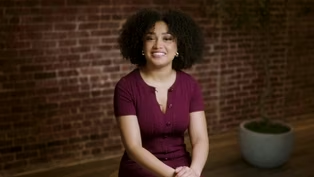
A Brief But Spectacular take on growing up a theater kid
Video has Closed Captions
Jasmine Amy Rogers' Brief But Spectacular take on growing up a theater kid (3m 6s)
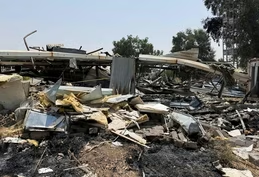
Brief pause in Iran war ends with new attacks in Iraq, Egypt
Video has Closed Captions
Brief pause in Iran war ends with new attacks in Iraq and Egypt (5m 4s)
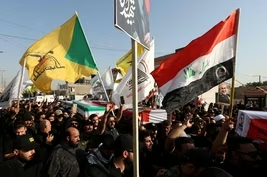
Ex-Iraqi diplomat on forces driving Iran war across region
Video has Closed Captions
Former Iraqi diplomat on forces driving Iran war across region (5m 44s)
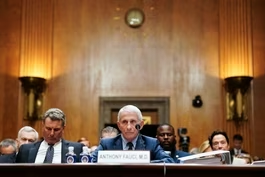
Fauci invokes 5th Amendment during COVID origins hearing
Video has Closed Captions
Fauci invokes 5th Amendment right during GOP-led hearing on COVID origins (6m 18s)
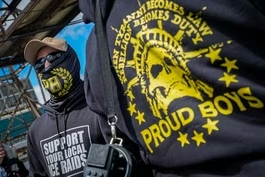
Journalist details weekend spent with far-right Proud Boys
Video has Closed Captions
Journalist details weekend spent with far-right Proud Boys (7m 22s)
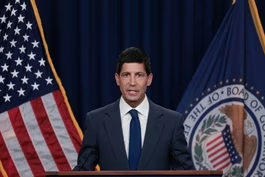
News Wrap: Federal Reserve holds interest rates steady
Video has Closed Captions
News Wrap: Federal Reserve holds interest rates steady, but some vote for increase (5m 22s)
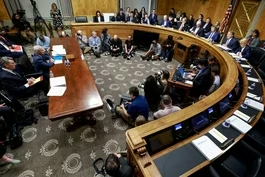
What brought Fauci back before Congress
Video has Closed Captions
The campaign against Fauci and what brought him back before Congress (6m 20s)

Why single women are outpacing single men in homeownership
Video has Closed Captions
Single women are outpacing single men in homeownership, but some face backlash (6m 32s)
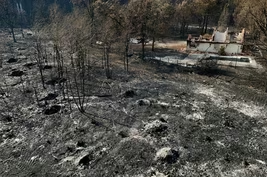
Wildfires in Europe push emergency response to the limit
Video has Closed Captions
Climate-fueled wildfires in Europe push emergency response to the limit (6m 58s)
Providing Support for PBS.org
Learn Moreabout PBS online sponsorship New Episode
- News and Public Affairs

Today's top journalists discuss Washington's current political events and public affairs.

- News and Public Affairs

FRONTLINE is investigative journalism that questions, explains and changes our world.

 New Episode
 New Episode
 New Episode
 New Episode
 New Episode
 New Episode
 New Episode
 New Episode
 New Episode
Support for PBS provided by:
Major corporate funding for the PBS News Hour is provided by BDO, BNSF, Consumer Cellular, American Cruise Lines, and Raymond James. Funding for the PBS NewsHour Weekend is provided by...