
January 12, 2026 - PBS News Hour full episode
1/12/2026 | 57m 46sVideo has Closed Captions
January 12, 2026 - PBS News Hour full episode
Monday on the News Hour, Federal Reserve Chair Jerome Powell comes under criminal investigation by the Trump Justice Department. Protests grow in Iran, but so does the death toll, as the regime cracks down on dissent. Plus, how the Trump administration is increasingly using extremist rhetoric to bolster its policies.
Problems playing video? | Closed Captioning Feedback
Problems playing video? | Closed Captioning Feedback
Major corporate funding for the PBS News Hour is provided by BDO, BNSF, Consumer Cellular, American Cruise Lines, and Raymond James. Funding for the PBS NewsHour Weekend is provided by...
Support provided by:

January 12, 2026 - PBS News Hour full episode
1/12/2026 | 57m 46sVideo has Closed Captions
Monday on the News Hour, Federal Reserve Chair Jerome Powell comes under criminal investigation by the Trump Justice Department. Protests grow in Iran, but so does the death toll, as the regime cracks down on dissent. Plus, how the Trump administration is increasingly using extremist rhetoric to bolster its policies.
Problems playing video? | Closed Captioning Feedback
How to Watch PBS News Hour
PBS News Hour is available to stream on pbs.org and the free PBS App, available on iPhone, Apple TV, Android TV, Android smartphones, Amazon Fire TV, Amazon Fire Tablet, Roku, Samsung Smart TV, and Vizio.
Providing Support for PBS.org
Learn Moreabout PBS online sponsorshipAMNA NAWAZ: Good evening.
I'm Amna Nawaz.
GEOFF BENNETT: And I'm Geoff Bennett.
On the "News Hour" tonight: Federal Reserve Chair Jerome Powell comes under criminal investigation by the Trump Justice Department.
JANET YELLEN, Former U.S.
Treasury Secretary: This is an atmosphere that is one of intimidation, where people will feel pressured to do what the president wants.
AMNA NAWAZ: Protests grow in Iran, and so does the death toll, as the regime cracks down on dissent.
GEOFF BENNETT: And how the Trump administration is increasingly using extremist rhetoric to bolster its policies.
CYNTHIA MILLER-IDRISS, American University: When you get people to stop knowing what's true and false, it's very easy for them to stop knowing what's right and wrong.
(BREAK) GEOFF BENNETT: Welcome to the "News Hour."
The Justice Department has launched an unprecedented criminal investigation against the Federal Reserve and its chairman, Jerome Powell.
AMNA NAWAZ: For his part, Powell made it clear he was fed up with what he sees as threats from President Trump and said he would not capitulate to political pressure when shaping economic policy.
It was a stunning turn of events, as several lawmakers from the president's own party also broke with Trump, suggesting his team had gone too far.
JEROME POWELL, Federal Reserve Chairman: On Friday, the Department of Justice served the Federal Reserve with grand jury subpoenas.
AMNA NAWAZ: Last night, an extraordinary message from Fed Chair Jerome Powell.
JEROME POWELL: No one, certainly not the chair of the Federal Reserve, is above the law, but this unprecedented action should be seen in the broader context of the administration's threats and ongoing pressure.
AMNA NAWAZ: That video posted by the Federal Reserve Sunday evening in response to a criminal investigation launched by U.S.
attorney Jeanine Pirro into the $2.2 billion renovation of the Federal Reserve headquarters.
But Powell claimed that is not what's behind this probe.
JEROME POWELL: Those are pretexts.
The threat of criminal charges is a consequence of the Federal Reserve setting interest rates based on our best assessment of what will serve the public, rather than following the preferences of the president.
AMNA NAWAZ: Since returning to office, President Trump has consistently and frequently attacked Powell.
DONALD TRUMP, President of the United States: No, he's a political hack, not very good.
He's not a smart guy.
AMNA NAWAZ: Threatening to fire him.
DONALD TRUMP: He's got some real mental problems.
No, there's something wrong with him.
It's just ridi -- I will be honest.
I'd love to fire his (EXPLETIVE DELETED).
AMNA NAWAZ: And criticizing the pace of interest rate cuts.
DONALD TRUMP: He's too late, always too late, a little slow, and I'm not happy with him.
AMNA NAWAZ: Over the last year, the Federal Reserve cut interest rates three times, most recently in December.
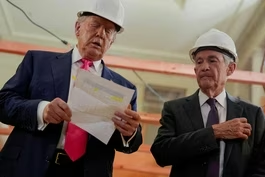
But the headquarters renovation project has fueled Trump's attacks, as in this exchange with Powell in July, when Trump visited the construction site.
DONALD TRUMP: It looks like it's about $3.1 billion.
It went up a little bit, or a lot.
So the 2.7 is now 3.1.
JEROME POWELL: I'm not aware of that, Mr.
President DONALD TRUMP: Yes, it just came out.
AMNA NAWAZ: In a Sunday night NBC interview, the president denied any involvement in the investigation, saying -- quote -- "I don't know anything about it."
Powell was first appointed to the Fed board by then President Obama in 2012, nominated by Trump in his first term to be chair in 2017, and reappointed by then-President Biden in 2022.
KEVIN HASSETT, Director, National Economic Council: I would expect that the markets would be happy to see that there's more transparency at the Fed.
AMNA NAWAZ: Today, National Economic Council Director Kevin Hassett, a potential replacement for Powell, defended the Justice Department's probe.
KEVIN HASSETT: I think that it's really important to understand where the taxpayer money goes and understand why it goes this way or that.
AMNA NAWAZ: As did White House Press Secretary Karoline Leavitt.
KAROLINE LEAVITT, White House Press Secretary: The president has every right to criticize the Fed chair.
He has a First Amendment right, just like all of you do.
And one thing's for sure the president's made it quite clear, is Jerome Powell is bad at his job.
As for whether or not Jerome Powell is a criminal, that's an answer the Department of Justice is going to have to find out.
AMNA NAWAZ: Limited pushback today from congressional Republicans, Senator Kevin Cramer calling Powell a - - quote -- "bad Fed chair," but adding, "I do not believe, however, he is a criminal."
Senator Thom Tillis went further, saying he would -- quote -- "oppose the confirmation of any nominee for the Fed, including the upcoming Fed chair vacancy, until this legal matter is fully resolved."
Reaction from House Speaker Mike Johnson was definitive when asked if the DOJ was being weaponized.
REP.
MIKE JOHNSON (R-LA): Of course not.
AMNA NAWAZ: The markets reacted initially too, with the Dow at one point dropping more than 400 points after the opening bell.
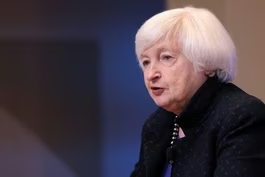
For more, I'm joined by Janet Yellen.
She served as chair of the Federal Reserve Board from 2014 to 2018.
The current Fed chair, Jerome Powell, started his term immediately after her.
Most recently, she served as treasury secretary during the Biden administration.
Chair Yellen, welcome back to the NewsHour.
Thanks for joining us.
JANET YELLEN, Former U.S.
Treasury Secretary: Thank you so much.
Thanks for having me.
AMNA NAWAZ: So you said in an interview with The New York Times today that you believe the Department of Justice is being weaponized here, in your words, you said, to go after somebody that you don't have a valid basis to get rid of.
In your view, what is this investigation really about?
JANET YELLEN: Well, it's really about wanting to intimidate Fed leadership to be able to control monetary policy decisions, to bend monetary policy to the president's will.
He's been very openly critical really since his second term began of the Fed's policy decisions.
And he's indicated that he wants far lower interest rates than the Fed has regarded as reasonable to set, given that inflation is still significantly above the Fed's 2 percent target and the congressional mandate the Fed's been given to achieve price stability.
And the labor market, while it's shown some signs of weakening, is still -- the unemployment rate is very low, and it's still in good shape.
And President Trump has indicated that one of his goals is to lower the amount of interest that the government has to pay to finance roughly $38 trillion in outstanding federal debt.
Now, that is not one of the goals that Congress has assigned to the Federal Reserve.
And that's a very dangerous thing to hear a president say he thinks is an appropriate goal for monetary policy, because it's once central banks lose their independence and are forced to help governments finance deficits, that's when we see that's always a precondition for high and even hyper inflation.
AMNA NAWAZ: Can I just get your take on the context here of this moment, Chair Yellen?
Because it's been pointed out past presidents, Republican and Democrat, have pressured the Fed in different ways to lower interest rates.
Karoline Leavitt, I'm sure you saw earlier today, made the point that the president has a right to criticize Chair Powell and the policy of the Fed.
Why do you feel this is different in this moment?
JANET YELLEN: Well, he does have a right, although I don't think it's a wise thing to do.
And I think, during the Clinton administration, the Bush administration, Obama, Biden, the White House really was very careful not to comment on Fed policy and to support the Fed's independence, because it's better for the economy.
But the president has a right, of course, to criticize the Fed.
But President Trump has gone much further than that.
He's asserted that he has the right to remove one of the members of the Federal Reserve Board, Lisa Cook, for a cause.
And the Federal Reserve Act does allow the president to remove people for cause.
But this has never been done.
So it's very clear that he is trying to remove people whose views he disagrees with from the Federal Reserve Board to insert his own appointees.
AMNA NAWAZ: I saw it reported you called this now criminal probe that's been launched the most significant attack on the Fed's independence that we've seen.
And, specifically, we should point out that prosecutors are reportedly looking at Chair Powell's congressional testimony from last summer about that renovation project at the Fed's headquarters.
I just want to put to you what one Republican senator on the Banking Committee said That's Senator Cynthia Lummis.
And she said: "Whether Chair Powell was unprepared for his testimony or intentionally misled Congress about the Fed's extravagant spending, the American people deserve answers."
I guess my question to you is, what would you say to her and to others who say, let the process play out, let the facts fall where they may?
JANET YELLEN: Well, of course, Congress has oversight of the Fed, and they have every right to look into the building project and to demand answers and information.
And I believe the Fed has provided all of the information that has been requested about the project.
I will be very surprised if evidence emerges that Chair Powell was untruthful in his testimony, knowing him.
It is my guess that that is not the case.
AMNA NAWAZ: Chair Yellen, I've heard you say that all this could have an impact on the Fed's independence, that it is at risk.
I guess, are you looking at this now and thinking, has it already had an impact?
All of the president's political pressure, this criminal probe that's now been launched, from when you talk to people on the inside now, is it already having an impact on how they're doing their jobs?
JANET YELLEN: Well, I think it is placing a lot of pressure on Fed leadership.
When you think about speaking out about your views about the economy and monetary policy, and you know that, if you say something that displeases the president, that you may find yourself an object of a criminal probe by the Department of Justice, this is an atmosphere that is one of intimidation where people will feel pressured to do what the president wants in order to avoid harm both to the institution and to themselves personally.
And it may make people question whether or not they want to hold senior roles in the Federal Reserve if they're not going to be able to take the actions that they think are in the public mandate and accord with their congressional mandate.
AMNA NAWAZ: All right, that is the former Chair of the U.S.
Federal Reserve Board Janet Yellen joining us tonight.
Chair Yellen, thank you for your time.
It's good to speak with you.
JANET YELLEN: Thank you so much.
GEOFF BENNETT: And now let's dive into some of the legal questions behind all of this and similar moves by the president in other cases.
We're joined now by Mary McCord, a former federal prosecutor, now executive director of the Institute for Constitutional Advocacy and Protection at Georgetown University.
Mary, it's always good to see you.
So, Jeanine Pirro, who is leading this criminal investigation as the U.S.
attorney for Washington D.C., longtime Trump ally, what are the standard guardrails when the appearance of a political conflict of interest is this intense?
MARY MCCORD, Former Justice Department Official: Well, this is at the very earliest stage, right, with the service of a subpoena seeking information from Mr.
Powell and from the Federal Reserve.
And so that -- we are a long way from any criminal charges.
If the office determines that they've got evidence sufficient to seek a grand jury indictment, they would then have to go before a grand jury and the grand jury would have to vote.
At least 12 members of the grand jury out of up to 23 would have to vote to return an indictment.
And then, if that were to happen, there would be -- the case would be brought into federal court.
There would be opportunities for Mr.
Powell to make motions to dismiss the case, including, I would expect here, on grounds of vindictiveness, because this is -- because of what you've just been talking about on this program about the pattern of pressure on Jerome Powell to cause the board to lower interest rates, and then the really awful things that the president has said about him and criticized him, all very suspicious timing with the bringing of this investigation.
So there'd be an opportunity for him to make motions based on that and other things.
And, ultimately, if his motions were denied, he would go to trial.
And then, of course, a jury of 12 would have to find unanimously beyond a reasonable doubt that every element of the offense has been proved.
And I would note that, with respect to the offenses that potentially are under investigation here, false statements to Congress and perjury, these are the things that Representative Luna referred to the attorney general for potential investigation, it doesn't mean that that's exactly what they're investigating, but that's what the indications are.
Those charges require willfully and knowingly making false statements.
And there's just nothing that I've heard so far, based on Mr.
Powell's testimony in June, Chairman Powell's testimony in June, that would suggest a basis for some willful and willfully false statement about a material fact.
GEOFF BENNETT: And the Trump administration also tried to remove Fed Governor Lisa Cook unproven allegations of mortgage fraud.
The Supreme Court has allowed her to remain on the board for now.
Do the Cook and Powell cases have any direct bearing on one another?
MARY MCCORD: Well, I -- the Cook case is going to be heard by the Supreme Court next week.
And I actually think the timing of this revelation of these -- of this criminal investigation against Mr.
Powell, while not technically related to the case in front of the court, I think it is something that lends credence to an argument that the attempt to get rid of board member Lisa Cook is not based in -- it's not well-grounded.
I mean, he -- the president offered his version of cause, meaning these allegations that again are just allegations of some sort of mortgage fraud that many of those who have looked carefully at the facts think don't stand up.
And so, in that environment of pressure, in the middle also, remember, of President Trump removing Democratic appointed board members from other multimember independent commissions, like the FTC, the NLRB, the CFPB, we could do alphabet soup here, I mean, this is a -- has been a year of removals of Democrats or those appointed by Democrats in favor of having boards made up of all of his own appointees.
So I think the context of adding this real lever of power, potential criminal investigation, needs to be thought of in the context of everything else happening, and including looking at the attempted firing of Lisa Cook.
GEOFF BENNETT: And after the tossed indictments against James Comey and Letitia James, what does it mean institutionally that the Trump Justice Department is even pursuing this case against Powell, regardless of whether it ever results in charges?
MARY MCCORD: Well, as you and I've discussed before, Jeff, it does seem like the White House and the president in particular is really directing the investigations that the Department of Justice engages in, particularly with respect to those people he perceives as his political opponents, James Comey, Letitia James, Lisa Cook, and now Jerome Powell.
And he -- there are also investigations into people like Adam Schiff, right?
So the president is denying that he had anything to do with this, but I am skeptical of that, given how many times he has disparaged Mr.
Powell and the pattern that this fits into of the way he would disparage and call for investigations of others, and then the Justice Department launches those investigations.
So it does not pass the smell test.
GEOFF BENNETT: Mary McCord, thanks, as always, for speaking with us.
We appreciate it.
We start the day's other headlines in Minnesota.
State and city officials are suing the federal government to try to stop the surge of immigration enforcement in Minneapolis and St.
Paul.
It comes just days after a 37-year-old woman, Renee Good, was shot and killed by an ICE agent in Minneapolis.
The Department of Homeland Security says it's pushing more than 2,000 immigration officers into Minnesota as part of a crackdown targeting fraud in the state.
This afternoon, Minnesota's attorney general said the increased action is jeopardizing community safety.
KEITH ELLISON, Minnesota Attorney General: Thousands of poorly trained, aggressive and armed agents of the state -- of the federal government have rolled into our communities, overwhelmed our local police departments.
And law enforcement agencies should be focused on our public safety.
But, instead, many are dealing with the aftermath of DHS agents' chaos and violence.
GEOFF BENNETT: Meantime, another tense scene unfolded between neighborhood activists and federal officers just blocks from where Good was shot.
This crowd formed after ICE agents reportedly rear-ended a bystander's car.
Officers then fired tear gas to disperse the protesters.
Also today, Illinois state officials in the city of Chicago sued the Department of Homeland Security over what they called unlawful and dangerous tactics carried out by federal agents.
Federal officials have defended their work in both Illinois and Minnesota, saying it's necessary to carry out President Trump's immigration agenda.
Arizona Senator Mark Kelly is suing the Pentagon over its attempts to punish him for urging members of the military to refuse illegal orders.
In his lawsuit, the former U.S.
Navy pilot argued that the First Amendment forbids the government and its officials from punishing disfavored expression or retaliating against protected speech.
Defense Secretary Pete Hegseth announced last week that he was censuring Kelly, a procedural step that could lead to a demotion and a cut in retirement pay.
In November, Kelly and five other Democrats released a video calling on troops not to follow orders if they are unlawful.
Greenland is asserting its place inside of the NATO military alliance as President Trump continues to push the idea of a U.S.
takeover.
The government there released a statement today saying: "As part of the Danish Commonwealth, Greenland is a member of NATO and the defense of Greenland must therefore be through NATO."
It comes after President Trump told reporters last night that the U.S.
would have Greenland one way or another.
But NATO Secretary General Mark Rutte today chose to focus on what he sees as cooperation, not conflict.
MARK RUTTE, NATO Secretary-General: And I applaud the fact that our colleagues who are bordering on the Arctic have come together, have worked together and have decided to get NATO more and more involved.
That's the United States, that's Canada, that's Iceland, Denmark and the other European countries bordering on the High North, all seven, but, of course with the whole of the alliance.
Meantime, China also weighed in today, pushing back on President Trump's claims that the U.S.
needs to take Greenland to prevent China or Russia from doing so.
A Chinese Foreign Ministry spokesperson said the U.S.
should not use other countries, in their words, as a pretext for pursuing its own interests.
Venezuela's interim government said today it had released more than 100 political prisoners, though human rights groups say the number is far lower.
That comes as opposition leader and Nobel Peace Prize winner Maria Corina Machado asked Pope Leo today for his help in securing more prisoner releases.
She's due to meet with President Trump on Thursday.
Separately, Mr.
Trump says he's inclined to freeze ExxonMobil out of Venezuela's oil market after its CEO called the Venezuelan market uninvestable.
In New York City, nearly 15,000 nurses walked off the job today after contract negotiations hit a wall over the weekend.
It's the largest nurses strike in the city's history.
(CHANTING) GEOFF BENNETT: Striking workers gathered outside locations linked to three private nonprofit hospital groups.
Demands vary by hospital, but the nurses union says staffing levels and workplace safety are among the key issues.
Mayor Zohran Mamdani showed up in support of the workers and pointed out that hospital executives are raking in millions.
ZOHRAN MAMDANI (D), Mayor of New York City: This strike is not just a question of how much nurses earn per hour or what health benefits they receive, although both of those issues matter deeply.
It is also a question of who deserves to benefit from this system.
GEOFF BENNETT: The hospitals say the union's demands are too costly.
In a statement, New York Presbyterian said: "We're ready to keep negotiating a fair and reasonable contract that reflects our respect for our nurses and the critical role they play and also recognizes the challenging realities of today's health care environment."
The hospitals have hired temporary nurses to help in the meantime, though some sites have canceled surgeries and tried to discharge patients ahead of the strike.
In Mississippi, the FBI says the suspect in a synagogue fire admitted to targeting the site because of its -- quote -- "Jewish ties."
The FBI says Stephen Pittman confessed to lighting the fire inside the Beth Israel Congregation in Jackson this past weekend.
He was charged today with maliciously damaging or destroying a building by means of fire or an explosive.
No one was injured, but the synagogue's library and administrative offices were damaged.
Beth Israel was founded in 1860.
It was bombed by the KKK in the 1960s over its rabbi's support for civil rights.
Paramount Skydance is ramping up its efforts to acquire Warner Bros.
Discovery.
Today, the company said it would name its own slate of directors to the Warner Bros.
board.
And it filed a lawsuit seeking information on how Warner Bros.
decided that a rival offer from Netflix is better than its own.
Warner Bros.
has already rejected multiple takeover efforts from paramount.
Instead, it's urging shareholders to back the sale of its streaming and studio businesses to Netflix in a $72 billion deal.
On Wall Street today, stocks managed modest gains, as traders brushed off early concerns about President Trump's battle with the Fed.
The Dow Jones industrial average added more than 80 points on the day.
The Nasdaq managed a gain of about 60 points.
The S&P 500 also ended higher, rising about 10 points.
Still to come on the "News Hour": the Trump administration ad campaigns that are borrowing from white nationalist ideas; Tamara Keith and Amy Walter break down the latest political headlines; and an effort that's trying to rekindle a love for reading.
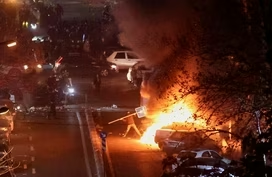
AMNA NAWAZ: Protests in Iran continued to grow today and over the weekend, as has the death toll, with security forces now estimated to have killed at least 500 protesters, perhaps many more.
GEOFF BENNETT: In addition to renewed military threats from President Trump, late today, he issued another threat, saying: "Any country doing business with Iran will pay a tariff of 25 percent on any and all business being done with the United States."
It is unclear what sectors the president is designating.
Nick Schifrin reports now.
And a warning: Some images in this story are disturbing.
NICK SCHIFRIN: In Iran, the street demands the end of the regime, spews contempt for their leaders, and declares this the final battle.
Over the last few days, protesters set fire to symbols of the regime's repression, including this mosque in Tehran and sources of government power, including municipal buildings in the north.
The response has been ruthless.
In the last two weeks, human rights groups now accuse security forces of killing about 500 protesters, soaking the nation's streets in its citizens' blood, and now new footage of the aftermath of a massacre, rows of body bags all believed to be protesters who fought and died demanding freedom, line the floor of the Kahrizak morgue outside of Tehran, so many bodies, they overflowed outside, where family members were beleaguered by loss.
The regime called these victims all lined up for their loved ones to find armed terrorists, the toll so high, morgue officials cycled through images of the dead so they could be identified.
Today, the government gathered its own march, tens of thousands, led by President Masoud Pezeshkian, who this weekend accused Iran's unnamed enemies of bringing - - quote -- "trained terrorists" into Iran.
Today, Foreign Minister Abbas Araghchi aimed his comments directly at the U.S.
ABBAS ARAGHCHI, Iranian Foreign Minister (through translator): We do not seek war, but we are fully prepared for it.
At the same time, as I have repeatedly said, we are also ready for negotiations.
NICK SCHIFRIN: Last night, President Trump confirmed he was considering a military strike.
DONALD TRUMP, President of the United States: But we're looking at it very seriously.
The military is looking at it.
And we're looking at some very strong options.
NICK SCHIFRIN: But also acknowledged Iran's willingness to talk.
DONALD TRUMP: A meeting is being set up, but we may have to act because of what's happening before the meeting.
NICK SCHIFRIN: The protests began in late December triggered by rising prices.
They expanded into calls for regime change and in unprecedented ways, geographically spreading from urban centers to rural provinces such as Ardabil in the north, and socioeconomically, to include both the working and middle classes across the country.
And despite the danger, protesters continue their clashes with police, calling for an end to a government that gives religious leaders ultimate control.
And they're willing to pay the ultimate price.
This purported video shows protesters checking their bloodied friends' signs of life, these scenes exactly what the government hoped to hide through an unprecedented Internet shutdown.
ALI TEHRANI, Director of D.C.
Operations, Psiphon: This is the most extreme shutdown that we have seen in the history of the Internet inside the country.
NICK SCHIFRIN: Ali Tehrani is the director of operations of Psiphon, which provides protesters around the world virtual private networks to bypass state censorship.
He says Iran shut down the Internet faster and with fewer loopholes than ever before, showing the regime fears the protest threat is existential.
ALI TEHRANI: The national Internet shutdown is very, very rare.
And the reason for that is because of the collateral damage.
The airports don't work.
The banks don't work.
A lot of internal services do not work.
When a regime such as Iran's chooses to do that, it means that there is a higher stake at place.
This is the biggest threat that they have ever felt.
Therefore, they implemented the Internet shutdown the way that they are doing it right now.
NICK SCHIFRIN: But the Trump administration has partially cut Tehrani's funding... NARRATOR: Courier, a ship without guns, goes into battle armed with the greatest weapon of all, truth.
NICK SCHIFRIN: ... as part of its cuts to the parent organization A Voice of America.
NARRATOR: Citizens around the world are being tortured, imprisoned and even killed for their online speech.
NICK SCHIFRIN: Those cuts also hit VOA's digital descendant, the Open Technology Fund, which supports Psiphon and other software that opens windows for protesters to share videos and communicate despite government attempts to close them.
ALI TEHRANI: One of the pillars of the U.S.
policy in the past two decades has been restoring this information.
And that is paying off.
All these people chanting on the streets like what they are looking for, it's because this window was open to them.
I mean, it didn't happen overnight.
It didn't happen accidentally.
It is because this option, this window of opportunity was open in front of them, and they could see that what they could demand.
NICK SCHIFRIN: And so Tehrani and others want the U.S.
government to restore funding to help protesters demand change and broadcast it to the world.
For the "PBS News Hour," I'm Nick Schifrin.
AMNA NAWAZ: Just weeks into the new year, the Trump administration has surged ICE agents to American cities, overthrown a foreign head of state, threatened a military takeover of Greenland, and rewritten the history of January 6.
As Liz Landers reports, the administration has rolled out a campaign across departments that draws on images and ideas borrowed from right-wing and white nationalist circles.
LIZ LANDERS: From the U.S.
Department of Labor, a message: "One homeland, one people, one heritage.
Remember who you are, American."
It's a video that appears to be part of a campaign now ramping up to sell the administration's efforts to the American people, FOR example, calling on potential ICE recruits to - - quote -- "defend the homeland" from outsiders while featuring heroic images of white men, often from a bygone era.
Then there's this tweet from Friday, an ICE recruitment ad featuring the turn of phrase "We will have our home again" plastered over an image of a man on horseback and a stealth bomber flying in the distance.
That's a reference to the song "We'll Have Our Home Again," a white supremacist anthem favored by the Proud Boys.
(SINGING) LIZ LANDERS: Another image tells supporters to -- quote -- "Trust the plan," the slogan of the right-wing conspiracy theory known as QAnon, which posits there's a global cabal of pedophiles and deep state actors trafficking children and that Trump is fighting it.
It's also a movement heavily involved in the insurrection on January 6, 2021.
Last week, the Trump administration published a new Web site rewriting that history to blame Democrats for security failures that day and to justify the president's pardoning of more than 1,500 defendants.
Weighing in on another era, last week, President Trump also sat for a lengthy interview with The New York Times.
He was asked about the civil rights movement and told reporters that while the landmark legislation did some good things, he said -- quote -- "It also hurt a lot of people.
People that deserve to go to a college or deserve to get a job were unable to get a job.
So it was -- it was a reverse discrimination."
A day later, Trump supporter and billionaire Elon Musk wrote "100" above this message on X, which read in part -- quote -- "If white men become a minority, we will be slaughtered.
White solidarity is the only way to survive."
That's known as the Great replacement Theory, popular in white nationalist circles that falsely claims the white population is being intentionally replaced by nonwhites.
For the "PBS News Hour," I'm Liz Landers.
AMNA NAWAZ: For more context on what some of these images and posts mean and why the Trump administration is using them, we turn now to Cynthia Miller-Idriss, director of the Polarization and Extremism Research Innovation Lab at American University.
Welcome back.
Thanks for being here.
CYNTHIA MILLER-IDRISS, American University: Thanks for having me.
AMNA NAWAZ: So we have seen some of these messages before, but this ramping up of their delivery and from multiple official administration accounts, what does all that signal to you at this point, nearly one year into this administration?
CYNTHIA MILLER-IDRISS: Yes, it does feel like a turning point, a turning point in the propaganda campaign, if you will, and the shift to try to change people's minds about what's happening.
I think they feel we're at a moment when ICE has a 57 percent disapproval rating, I heard today, where it's the second least liked federal agency, only after the IRS.
And so we have a moment when the American public is seeing what's happening, are watching abuses, are watching cell phone video, especially the recent murder of a protester.
That, I think, is why we're seeing this kind of campaign to try to position what ICE is doing as in the public interest, as safety, and, of course, with a lot of dog whistles, or sometimes not even dog whistles, making racist and conspiratorial claims about what would happen if they don't do it.
AMNA NAWAZ: Let's take just a closer look at some of the examples that Liz was just citing there, because some people will look at this and say, I don't see anything wrong with this.
There's the painting, for example, this 1870s painting called "American Progress," was posted by Homeland Security.
It features a sort of manifest destiny tableau, talks about a heritage worth protecting.
Why is that significant?
Why this reliance on this sort of old imagery and this messaging, this language?
CYNTHIA MILLER-IDRISS: Yes.
So, well, propaganda messaging relies on people's memories of other images that they might associate with positive things even.
So we will see even terrorist groups use things like civil rights iconographic messaging, or women's rights iconography to sort of position themselves as a liberating force from oppressors.
We see in that particular image, not just a woman flying over, a white woman, carrying a textbook, right, a really interesting part, that that is known as a kind of education is going to lead the way, we're going to claim what we can about knowledge and make sure that people believe as we claim more space, at a moment when we're also invading Venezuela and making threats about Greenland.
AMNA NAWAZ: He's not part of the administration technically, but to have Elon Musk openly retweeting white nationalist language, why is that significant?
CYNTHIA MILLER-IDRISS: Well, white -- this kind of white nationalist language, when it's conspiratorial, it's been linked to terrorist attacks in Pittsburgh, in El Paso, in Buffalo.
I mean, that was the motivating -- in Christchurch, New Zealand, in Oslo, Norway.
I mean, hundreds of people have died because of that conspiracy theory, because people believe there is a dire threat posed by multicultural societies and that someone is orchestrating it to make white people disappear.
And so that is dangerous.
AMNA NAWAZ: There's also this piece that Liz reported on in a recent interview the president gave articulating his views on the civil rights movement, which was the Black-led equal rights push to end legal discrimination and segregation in this country.
He said it hurt a lot of people and ended in reverse discrimination.
What does that tell you about where these ideas are coming from and how they're making their way to the president of the United States?
CYNTHIA MILLER-IDRISS: Yes, I think -- well, I think we're seeing several different things.
In that statement, I think one of the things we're seeing is an unedited version of a belief system that has possibly always been there.
It's not just new advisers suggesting something.
It is a belief that white men are losing ground and that something has to be done to restore male standards, as we heard the secretary of defense say recently to the military, or Mark Zuckerberg that what we really need his masculine energy in the corporate sector, right?
So these kind of gloves are off, right?
There's no more hiding those kinds of statements.
And I think President Trump is an example of someone who has always believed that kind of thing and is now feeling more emboldened or empowered to say it.
AMNA NAWAZ: These are ideas, as you have noted and tracked, they have long been simmering below the surface.
Now they're sort of out in the open.
You also cited a number of other big things that are going on, on the planet right now and as a result of U.S.
policy.
When you see historically these kinds of campaigns, propaganda pushes, is it because they're trying to get a message out or is it distraction from something else?
CYNTHIA MILLER-IDRISS: It's both.
So one of the things we see is that one of the very first things undemocratic leaders do is to try to confuse people, to make -- to say there's alternative facts, there are other ways of seeing the world, to undermine journalism, the media, academics, expertise, scientists, to basically say, this isn't true, whether that's about vaccines or about what we saw in a video was who shot and why a woman who was protesting.
So that kind of confusion, it's what Hannah Arendt said about the Nazis, that you -- when you get people to stop knowing what's true and false, it's very easy for them to stop knowing what's right and wrong.
And so I think that's one of the first things we see, is that confuse and then flood the zone with a lot of different things happening all at once.
AMNA NAWAZ: Cynthia Miller-Idriss of American University, thank you for being here.
Really appreciate your time.
CYNTHIA MILLER-IDRISS: Thank you for having me.
GEOFF BENNETT: It is only Monday, and it is shaping up to be a busy week as tensions continue to rise in Minneapolis after the ICE shooting and some Republicans push back against the president's threats to the Federal Reserve and the strike in Venezuela.
A lot to talk about with our Politics Monday team.
That's Amy Walter of The Cook Political Report With Amy Walter and Tamara Keith of NPR.
It's good to see you both.
AMY WALTER, The Cook Political Report: Good to be here.
GEOFF BENNETT: So let's start with that headline, last night, the DOJ launching investigation into the Federal Reserve and its chair, Jerome Powell, amid President Trump's now long-running pressure campaign to lower interest rates.
Tam, I mean, so far, there are just a handful of Republicans, Lisa Murkowski of Alaska, Thom Tillis of North Carolina, who's not running again, who say this crosses a line.
TAMARA KEITH, National Public Radio: Yes.
And then there are a few others who say, well, this is a distraction or they'd like to see this resolved before the before the president's nominee for a new Fed chair comes through.
Tillis is saying that he intends to take a stand, that he does not want this investigation hanging over and that he does not intend to vote to confirm Trump nominees to the Fed until this is dealt with.
But this is still -- in terms of pushback, it's still pretty tepid.
You have the speaker of the House saying he doesn't really have a problem with it.
You have a lot of people just not commenting on the investigation and bashing Powell, which is essentially what President Trump did as well, saying, oh, I don't know anything about that, but he's not good at what -- at his job and he's not good at building buildings.
Because, of course, the underlying premise here is that there are cost overruns in the construction or reconstruction of the Federal Reserve building.
This is part of a long pressure campaign from President Trump.
In July, he toured the Fed headquarters to get his eyes on it and said he would fire somebody if that person was as over budget as this project is.
And as recently as December, he was saying he was going to sue Powell for -- quote -- "incompetence."
And then, of course, there is Lisa Cook, the other Fed governor who is about to be argued -- her case is about to be argued before the Supreme Court about whether Trump can fire her for cause, when in fact there has been no cause proven.
GEOFF BENNETT: And, Amy, you have these two or three Republicans who are speaking out on this issue combined with the five Senate Republicans who voted with all the Democrats on that war resolution to rein in President Trump's actions in Venezuela.
AMY WALTER: Right.
GEOFF BENNETT: How do you read all that?
AMY WALTER: Yes, I think Tam had the right word, which was tepid.
Many of the people who have come out on the War Powers Act, who've come out speaking out about Powell are also the people who we see as sort of the usual suspects.
They're the same people over and over again, Murkowski being one of them from Alaska.
Tillis, as you noted, is leaving.
And then you have some of the other moderates like Susan Collins from Maine or Ron Paul -- Rand Paul, I'm sorry, from Kentucky, who is sort of eclectic.
He is... TAMARA KEITH: Is his own man.
AMY WALTER: He's been -- yes, he's been on the other side of Trump for some time now.
So you're not seeing, like, a concentrated force of Republicans in any of these measures coming out against what the president's doing, even as we see, for example, there was a vote to try to overturn a veto of two very popular, uncontroversial bills that had passed earlier in the year.
The president is upset about certain things happening in Colorado.
He's upset about certain things not happening in Florida.
He said, I'm going to veto this not-controversial legislation.
Only about 25, 30 Republicans agreed to go back and try to overturn that veto.
The one thing that Congress has stood up, I will say, is on the filibuster, where Republican senators, those who are big fans of the president and those who maybe aren't, are all seemingly in agreement that they do not want to follow Trump's admonition to get rid of that filibuster.
GEOFF BENNETT: Let's shift our focus to Minnesota, because protests continued there over the weekend.
Kristi Noem continued to double down on the administration's defense, even surging more federal law enforcement to the city.
Tam, why has the administration chosen such an aggressive posture here, even after the fatal shooting of a U.S.
citizen in the street, even in the face of all this mounting backlash?
TAMARA KEITH: This administration has one gear, and that is just charge forward.
Never apologize, go forward.
And they are driven by the view that they are doing what they were elected to do, that this is what Trump's base wants.
Now, if you look at polling on any number of topics, including immigration enforcement, including on the Fed, what you see is that the president has lost independents and he never had Republicans -- never had Democrats.
But he is losing independents on a bunch of these issues.
And this is just another case of him really governing for his voters, versus governing for a broader swathe of the country.
GEOFF BENNETT: And, Amy, there can be an appreciation for tough positions on crime, tough positions on illegal immigration, even while there's broad concern about overreach and unilateral power.
AMY WALTER: Right.
GEOFF BENNETT: How are Americans -- just based on the data, how are Americans viewing all of this?
AMY WALTER: Well, I mean, I think Tam has that correct that, overwhelmingly, where Americans seem to sit is kind of in this middle place, not surprisingly, which is to say, we want to see enforcement on the border.
We want to see enforcement of our laws.
If they go over the line, we would like to see accountability for those things.
And what's interesting is watching Democrats try to also figure out this moment and at this time.
If you remember, back in the first administration, there were a lot of Democrats after the family separation policy who came out and said, we should abolish ICE.
There was some backlash among Democrats after that election that that was too -- they went too far and it gave Republicans the opportunity to own the crime and safety issue.
You're not hearing Democrats talk about it as much this time around.
And, in fact, there's really not much appetite from leadership to hold government funding over DHS to once again shut the government down over an issue like this.
So, even as there is backlash to what Republicans, what the administration is doing and saying, there is not necessarily an appetite for Democrats to go all in to say, let's get rid of ICE altogether or let's hold off their funding.
GEOFF BENNETT: To your point that the White House is doing what they believe the American people elected them to do, two weeks ago, we were talking about the Epstein files.
Now we're talking about Venezuela, Greenland, what happened in Minnesota.
Is this the conversation Republicans want to be having in an election year?
TAMARA KEITH: Well, President Trump tomorrow is going to Detroit to deliver a speech at the Economic Club of Detroit.
He's going to tour a Ford F-150 plant.
That is what the administration keeps telling us they want to be talking about.
I will be very interested to see whether this speech weaves, like almost every speech the president gives, or whether he stays on message on the economy.
What Republicans want is the president to focus on affordability and convince the American public that things are getting better.
But often what they're getting is a lot of everything else.
And next week, the president's going to go to Davos and talk about housing affordability in Davos, which is a little discordant.
GEOFF BENNETT: Tamara Keith, Amy Walter, thanks, as always.
AMY WALTER: You're welcome.
TAMARA KEITH: You're welcome.
AMNA NAWAZ: Reading for pleasure has fallen by some 40 percent in the last 20 years, continuing a long-running downward trend.
And, by many measures, reading skills for both students and adults continue to fall.
That's just part of the impetus for a new effort to boost the world of words.
Senior arts correspondent Jeffrey Brown talks to Elizabeth Alexander, president of the Mellon Foundation.
It's part of our arts and culture series, Canvas.
JEFFREY BROWN: A book festival in Miami, a haven for poetry in New York, a small publisher in Minneapolis, all part of the noncommercial literary world that nourished Elizabeth Alexander as a young poet.
ELIZABETH ALEXANDER, President, Andrew W. Mellon Foundation: I went to places like the Loft in Minneapolis to do a reading and met so many people there.
I went to bookstores that devote themselves to the work of small presses and met my audiences there.
I went to an artist colony and had time to write more poems and also meet other writers and artists and musicians and see how they approached their craft.
That's kind of how I know what works.
JEFFREY BROWN: And now you want to make sure those survive?
ELIZABETH ALEXANDER: Yes, absolutely.
JEFFREY BROWN: She's now in a position to do just that as president of the Mellon Foundation, one of the nation's largest philanthropies and, for the record, a "News Hour" funder.
A new literary arts fund started with six other foundations will pump $50 million over five years toward nonprofit organizations that serve writers and writing, small presses, including of literature in translation, residencies, fellowships and more, a sector, says Alexander, of those who work with words struggling to survive.
ELIZABETH ALEXANDER: The spaces that we're particularly interested in are, how do these words make their way around?
Someone's got to put them on paper.
Someone's got to make them in book form.
Someone's got to give spaces for there to be readings and workshops.
Someone's got to make literary centers where people know that literature is valued.
Each day, we go about our business.
JEFFREY BROWN: But just how much is literature valued in today's culture?
Alexander herself has been at the center of national attention, reading her poem "Praise Song for the Day" at the 2009 inauguration of Barack Obama.
ELIZABETH ALEXANDER: We encounter each other in words, words spiny or smooth, whispered or declaimed, words to consider, reconsider.
JEFFREY BROWN: But headlines these days point to a crisis of national inattention and withdrawal from reading, a continuing decline in reading for pleasure, a steady drop in literacy rates.
And what we keep hearing is that the reading is going down, both of ability to read and also of reading for pleasure.
Is crisis the word you would use?
What do you see happening?
ELIZABETH ALEXANDER: I would use that word and I would also add the other piece on, the leisure time, both actual leisure time and the perception that you could use your leisure time to disappear in a book, that that is something that is under pressure.
We have tremendous pressures with book banning.
The kinds of experiences and lives and stories that are now being taken off library shelves and removed from school systems, that's another kind of crisis that we find ourselves in that this literary fund isn't designed to address precisely, but it does give you a sense of the times.
JEFFREY BROWN: The times also include federal funding cuts to the IMLS, an agency that funds libraries across the country, and to the National Endowments for the Arts and Humanities.
ELIZABETH ALEXANDER: It's all related, the $15 million grant that we made to the Federation of State Humanities Councils, so that every single humanities council in the country could stay afloat, and a lot of what they do -- they do many different things, but they do things like oral histories of veterans in a particular community, or poetry workshops for people in a community.
A lot of powerful word activity happens at humanities center, so that is a way alongside this initiative that we're trying to more directly address that crisis.
JEFFREY BROWN: In fact, Mellon itself has been the target of attacks from the right, as has the focus on DEI it and many other institutions of all kinds have embraced.
Alexander is not backing down.
ELIZABETH ALEXANDER: Our mission is unchanged, which is, we fund arts, humanities, higher education, humanities in public places, libraries, archives.
That's what we do, and we do it with a social justice lens.
We're always thinking about access, and we're always thinking about equity, and we're always thinking about which voices have not been brought to the fore or supported.
And I think that that context, as it connects to the literary arts, to me, the biggest crisis of our time is the atmosphere of dehumanization that we're living in.
JEFFREY BROWN: Meaning?
ELIZABETH ALEXANDER: Meaning that people are being othered from on high, meaning that the coarseness of language and action to value some lives more than others, to disparage is something that is ever more ambient.
JEFFREY BROWN: I presume you're talking about even at the highest levels of government, where we hear words used that way.
ELIZABETH ALEXANDER: And that are out of bounds.
JEFFREY BROWN: Out of bounds.
ELIZABETH ALEXANDER: Yes.
And I honestly believe that certainly learning, but also the arts and, in the case of today's topic, the word, are the best way, the most efficient and powerful way for people to see each other, and for people to understand that we all live different lives, and that, as a species, honestly, we don't survive if we don't figure out how to hear, respect and see each other.
And I think that literature has superpowers to do that.
JEFFREY BROWN: All right, Elizabeth Alexander, thank you very much.
ELIZABETH ALEXANDER: What a pleasure.
Thank you.
AMNA NAWAZ: And that is the "News Hour" for tonight.
I'm Amna Nawaz.
GEOFF BENNETT: And I'm Geoff Bennett.
For all of us here at the "News Hour," thanks for spending part of your evening with us.

Ex-prosecutor on Powell probe, Trump targeting opponents
Video has Closed Captions
Clip: 1/12/2026 | 5m 42s | Ex-prosecutor on DOJ’s Powell probe and Trump’s targeting of opponents (5m 42s)
Iran protests escalate as regime crackdown leaves 500 dead
Video has Closed Captions
Clip: 1/12/2026 | 5m 38s | Iran protests escalate as regime crackdown leaves more than 500 dead (5m 38s)

Literary Arts Fund created to rekindle a love for reading
Video has Closed Captions
Clip: 1/12/2026 | 6m 34s | Literary Arts Fund created to rekindle a love for reading (6m 34s)
Powell pushes back as Trump’s DOJ launches investigation
Video has Closed Captions
Clip: 1/12/2026 | 3m 53s | Powell pushes back as Trump’s DOJ launches unprecedented investigation into Fed (3m 53s)
Tamara Keith and Amy Walter on pushback to Fed threats
Video has Closed Captions
Clip: 1/12/2026 | 8m 13s | Tamara Keith and Amy Walter on pushback to Trump's threats to Federal Reserve (8m 13s)

Trump administration using rhetoric linked to extremists
Video has Closed Captions
Clip: 1/12/2026 | 8m 29s | Trump administration's posts echo rhetoric linked to extremist groups (8m 29s)
Trump's intimidation of Fed threatens stability, Yellen says
Video has Closed Captions
Clip: 1/12/2026 | 7m 3s | Trump's intimidation of Fed's leadership threatens economic stability, Yellen says (7m 3s)
Providing Support for PBS.org
Learn Moreabout PBS online sponsorship
- News and Public Affairs

FRONTLINE is investigative journalism that questions, explains and changes our world.

- News and Public Affairs

Amanpour and Company features conversations with leaders and decision makers.











Support for PBS provided by:
Major corporate funding for the PBS News Hour is provided by BDO, BNSF, Consumer Cellular, American Cruise Lines, and Raymond James. Funding for the PBS NewsHour Weekend is provided by...