
Reiner deaths renew talks for families facing mental illness
Clip: 12/23/2025 | 8m 56sVideo has Closed Captions
Reiner deaths renew conversations for families struggling with mental illness, addiction
The murders of Rob Reiner and his wife, Michele, allegedly by their son, have renewed difficult conversations for families struggling with mental illness and addiction. Someone who traveled that path is Virginia state Sen. Cree Deeds. His 24-year-old son, who struggled with bipolar disorder, attacked his father before taking his own life. William Brangham sat down with Deeds to discuss more.
Problems playing video? | Closed Captioning Feedback
Problems playing video? | Closed Captioning Feedback
Major corporate funding for the PBS News Hour is provided by BDO, BNSF, Consumer Cellular, American Cruise Lines, and Raymond James. Funding for the PBS NewsHour Weekend is provided by...
Reiner deaths renew talks for families facing mental illness
Clip: 12/23/2025 | 8m 56sVideo has Closed Captions
The murders of Rob Reiner and his wife, Michele, allegedly by their son, have renewed difficult conversations for families struggling with mental illness and addiction. Someone who traveled that path is Virginia state Sen. Cree Deeds. His 24-year-old son, who struggled with bipolar disorder, attacked his father before taking his own life. William Brangham sat down with Deeds to discuss more.
Problems playing video? | Closed Captioning Feedback
How to Watch PBS News Hour
PBS News Hour is available to stream on pbs.org and the free PBS App, available on iPhone, Apple TV, Android TV, Android smartphones, Amazon Fire TV, Amazon Fire Tablet, Roku, Samsung Smart TV, and Vizio.
Providing Support for PBS.org
Learn Moreabout PBS online sponsorshipWILLIAM BRANGHAM: The murders of filmmaker# Rob Reiner and his wife Michele Singer Reiner,## allegedly by their son Nick, have renewed# difficult conversations across the country## for other families who are struggling# with mental illness and addiction.
Nick Reiner had many well publicized struggles# over the years, serious health crises, repeated## treatments for substance use, and recent reports# suggested he was being treated for schizophrenia.## We still don't know what happened with# the Reiners, but we do know mental illness## and addiction can be profoundly difficult# challenges, even for families with means.
So we turn to someone who has traveled# that difficult path within his own family,## Virginia State Senator Creigh Deeds.# In 2013, his 24-year-old son, Gus,## who'd struggled with bipolar disorder for years,# attacked his father, before taking his own life.
Senator, thank you so much# for being here and talking## with us about this very, very difficult topic.
We should say at the outset --# I know you know this -- that## people struggling with mental illness# are not inherently violent.
They're## much more likely to be the victims of# violence than the perpetrators of it.
But, still, when#you first heard what's alleged to have happened with the Reiner# family, what was your reaction?
STATE SEN.
CREIGH DEEDS: Well, just heartbreak# for the family, heartbreak that these beautiful## people were lost, and heartbreak that they# couldn't get the help they needed for their son.
I mean, mental health is so misunderstood, and we# built up this wall of stigma around it for years## and really prevented, put up roadblocks# in the way of people trying to get help.## So I also thought about the struggle# of trying to care for an adult child.
You know, even -- just because a# child turns 18 doesn't make them## less of a child.
But there's a huge# challenge to try to get services.
You## can lead a horse to water.
You can't make# them drink, as an old saying, I guess,## and the same thing is true when you're trying# to get services for somebody you care about.
WILLIAM BRANGHAM: I want to ask you# a little bit more about that.
Again,## we don't know the full extent of what happened# with Nick Reiner.
But we also know that mental## illness and substance abuse often go hand in hand.
Can you just tell us a little bit more about the## struggles that you had trying# to get care for your son, Gus?
STATE SEN.
CREIGH DEEDS: Well, that was# a long time ago now, but the reality is## that a lot of people don't understand that# they are ill.
They won't accept the fact## that they are ill.
And they don't want --# there are things they don't want to do.
And as an adult child, you have# to either get them to be treated,## I guess to volunteer at some point, even when# it's involuntary, to try to get them to treatment,## or to get them to sign something that will give# you the authority to help them make decisions,## or you're going to have to# go to court and file suit.
It just -- there's one difficulty# after another one.
And with my son,## we just -- we struggled to get him to# acknowledge the problems and acknowledge## that he needed care.
And, in the end, he# was just ill and delusional and he would## not accept care.
He would not.
So it's not# a laughing matter at all.
It's very tough.
WILLIAM BRANGHAM: And you're saying that, once# a person turns 18, legally, for all sorts of## medical privacy and autonomy reasons, you as a# parent don't have autonomy over them anymore.
STATE SEN.
CREIGH DEEDS: That's# absolutely true.
I mean, in fact,## lots of cases, under federal law# and state law, once they turn 14,## they have a certain amount of independence.# They don't have to be treated, have to receive## the treatment you prescribe for them, you# think they need, that I think that they need.
I wanted my son to receive care.
I did# the best I could to get him to places## where he could receive that care.
And# he refused.
And that's often the case.
WILLIAM BRANGHAM: After your family's tragedy,# you were part of a commission in Virginia to## look at the gaps in mental health care.
That# was over a decade ago.
What has happened in## your state?
What has happened nationally?
Are# we doing a better job now than we were then?
STATE SEN.
CREIGH DEEDS: We're doing# a better job, but the reality is,## we had -- had, we for so long neglected the# issue that we still have so much work to do.
When I was in the hospital for several days after## my son's situation, after he attacked me# and then he died -- I was in the hospital## and I was just scheming up.
I was in# the fortunate position of being in the## General Assembly.
So I was going to be able# to make some change or hope to make change.
I had lots of questions.
I had quite more# questions than answers.
We created this## commission to study mental health.
And out of that# group -- that met for about eight or nine years,## out of that group, the Virginia Behavioral# Health Commission, which is a permanent,## staffed commission that staff is doing research# on figuring out ways to address mental illness.
What we have done in Virginia is, we have# added several hundred million dollars a## year to our public mental health system,# because we have had to build out services.## We have taken the list of mandated# services from public health providers,## public mental health providers, our community# service boards in Virginia, from two to nine.
We are focused on keeping people out# of crisis.
We have done some things,## yes, and I'm proud of that work,# but we have still got a lot to do.
WILLIAM BRANGHAM: The Reiner family was# very public about their struggles.
They## even made a film that dramatized some# of Nick's experience.
You, as you said,## were in the legislature when this happened.
You# couldn't avoid talking about what had happened.
But a lot of families, as you mentioned,# feel an intense stigma and shame and## blame and struggle to talk openly# about what they're dealing with,## let alone get help.
How much of# an issue is that still today?
STATE SEN.
CREIGH DEEDS: It's a huge issue.# Here's the thing.
There are tragedies every day,## and nearly every family suffers# a tragedy of some kind.
They're## not all on the front page of the# newspaper.
In fact, few of them are.
So you have to have empathy for what# people are going through.
And I think## that you have to show kindness all# the time.
But the reality is that,## historically, we have had walled# stigma up around mental health.## We have made people be -- feel discouraged, feel# embarrassed about mental health, feel discouraged## from seeking treatment, feeling discouraged# from acknowledging that a problem exists.
And the stigma is still out there.
We are slowly# tearing down the walls.
We -- several years ago,## we put in Virginia in the health curriculum of# public -- our public schools some mental health## awareness, particularly in# eighth and ninth grades.## It's true that about 70 percent of# those people that have serious mental## illness first experience a crisis some# time between the ages of 14 or 24.
So you want to build up the knowledge of# mental health and the knowledge of warning## signs for people when they're# in that age group.
In Virginia,## what we have done is incorporate mental health# awareness into our health curriculum in the## public schools for eighth and ninth graders,# so that young people at the age when they might## begin experiencing some mental health crisis# can have some knowledge of what's going on.
Here's the problem.
The brain is part of the body.# Mental health care is health care.
People have to## acknowledge that.
They have to acknowledge that# it's all right to feel bad.
It's all right to## have these -- a mental illness.
It's just -- the# frustrating thing is that we have fund-raisers.
We focus on things like breast cancer or a whole# bunch of other illnesses, but, for mental health,## we use words like crazy.
And it begins by thinking# about the way we talk, thinking about the way we## talk.
We can tear down the walls of stigma# ourselves.
We just have to focus on trying## to make sure that people can get the treatment# they need and can get well in their communities.
WILLIAM BRANGHAM: That is Virginia# State Senator Creigh Deeds.
Senator, thank you so much for taking the# time.
Really appreciate your insights.
STATE SEN.
CREIGH DEEDS: Thank# you so much.
Yes, bye-bye.
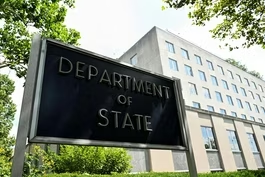
How diplomat recall fits into Trump's foreign policy shift
Video has Closed Captions
Clip: 12/23/2025 | 7m 28s | How recall of career diplomats fits into Trump's foreign policy shift (7m 28s)

How 'Trump accounts' for children work, and who will benefit
Video has Closed Captions
Clip: 12/23/2025 | 8m 32s | How 'Trump accounts' for children work, and who will benefit most (8m 32s)
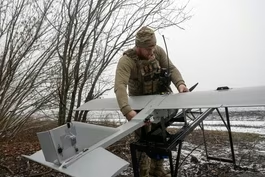
Inside look at Ukraine's high-profile drone strikes
Video has Closed Captions
Clip: 12/23/2025 | 5m 39s | Inside the Ukrainian drone unit responsible for high-profile strikes (5m 39s)
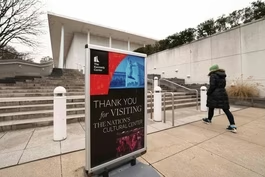
Kennedy Center renaming highlights Trump's reshaping of D.C.
Video has Closed Captions
Clip: 12/23/2025 | 6m 52s | Kennedy Center renaming highlights Trump's reshaping of Washington in his image (6m 52s)
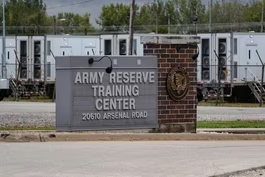
News Wrap: Guard deployment to Chicago blocked for now
Video has Closed Captions
Clip: 12/23/2025 | 4m 30s | News Wrap: Supreme Court blocks National Guard deployment to Chicago for now (4m 30s)
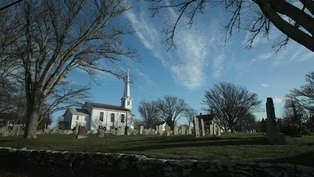
Rhode Island town says it inspired 'It's a Wonderful Life'
Video has Closed Captions
Clip: 12/23/2025 | 5m 22s | How a small town in Rhode Island is connected to 'It's a Wonderful Life' (5m 22s)
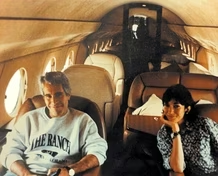
Where Trump is mentioned in latest Epstein files release
Video has Closed Captions
Clip: 12/23/2025 | 4m 50s | What the latest Epstein files release reveals, and where Trump is mentioned (4m 50s)
Providing Support for PBS.org
Learn Moreabout PBS online sponsorship
- News and Public Affairs

FRONTLINE is investigative journalism that questions, explains and changes our world.

- News and Public Affairs

Amanpour and Company features conversations with leaders and decision makers.










Support for PBS provided by:
Major corporate funding for the PBS News Hour is provided by BDO, BNSF, Consumer Cellular, American Cruise Lines, and Raymond James. Funding for the PBS NewsHour Weekend is provided by...