State of Affairs with Steve Adubato
Dr. Benjamin Dworkin; Mike Hellstrom; Steve Beatty
Season 10 Episode 5 | 27m 33sVideo has Closed Captions
Dr. Benjamin Dworkin; Mike Hellstrom; Steve Beatty
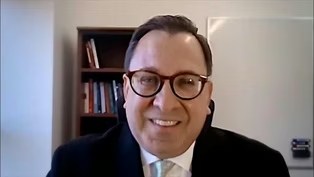
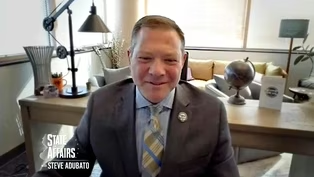
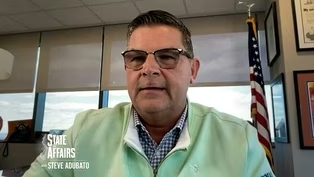
Dr. Benjamin Dworkin, Director of the Rowan Institute for Public Policy & Citizenship, about Governor Sherrill’s affordability agenda and last-minute spending. Mike Hellstrom, VP & Eastern Regional Manager of LIUNA, examines the importance of the Gateway Tunnel Project for the region’s success. Steve Beatty, President of the NJEA, discusses challenges facing the education sector.
Problems playing video? | Closed Captioning Feedback
Problems playing video? | Closed Captioning Feedback
State of Affairs with Steve Adubato is a local public television program presented by NJ PBS
State of Affairs with Steve Adubato
Dr. Benjamin Dworkin; Mike Hellstrom; Steve Beatty
Season 10 Episode 5 | 27m 33sVideo has Closed Captions
Dr. Benjamin Dworkin, Director of the Rowan Institute for Public Policy & Citizenship, about Governor Sherrill’s affordability agenda and last-minute spending. Mike Hellstrom, VP & Eastern Regional Manager of LIUNA, examines the importance of the Gateway Tunnel Project for the region’s success. Steve Beatty, President of the NJEA, discusses challenges facing the education sector.
Problems playing video? | Closed Captioning Feedback
How to Watch State of Affairs with Steve Adubato
State of Affairs with Steve Adubato is available to stream on pbs.org and the free PBS App, available on iPhone, Apple TV, Android TV, Android smartphones, Amazon Fire TV, Amazon Fire Tablet, Roku, Samsung Smart TV, LG TV, and Vizio.
Providing Support for PBS.org
Learn Moreabout PBS online sponsorship- [Narrator] Funding for this edition of State of Affairs with Steve Adubato has been provided by NJ Transit.
Your ride to the world’s game.
The New Jersey Economic Development Authority.
New Jersey Manufacturing Extension Program.
South Jersey Industries.
The parent company of South Jersey Gas, and Elizabethtown gas.
Robert Wood Johnson Foundation.
Working to create a future where health is no longer a privilege, but a right.
New Jersey Sharing Network.
The Port Authority of New York and New Jersey.
Moving the region through air, land, rail, and sea.
And by Garden State Initiative Promotional support provided by Insider NJ.
And by NJBIA.
We put business at the center.
[INSPRATIONAL MUSIC] - Hi, everyone, Steve Adubato, everything you need to know about public policy, citizenship, and politics.
With our good friend Dr.
Ben Dworkin, Director of the Rowan University Institute for Public Policy and Citizenship.
Rowan University, one of our higher ed partners.
Good to see you, my friend.
- Good to see you, Steve.
Thanks for having me back on.
- You got it.
We're doing this on St.
Patrick's Day.
It'll be seen later March 17th.
Rate Governor Sherrill.
Even though she's only given her state of the state and her budget address, and now the fun begins with the legislature working out the details of this budget.
How's she doing so far?
- Oh, I think she's doing quite well.
So I'd give her eight and a half, nine.
I mean, I'm sure there are always hiccups at the beginning, but she's done, I think, the key things that she needed to do in these first few months.
She avoided major tax hikes despite the $3-billion budget shortfall.
She has focused, public... Her messaging has been focused on energy prices and affordability overall.
So, you know, it's very early, obviously, but I think this is... She's off to a good start.
- By the way, go on our website, steveadubato.org.
We're doing a half hour with Governor Sherrill on a whole range of important issues impacting the nine million citizens of the great state of New Jersey.
Ben, here's the thing I keep thinking about.
The governor comes in and there's a new sheriff in town.
That expression is real in this case.
She wants to change the way the state spends money.
She also wants to change the way state legislators, you know where I'm going, add on to the budget.
A lot of money last year, many, many hundreds of millions of dollars for pet projects.
Full disclosure, as a former state legislator back in the '80's, yes, I got pet projects into the budget.
Yeah, like a bus for senior citizens in one of the towns I represented.
School aid for a community in my hometown of Montclair that was desegregating their schools and they needed transportation.
What is a pet project or pork to one is important to constituents, citizenship, which you are into at the institute, for another.
Is it all bad, Ben?
- Absolutely not.
And I think you gave a good example.
What these legislators will try and say: "Listen, I have this nonprofit "that needs a little extra cash "because they need a new route, "but they do really good work."
Or, "I need a bus," like you talked about, "to help with senior citizens."
These kinds of projects are small.
But they add up.
- They add up.
- And what happens is that the good side is, A, they are almost exclusively for good things.
If you lived in that community, you'd see it as a positive thing.
Also, importantly, they relate to politics.
Because as you know as well as anybody, Steve, when you are putting together the numbers, the coalition to pass legislation, you need 41 votes in the Assembly, 21 in the Senate.
And sometimes in order to get those votes, you need to give a little here.
Like, "Okay, we need you to take this tough vote "because it's what's important to the state.
"We need to push this agenda."
And that legislator says, "Well, yeah, "so help me out in my district "with this extra piece of spending "that's going to a good cause."
And so if we eliminated all of that, I think, you know, we'd have a much tougher time legislating.
What is of concern to the governor here is clearly the under-the-radar nature that these spending bills have been done, the manner in which they're done.
The: "We are not gonna tell anybody until months later."
That kind of legislating is something that I think she's gonna be focused on, but the spending itself is not necessarily a bad thing at all.
- One more thing on this, and we'll get off it.
Just remember: when I was in the legislature, the Democrats were in control of both houses, I happened to be a Democratic legislator.
All those Christmas tree items, all those special spending items?
They went to Democrats.
That hasn't changed in many years.
Point being: the party in power in the legislature gets most of those projects.
It's not as if Republican legislators in their districts don't need projects.
They just don't get them 'cause they're not in control.
All right, Ben, I'm gonna move on.
Let's try this.
I keep thinking about Hurricane Sandy and a Republican governor, Chris Christie at the time, supporting Mitt Romney running for president against Barack Obama, but then welcoming Barack Obama to the Jersey Shore.
Whether it was a hug or not, I don't really care, but they treated him with respect, the whole bit.
He needed help from the feds to help New Jersey in a crisis.
Talk about Governor Sherrill's relationship with President Trump and why that matters so much.
- It's a balancing act, and it was a balancing act for former governor Phil Murphy, who had to deal with the Trump administration, certainly in the beginning part of his term, and it's gonna be a balancing act for Mikie Sherrill.
You have, at the same time, the state of New Jersey, like every state, relies on the federal government, relies on the federal government bureaucracy.
Tremendous, millions, tens of millions, hundreds of millions of dollars, billions even in funding that comes to New Jersey.
And to have a very sour relationship that leads to vindictiveness from the federal side, because they're the ones providing the money, that says we're gonna block it, as we've seen with the critical Gateway Tunnel Project?
That's a huge problem.
So you have to, I think what Phil Murphy did, what Mikie Sherrill, what we expect her to do, is you fight where you need to fight.
And beyond that, you don't go out necessarily picking fights.
You don't go out necessarily trying to stick, you know, your finger in the eye of the federal administration, the Trump administration.
Because you obviously need to work with these folks, and that won't necessarily make that process easier.
But when you have to take them to court, you take 'em to court.
- Yeah, and here's what's interesting.
This is gonna wind up in the courts if it ever moves forward, and Ben knows this.
The governor talks about affordability.
Huge issue across the state.
One of the things she's talking about now is the potential of merging, consolidating school districts.
Because there are too many school districts, and some of them have administrators with a very small number of students.
Some of 'em have way too many people on the staff, if you will.
Way too many schools.
Point being: should the governor force consolidation and merging of smaller districts?
Or should she, once again, as most governors have done, say, "It would be a good thing if you did it, "and you might get some extra state aid."
Because, Ben, in the end, most people want their own school district, but they also want to keep property taxes down.
And that doesn't add up.
- Yeah, this is, look, Bill Clinton famously said: "If it were easy, it would've been done by now."
- That’s right.
- It's not an easy question.
Which is why every governor up through this point has been unable to really.... Floats the idea of forced regionalization and then retracts.
So you have a situation now where I think Mikie Sherrill is looking for cost savings by regionalizing curriculum, having the standard curriculum among all the different districts that send to a regional school system.
That might save some dollars.
You're talking about state senator Vin Gopal, Democrat, head of the Education Committee, putting in any number of bills where we have tiny, tiny districts, you're talking about 400 kids in the entire district, merging with others because both of them are paying for, you know, directors of curriculum, an extra principal, et cetera.
So you have these things.
I think it's finally coming to a head.
We'll see how much savings actually cover this.
The smallest districts spend the least amount of money, but there's still potential savings there.
And I think this is part of a larger discussion that's gonna be had, in which they're really, they, the Sherrill administration, are seriously thinking about forced regionalization to just move the ball forward.
- We'll continue that conversation with Professor Benjamin Dworkin, Director of the Rowan University Institute for Public Policy and Citizenship.
It's an important public policy question.
It impacts everyone in the state.
Thank you, my friend, we'll talk soon, Ben.
- Thank you so much, Steve.
- You got it.
Stay with us, we'll be right back.
(grand music) - [Announcer] To see more State of Affairs with Steve Adubato programs, find us online and follow us on social media.
- We're now joined by Michael Hellstrom, who is Vice President and Eastern Regional Manager of the Laborers' International Union of North America.
Good to see you, Mike.
- Same here, Steve.
Good.
Thanks for having me.
- Couple things here.
The organization, describe it, and LIUNA is the acronym, right?
- Yeah, Laborers International Union of North America represents 530,000 construction workers across America and Canada, 40,000 of them right here in the Eastern Region, 25,000 here in the state of New Jersey.
- And you have been a member since '84, 1984?
- Yeah, from a very young age of 17 years old, I joined my union, and proud member for about 42 years and counting.
- Well done.
Also, thank you for your service in the Navy.
- Oh, thank you.
- 1985 to '89, Somalia and the Persian Gulf.
Thank you very much for your service, Mike.
- Yeah.
- Hey, Mike, we had on the Governor today, and by the way, go on our website, SteveAdubato.org, look for the half hour with the Governor.
Big chunk of that was about Gateway.
Mike knows a little bit about Gateway.
Mike, describe the Gateway Tunnel.
Also Kris Kolluri, head of New Jersey Transit, talking about it as well.
From your perspective, what is the economic /employment implications of all these stops and starts at the Gateway Tunnel?
We're taping on the 17th of March.
It is in fact St.
Patrick's Day.
Pick it up from there, Mike.
- Yeah, look, it's the biggest infrastructure project in America.
I mean, it's vital to not just New Jersey's economy, but really, the Northeast economy and America's economy, right?
If the tunnels were to fail, right, you know, being 112, 115 years old and they were to fail, it could impact 20 to 25% of America's GDP, which I just think is an alarm bell for America to understand that this is a big project that needs to be built right now so that we don't have a catastrophic event happening that could impact the economy all across America, especially here in the Northeast.
And look, thousands of our members are anticipating this project from the days back in the Christie Administration when it had a first false start 17 years ago, trying to get this project going.
And finally, here we are with shovels in the ground and getting ready to bore tunnels, and, you know, we have an administration in Washington, D.C., that just wants to play games with infrastructure.
That is not a partisan issue.
It's an American issue, and this is vital to the American economy, especially here in New Jersey and the New York area.
- Explain to folks, Mike, what happens every time there's a halt.
Say the Trump administration again says, "Listen, we found another reason to stop this."
I know the courts got involved last time, but when it stops, explain to folks, Mike, what that really means to people's lives.
- Yeah.
First of all, you know, when you stop a project, you are essentially wasting millions of dollars because all of the progress that has been completed up to the point of the stoppage, you then have to secure all that work.
You just cannot abandon the site and just walk away from it.
So all that progress just has to be tidy too, that costs a lot of money to do, and then to restart the project and really get those contractors to come back, remobilize, get all that manpower back to the project, and hopefully, that manpower didn't go off to other projects because, you know, working people wanna work, right?
They just don't wanna sit on the sidelines and wait.
They'll go out and find another job.
And that could impact contractors' ability to find skilled hands to be able to perform the work that needs to be performed.
So the cost overruns are just a waste of taxpayer dollars and just a waste of resources when we should be building the biggest infrastructure project here in America.
- Mike, are you and your colleagues with the Laborers' and others involved in this, including the Governor, and we talked about Kris Kolluri at New Jersey Transit and others, are you waiting for more... Are more federal dollars supposed to be coming?
- Yeah, so this project is funded by a $6.5 billion grant from really the United States Department of Transportation, the biggest federal grant that has ever been granted towards any kind of infrastructure project in America.
That's the magnitude of the grant.
And then both New Jersey and New York are coming up with the other essentially 50% of the $16 billion that we'll take to build two new tunnels and rehab the two existing tunnels.
So it's a bi-state partnership between New Jersey and New York with the federal government as a partner in it.
And so it's a three-way partnership.
Both states are gonna put up their money.
The federal government has to put up their money, and this is something that Congress has already allocated the money to.
So we don't need any further approvals.
We don't need anything other than the federal government just sending its money to the Gateway Development Commission so that it can continue to work and build these tunnels out.
- You know, Kris Kolluri said to us, what's interesting is that, and again, Kris is the former head of the Gateway Corporation, so he understands it well, and he negotiated a lot of these deals, right, Mike?
- Yeah.
- With the feds.
He said to me, "Steve, the President, and no one else in the federal administration is saying the project's not worthy.
They're not saying that at all.
They're coming up with issues having to do with DEI, or it's wasting.
I'm not sure what the issue is."
Is it clear to you, Mike, that there's a rationale for any of these, the feds stopping?
Is there any rationale, other than we have the right to do it, so we're doing it.
Take us to court.
- No, absolutely not.
I mean, I think that the government, you know, look, the Trump administration's desire to play politics here with critical infrastructure, it's an insult to us as working people.
It should be an insult to commuters.
It should be an insult to people that rely upon that infrastructure to get to and from both either New York and New Jersey.
He's toying around with it just because he can.
There is no issue here that should stop the federal government from funding this project.
As I said, Congress has already allocated the money, and when Congress allocates the money, that's the power of Congress to spend.
And the President only has to send the money.
That's all he has to do here, but he's doing it really for political purposes.
- I'm gonna put you on the spot, Mike.
I bet a fair number of your of laborers, right, voted for the President, a fair number.
- Yeah.
- 'Cause I think that's true in a lot of organizations, including organized labor.
How clear is it to them that there's no reason for this to be done, and they didn't vote for the president to be president to do something like this?
- Yeah, I think you're exactly right.
I mean, definitely they are definitely seeing that this is not what they voted for.
They may have voted for other things that Donald Trump- - Yeah, there are whole bunch of reasons - He had campaigned on, but they definitely did not vote to become unemployed.
And as such, when the shutdown was getting ready to happen, you know, we had those interviews and face-to-face conversations with our members, and they literally told us from really their own voices that, "Look, we may have voted for him, but we surely didn't vote for this," right?
And it's almost essentially that Donald Trump doesn't want to build big, beautiful things, right?
This is not an American-first agenda.
And you know, if we had one message to the President, it would be fulfill his obligation as President and do big, beautiful things in this country.
And building the Gateway Tunnel project is one of those big, beautiful things that he could be building.
- Mike Hellstrom is Vice President and Eastern Regional Manager of the Laborers' International Union of North America, otherwise known as LIUNA.
Hey, Mike, thank you.
It won't be the last time we have you.
We'll keep talking about this.
A hugely important project.
Thank you, Mike.
- Thanks very much.
I appreciate being here.
Thank you.
- You got it.
Stay with us.
We'll be right back.
(grand music) - [Announcer] To see more State of Affairs with Steve Adubato programs, find us online and follow us on social media.
- We're now joined by Steve Beatty, who is president of the New Jersey Education Association, a longtime supporter of public broadcasting and our programming at Caucus Educational Corporation.
Steve, good to see you.
- Steve, always a pleasure.
Thank you for having me.
- We interviewed the governor today.
We're taping on the 17th of March, St.
Patrick's Day.
It'll be seen later.
Big part of that discussion was about fiscal matters.
One of the things we didn't get into that I want you to talk about is what is your understanding of the governor's position, her policy as it relates to public employee pensions and health benefits and the role of the state government in financing those?
- Yeah, thanks for that question.
First of all, it's important, the pensions, we know, and we're thankful that she's made the commitment as she promised to fully fund the pension, because that is something that we just cannot go on without.
As public employees, as a high school teacher myself for 25 years, I know I put my time in and that all educators deserve to be able to retire.
So we're very thankful that she has committed herself to the full pension payment.
Healthcare is another issue, right?
We all look at this situation involving just spiraling costs on the supply side.
And again, that's no fault of our public employees in that regard, but we need to make sure that we can find a way to work together, as we've always done, to ensure that all our public employees get good high quality healthcare, and that the costs aren't just passed on to us.
- And you don't control, it's not my job to explain your position, but you don't control healthcare costs.
-Correct.
- Health insurance companies, they establish those rates.
Right?
And so right now, is there a percentage that teachers pay of their own health benefits?
Is all of it paid by the state?
What is it?
- Yeah, so years ago under Chris Christie, we had our chapter, so health benefits were, when I first started teaching in 1993, health benefits program were part of the package, right?
Now it's part of the package, and you know, during the administration, you know, we were hit with now an increasingly high levy under what we call Chapter 78.
Which meant employees paid a percent of the premium, which has skyrocketed.
And that's, we saw what we call net negative, meaning we would get raises, but the raises would be chewed up by the increase in premium.
So Chapter 44, which we negotiated several years ago, disconnected that, and now we pay a percent of our salary towards our healthcare premiums.
- Got it.
Shift gears on this.
Talk to us about teacher recruitment and retention during these challenge times.
- Yeah, that's a big thing.
I mean, I knew when I was growing up and in third grade when I had Miss Zane, I knew I wanted to be a teacher.
The greatest job, she had all the chalk she could ever hope to have, you know, and I thought, "That's what I want to be."
And that's all I did.
So when I went to college at Rutgers, go RU, I became a teacher, right?
And you know, the recruitment wasn't an issue, but for a lot of reasons, but I'll also specifically single out healthcare, pensions, and our salaries, it's been a big drag.
I mean, we've seen the numbers drop precipitously.
You can look at any metric where the enrollment and the college prep are down.
We're losing teachers and educators all around the state because on the new pension system, they have to teach or work until they're 65 years old to get a savings account.
So among other things, the workload, the respect, the things that go on, but all of sudden that pensions, that benefits are a big reason why we're having recruitment and a retention problem.
- So what are the implications of that, Steve?
- The implications of that, we're, you know, we're struggling to maintain what's been a stellar workforce among, if not the number one public schools in the nation year after year after year, where we have a great cohort of the best and brightest that go into public education.
But now, when you see someone that says, "Hey, I can start at a salary that's better than a first year educator and get bonuses and maybe even work from home two, three, four, five days a week."
It's tough to compete to get those types of, again, the best and brightest into all our positions, whether classroom teachers, ESPs, or anything in between.
- You know what's tricky about this?
I live in the town of Montclair.
You know it well, right?
Right now, as we do this program, there was just a couple referendums on the ballot.
I don't know what's gonna happen.
- Yeah, they're closing two schools.
Yeah.
- And one of the emails we got as taxpayers in town, was about teachers potentially losing their jobs.
- Yeah.
- So is it become more of a reality, Steve, that as budgets get tighter locally, public school teachers are more at risk?
- Yes.
And not just the teachers, it's educators overall, because we're losing ESP (indistinct), losing bus drivers, custodians, we're getting outsourcing.
So the short answer is yes.
I mean, we're the canary in the coal mine.
When budgets get cut and things happen, we're the first ones to really feel the pinch of that.
By losing jobs, class sizes going up, which really hurts everybody, 'cause really, we all believe in the same thing.
And again, as a career educator, classroom teacher, every single student deserves a great quality public education delivered by a great educator.
And we're seeing that at risk.
We talk about budgets, and again, I'm biased.
There should never not be enough money for public schools.
And my poster on the wall, you can't quite see over here, says, from the 70s when I was growing up, "I long for the day when schools have every dollar they need, and the Air Force has a bake sale for a bomber."
Because it's about priorities.
And that's really we're showing our future generation of kids, and our educators, that the priorities just aren't there for them.
- So let's keep talking about money, in the couple minutes we have left.
The school funding formula.
Everybody, virtually everyone, Steve, "The formula has to be fixed.
The formula has to be revised."
And by the way, right after you, we have the Republican budget officer in the Senate, Declan O'Scanlon, Senator O'Scanlon.
I'm gonna ask him that question.
You're gonna say "Reform it," I'm gonna say "How," and then the conversation gets murky.
- It does.
- How?
Does it need to be reformed, Steve, does it need to be reformed?
- Listen, it's 18 years old, right?
2008.
So it's always time to look at something after that period of time.
I mean, the good news is after years of being underfunded, you know that Governor Murphy upped the funding there, Governor Sherrill now, again, with record funding.
So, but it is a factor of looking at the formula.
And there are a lot of, in 2008 when the formula was divined, there are a lot of things now occurring today that weren't back then.
Special education costs, English language learners, geographies, so many vagaries that have now impacted on the ability for the formula to deliver.
So I think it's always a good time.
We were more than willing.
And I sat on the governor's transition team, and we were more than willing and able to sit with her and her team and look at, you know, any kind of recommendations for modifications or changes.
- Before I let you go, one minute left.
You became a teacher, public school educator, because?
And don't say that she had a lot of, what was your teacher's name?
- Miss Zane.
- What school?
Where?
- No, that was at Seth Boyden School in Maplewood, New Jersey.
- I love it.
It wasn't the chalk, what was it?
- You know, it was just the idea of embracing the students and being seen, I felt, in her class.
And it's something that was always my hallmark, my first job, and I won't, you know, was in Westfield in an alternative school.
And I learned very quickly, if you're an authentic person, if you get kids to buy in, that you can do anything with them and they will work for you.
So that's really what it's about.
That I really had a drive to try to reach kids, to make sure they felt seen, they felt respected.
And let's go from there and see what we can do and what your potential is and how we unlock that.
- Hey, Steve, we're glad that you did that.
And also to you and all of the educators and those connected to education at the NJEA, we thank you for your service every day.
Thank you, Steve.
- Appreciate that.
Appreciate you.
Thank you so much.
- I'm Steve Adubato, that's Steve Beatty from the New Jersey Education Association.
We'll see you next time.
- [Narrator] State of Affairs with Steve Adubato is a production of the Caucus Educational Corporation.
Funding has been provided by NJ Transit.
The New Jersey Economic Development Authority.
New Jersey Manufacturing Extension Program.
South Jersey Industries.
Robert Wood Johnson Foundation.
New Jersey Sharing Network.
The Port Authority of New York and New Jersey.
And by Garden State Initiative Promotional support provided by Insider NJ.
NJBIA.
- Next, please.
Okay, we need a neutral expression.
Sir, you're smiling.
- Oh, am I?
- [Narrator] Over 1 million lives in the US have been saved by organ donations.
So when you choose to become a donor, you're doing something good, which can make you feel really good.
- Next.
(woman sighs) - [Narrator] Register today at NJSN.org.
 New
NewExamining Governor Sherrill’s affordability agenda
Video has Closed Captions
Clip: S10 Ep5 | 10m 28s | Examining Governor Sherrill’s affordability agenda (10m 28s)
 New
NewPresident of NJEA discusses challenges facing education
Video has Closed Captions
Clip: S10 Ep5 | 8m 54s | President of NJEA discusses challenges facing education (8m 54s)
 New
NewVP of LIUNA examines the Gateway Tunnel Project
Video has Closed Captions
Clip: S10 Ep5 | 8m 57s | VP of LIUNA examines the Gateway Tunnel Project (8m 57s)
Providing Support for PBS.org
Learn Moreabout PBS online sponsorship
- News and Public Affairs

Top journalists deliver compelling original analysis of the hour's headlines.

- News and Public Affairs

Today's top journalists discuss Washington's current political events and public affairs.











Support for PBS provided by:
State of Affairs with Steve Adubato is a local public television program presented by NJ PBS