
Athens: Birth of Democracy
Season 53 Episode 8 | 53m 40sVideo has Audio Description
Archaeologists investigate the dramatic origins of democracy in ancient Greece 2,500 years ago.
Follow archaeological investigations into the dramatic origins of democracy in Greece 2,500 years ago. Mass graves and ancient ruins where tyrants were murdered shine new light on the birth of a revolutionary form of government.
See all videos with Audio DescriptionADProblems playing video? | Closed Captioning Feedback
Problems playing video? | Closed Captioning Feedback
National Corporate funding for NOVA is provided by Carlisle Companies. Major funding for NOVA is provided by the NOVA Science Trust and PBS viewers.
Support provided by:


Athens: Birth of Democracy
Season 53 Episode 8 | 53m 40sVideo has Audio Description
Follow archaeological investigations into the dramatic origins of democracy in Greece 2,500 years ago. Mass graves and ancient ruins where tyrants were murdered shine new light on the birth of a revolutionary form of government.
See all videos with Audio DescriptionADProblems playing video? | Closed Captioning Feedback
Where to Watch NOVA
NOVA is available to stream on pbs.org and the PBS app.
Buy Now
NOVA Labs
NOVA Labs is a free digital platform that engages teens and lifelong learners in games and interactives that foster authentic scientific exploration. Participants take part in real-world investigations by visualizing, analyzing, and playing with the same data that scientists use.Providing Support for PBS.org
Learn Moreabout PBS online sponsorship♪ ♪ NARRATOR: Athens, Greece.
Here, 2,500 years ago, a bold political experiment took place.
For more than a century, archaeologists and historians have been investigating this crucial period, when for the first time in recorded history, elite rulers shared power with humble citizens.
Inventing a new form of government: democracy.
PAUL CARTLEDGE: The ancient Greek word "demokratia" is two words put together: "demos," "kratos."
Demos is the people.
Kratos meant power, strength, force.
NARRATOR: What led to it?
How did it work?
And why did those in power allow it?
Today, researchers are finding new clues to answer these questions and more.
That's a smoking gun.
NARRATOR: Conducting hands-on experiments to decode ancient texts, understand evidence from the ancient ruins... ...and learn how this first democracy protected itself from tyranny, civil war and corruption.
PANAYOTIS ZESTANAKIS: It's a black one.
NARRATOR: Piecing together the epic story that laid the foundation for today's democratic societies.
"Athens: Birth of Democracy."
Right now, on "NOVA!"
♪ ♪ ♪ ♪ NARRATOR: In the heart of Athens, the capital of Greece, rises the Acropolis.
A rocky outcrop where the Parthenon stands.
Built 2,500 years ago, during a time of cultural and political upheaval... (blade unsheathing) ...that gave birth to the first democracy of western civilization.
For more than a century, archaeologists have been excavating at the foot of the Acropolis.
Because this is where many historians believe the Athenians invented a form of democracy that would help inspire the authors of the American constitution.
And in this park are the remains of the Agora: an ancient open plaza, where citizens gathered to decide their own fates.
JOHN CAMP: So it is essentially the center of town where democracy was first practiced and was in use for 200 years.
There's a legislative branch for the people making the laws, there's an executive branch for the magistrates running the city.
NARRATOR: There were also courts making major decisions about the future of Athens.
And all these branches were run mainly by ordinary citizens who were not elected by popular vote, but chosen at random, by lottery, and held their posts for just one year each.
This revolutionary experiment happened at a time when many other societies were ruled by kings, pharaohs or small groups of rich and powerful people.
While commoners had no say in public affairs.
♪ ♪ What sparked this revolutionary experiment?
♪ ♪ One clue might be a recent, disturbing discovery in the southwest of the city at a place called Phaleron.
(machinery beeping) Here, during excavation at a construction site, builders uncovered a vast, ancient cemetery.
Dated between the 8th and 5th centuries BCE, the burial ground contained the remains of Athenian men and women of all social classes.
And in 2016, archaeologists found something gruesome.
About 80 skeletons-- mostly young men in chains, all violently killed, placed side-by-side in three trenches.
Director of excavations, Stella Chryssoulaki, led the investigation into what looked like an ancient mass execution.
(translated): It was something we had never seen before.
Why were they handcuffed?
Why were there fractures at this specific spot on the skull on most of the individuals in this mass grave?
NARRATOR: The high salt content of the sandy soil destroyed any chemical traces that would allow the remains to be precisely dated.
But the designs of two small vases found next to them made it possible to determine when they were buried: the second half of the 7th century BCE.
The find was so unusual, archaeologists and historians immediately wanted to know, what happened here?
For their research, they turned to a vast body of texts copied by hand over the centuries.
At first by the Greeks and Romans, then later by Arab scholars and Christian scribes.
By studying these ancient texts, Stella made a connection with accounts of an attempted coup d'etat that took place in that very period.
In the late 7th century BCE, an Olympic champion, named Cylon, became intoxicated by his own popularity.
He dreamed of becoming the all-powerful ruler, or tyrant, of Athens.
Encouraged by supporters, he decided to seize power by force.
At the time, the city was ruled by an oligarchy: a few wealthy families, each represented by an archon, a magistrate responsible for managing political affairs.
These archons fought back against Cylon and his supporters, driving the coup plotters into the temple of Athena at the top of the Acropolis, where they sought refuge.
(translated): They went inside.
They shut the doors.
(doors clanging) They remained trapped inside.
NARRATOR: Greek religious practice forbade violence against anyone who placed themselves under the protection of a god or goddess.
CHRYSSOULAKI (translated): But they were held for many days.
They began to suffer and starve without food or water.
NARRATOR: The archons promised to keep them alive if they surrendered.
They did not want the men to die within the temple walls; a terrible sacrilege.
To maintain the goddess's protection, Cylon's supporters attached a rope to the statue of Athena and to each other.
What happened as they emerged is debated, but Stella thinks... (translated): One of the archons cut the rope.
And then they were killed.
It was an early form of civil war.
NARRATOR: Some archaeologists think these skeletons could be the remains of those insurrectionists.
Evidence of potential for violence in Athenian society during a time when tyranny was always a threat to the existing oligarchy.
No matter how secure the oligarchs' hold on power, the archons always feared that one of their own, or another charismatic leader from the elite, would rise up as a tyrant and depose them, seizing power for himself.
Which eventually did happen-- about 70 years later, in 560 BCE.
When a tyrant named Pisistratus seized power.
He ruled absolutely.
Eventually passing power to his sons, Hipparchus and Hippias, in a family reign that lasted for decades and ended in violence.
It's a story that's been brought to light thanks to some recent discoveries.
(building crumbling) A few hundred yards from the Acropolis, the clearing of some old buildings has given archaeologists expanded access to an important historical site.
(clanging) John Camp was the director of excavations here in the ancient Agora, for almost three decades.
In the most recently cleared area, he thinks he found traces of a place described in ancient texts... ...where a bloody murder changed the destiny of Athens.
VINCENT AZOULAY: So you think you really find the sanctuary of Leos?
CAMP: We'll see, but I'm interested in your opinion.
NARRATOR: He is eager to share this discovery with historian Vincent Azoulay.
It's quite emotional for me.
You know, I'm glad you're here.
NARRATOR: Vincent studies Athenian democracy.
How it emerged, and how it managed to control the elites, who never fully accepted a political system that gave so much power to commoners.
These are original walls, and those are original walls.
NARRATOR: According to John, they're close to the place where one of the tyrants of Athens was assassinated.
♪ ♪ On this day in 514 BCE, Athens' largest festival was in full swing.
The entire city celebrated the goddess Athena and marched in a grand procession to the top of the Acropolis.
(horses whinnying) Horsemen and infantrymen, musicians and water carriers, priestesses and young girls with offerings, paraded behind several hundred heads of cattle destined to be sacrificed and shared in honor of the goddess.
But during the excitement, the tyrant Hipparchus was attacked by two armed men and stabbed to death.
(blade unsheathing) (screaming, wailing) Ancient historians reported that the murder took place next to a small sanctuary called the Leokorion.
John thinks they've discovered the remains of this historic building.
And this is the best one here because it's got every letter.
It's clear as a bell.
And so, here you can see the epimeletai to Leos.
Dedicated this.
AZOULAY: That's quite convincing.
That's a smoking gun.
NARRATOR: The Leokorion was a sanctuary dedicated to the legendary hero Leos and his three daughters, who agreed to be sacrificed to save Athens from a plague.
Around the side here is another inscription.
AZOULAY: I am really convinced.
(chuckles) Really, for me, it's an emotional moment after working so many years on the subject.
NARRATOR: It seems that John has found where it all started.
Because this assassination triggered a series of events that led to the first democracy.
♪ ♪ But what was that first experiment like?
In search of clues, another team of researchers is investigating some mysterious stone fragments.
(translated): They're arranged like this.
NARRATOR: For a long time, archaeologists have wondered what these ancient pieces of marble were.
But French archaeologist Liliane Lopez-Rabatel and architect Nicolas Bresch have an idea.
(translated): These fragments have remained a mystery for almost a century.
The first archaeologist who found it in 1830 made a replica, with a small caption indicating that he did not know what it was used for, that it might be a clock.
A century later, an American researcher spotted the word "kleroterion" engraved on one side.
In Greek, "kleroterion" means "lottery machine."
(translated): This is what it looks like.
NARRATOR: No intact example of this kind of "lottery machine" has ever been found, only broken fragments.
So they have enlisted the help of sculptor Panayotis Zestanakis to recreate the original object and test their theory.
What we are going to do is experimental archaeology, actually, we are going to use only ancient techniques.
So, this might lead to interesting conclusions.
(translated): So, I'll take another photo of it.
NARRATOR: According to ancient texts, lottery machines played an essential role in Athenian democracy.
LOPEZ-RABATEL (translated): 1,200 annual positions were drawn by lottery.
In fact, a considerable number of people were drawn by lot every day, every month, every year.
NARRATOR: Unlike modern representative democracies, where citizens elect officials to govern, Athens was a more direct democracy, where representatives were chosen from the citizenry by drawing lots.
Liliane and her team want to recreate this early lottery machine and test it with 150 participants, to see how it worked in Athens 2,500 years ago.
When citizens needed a way to guarantee randomized selection to prevent fraud and corruption.
And allow any citizen to participate in public affairs and decision making.
But the road to this form of democracy was not smooth.
A tyrant had been killed.
(blade unsheathing) But what happened next?
What became of the two tyrant-slayers?
(translated): One was killed just after assassinating Hipparchus, and the other was tortured and then executed.
So tyranny didn't collapse, quite the contrary, it became even stronger, because the brother of the man who had been assassinated, Hippias, had survived.
NARRATOR: As a result, this second tyrant, Hippias, became completely paranoid and ruled Athens through terror.
Opponents of his regime were tortured, or executed without warning.
Thrown from a cliff.
To finally end the tyranny and change the destiny of Athens would take a foreign intervention and the arrival of a charismatic reformer.
In 510 BCE, the warrior city of Sparta, Athens' great rival, invaded and caused the tyrant Hippias to flee to Persia, a vast empire stretching from Turkey to Egypt and as far as Afghanistan.
And a major threat to the Greek World.
So when the deposed tyrant Hippias entered the service of the Persian king, Darius I, he became one of Greece's greatest traitors, and is still remembered that way today.
Meanwhile, in Athens, the king of Sparta sought to install a new tyrant, but the Athenians revolted.
And instead, they demanded the return of a respected aristocrat who had been exiled by Hippias.
A visionary named Cleisthenes.
AZOULAY (translated): Cleisthenes was the great reformer of classical Athens.
With the support of the people, and the people leaning on him, he truly laid the foundations of the democratic system.
NARRATOR: Some of the most crucial evidence of Cleisthenes' profound influence comes from a papyrus found at the end of the 19th century, in Egypt.
It features a copy of a text written by the philosopher Aristotle and his students at the end of the 4th century BCE: the Athenian constitution.
This precious ancient document is now at The British Library in London.
Historian Paul Cartledge has come here to examine this one surviving copy of Aristotle's survey of the constitutions of dozens of Greek and Mediterranean cities.
CARTLEDGE: Only one survives.
This is the one.
We don't have it all.
There are bits missing at the beginning and at the end.
NARRATOR: Paul studies the different forms of democracy that have existed throughout history, from Athens to the present day.
For him, this document reveals Cleisthenes as one of the main founders of Athenian democracy.
CARTLEDGE: He had the authority of having always resisted the tyrants, and therefore, he comes back and he's allowed back and he has the aura.
But he comes back, apparently, with a plan.
NARRATOR: Right away, Cleisthenes dramatically expands political participation, giving power to the majority of citizens.
Though the idea of citizenship was limited to adult males with Athenian parents, it was a major shift to expand power beyond those who were born rich.
The majority are poor, and the majority are farmers.
It's a revolutionary situation.
And opponents of Cleisthenes, oligarchs and people who don't like democracy, thought he was much too permissive.
So the notion that the demos-- the people-- is the power holder, that's new, completely new.
NARRATOR: So how did this Athenian democratic experiment work?
On the site of the Agora, archaeologists have found traces of Cleisthenes' major reforms, including the remains of a very special monument.
Here, ten statues of legendary Athenian heroes served as a gathering place for citizens who wanted to learn about the laws being proposed.
All important information concerning the life of the city was posted here.
And you, as an Athenian citizen, could stand out here and you could read these notices, but you couldn't quite touch them.
In the days before radio and television, telephones and newspapers, this is where public information started dissemination.
Were they being prescribed for the army, and how many days rations were they supposed to bring?
Were they involved in upcoming lawsuits?
Were they the subject of public honors?
NARRATOR: The ten statues represented ten tribes, and their makeup was a key part of Cleisthenes' plan to ensure fair and effective representation.
Cleisthenes understood that democracy would only work if he could bring citizens together in new ways.
First, he divided the Athenian territory into three zones: the city, the countryside, and the coast.
Each zone was divided into ten districts.
Each tribe included members from all three zones, with the different districts chosen by lot.
As a result, each tribe would include a mix of citizens who were geographically, or socially, distant from each other.
(translated): It was an absolutely extraordinary mixing of people, which had the effect of breaking up the aristocratic block.
Before, members of the elite could influence political life by relying on a whole clique of people who were dependent on them, especially economically.
But that was no longer possible, because people were now distributed, and distributed randomly.
♪ ♪ NARRATOR: How did Cleisthenes manage to enact such revolutionary reform?
The answer lies 75 miles from Athens, in a legendary sanctuary built on the side of a mountain.
A place the ancient Greeks considered to be the center of the world: the sanctuary of Delphi, dedicated to the god Apollo.
Rich and poor, all recognized the authority of Apollo and came to consult his oracle... ...the Pythia of Delphi.
This woman was the intermediary for the god... ...and so Cleisthenes came to visit her, asking her to randomly choose ten names among a hundred of Athens' founding heroes.
(translated): It was the Pythia of Delphi who, in a certain way, gave her endorsement to this distribution of citizens into ten new tribes, which legitimized what was a true revolution.
NARRATOR: For more than two centuries, the ten tribes of Cleisthenes were at the heart of Greek democracy... ...as was the use of random selection, which became one of the main political tools in Athens.
♪ ♪ In this direct democracy, there were almost no elections, no career politicians running to represent the people.
Most of the civic offices and positions, more than 1,200 in total, were chosen at random each year from a large pool of citizens.
Only a few positions were elected, such as military officers, treasurers, and water supply managers.
And each was elected for a limited term.
CAMP: Democracy for the ancients was not defined by election.
The ancients would laugh at us if we said that's a democratic society.
Election, according to the ideas of democrats, was oligarchy, because it favored the well-known, who would therefore be wealthy, well-born, politically active.
Whereas the lottery randomizes the process, and it doesn't advantage anybody on grounds of their birth, or their wealth.
NARRATOR: The drawing of lots was an obsession, and became a kind of "democratic technology."
But how did they do it?
At first, beans of different colors were used for drawing lots.
But that system could be rigged, and limited the number of people who could be selected.
♪ ♪ In an effort to make the process as transparent as possible, they developed wooden and marble machines, like the one archaeologists are trying to reconstruct, called the "kleroterion."
So how did these machines work?
Liliane Lopez-Rabatel and Nicolas Bresch worked for years to research and design a prototype, starting with clues contained in the papyrus.
According to this text, the names of citizens who were participating in a selection were inscribed on small strips of bronze or wood.
And these were inserted into the grooves.
Then, black and white cubes were mixed up and thrown into a funnel at the top of the machine, where they fell into a tube.
(translated): Based on our studies of the remains and cross-referencing information from the texts, we did some tests.
NARRATOR: The papyrus says the cubes were removed one by one.
If a black cube came out, the top row of citizen nametags were eliminated.
If the cube was white, then the name tags on that row were selected.
The process was repeated as many times as there were rows.
When the process was complete, the selected citizens became the decision makers for whatever matters were at hand.
(translated): What remains a bit mysterious is precisely how the cubes were extracted from the tube.
So we really want to work with the sculptor, Panayotis, to see how we can continue these tests.
(breeze blowing) (birds calling, motor wailing) NARRATOR: On the island of Tinos, 90 miles from Athens, the kleroterion begins to take shape.
(chisel clinking) (blowing) This is where the sculptor Panayotis lives, far from the hustle and bustle of the city.
ZESTANAKIS: One of the most difficult parts of making of the kleroterion is this hole, because it is against the grain of the marble.
It is easy to split the marble in this direction.
(chisel clinking) You can tell that everything is all right, judging with the ear.
If the sound changes, I have to be careful.
(clinking) But as long as this bell noise is the same all over the place, I'm okay.
There are no cracks inside.
If the sound was different from one side to the other... (clinking) there, that would be a problem.
(clinking) It's very dramatic.
(chiseling) NARRATOR: In ancient Athens, these machines could vary in size depending on how many people had to be selected.
♪ ♪ One of the biggest groups they were used for was a council of 500 citizens-- 50 from each of the ten tribes.
This council, made of citizens over the age of 30, was tasked with drafting new laws in preparation for a vote.
They met at the bouleuterion, located in the Agora.
CAMP: So, this is their meeting place.
It held 500 people, and they were here almost every single day, arguing, discussing, debating any proposed legislation that came up.
We have to assume that it was fairly noisy and they presumably sat in tribal contingents.
NARRATOR: Right next door was the Tholos, a circular building that housed the executive government of Athens.
This branch of government was made up of 50 councilors from one tribe.
A rotating group of 17 of them lived here day and night for a month, addressing any urgent matters that came up.
Then, they handed responsibility over to 50 citizens from another tribe, and so on.
This ensured that all ten tribes took part in the most important public affairs.
CAMP: And it is here that the democracy flourished.
This was the center of government.
♪ ♪ NARRATOR: But when it came to making policy decisions and passing new laws, how did this system actually work?
That process took place just a few minutes' walk from the Agora, on the other side of the Acropolis.
Called the Pnyx, this is where all the citizens of Athens gathered about four times a month to vote on laws proposed by the Athenian council.
DIMITRIS PLANTZOS (translated): They were always afraid of tyranny, they were always afraid of a new oligarchic regime; they tried very hard to avoid it.
NARRATOR: Archaeologist Dimitris Plantzos takes his students into the field so they can get a feeling for what it was like to participate in Athenian democracy.
♪ ♪ Here, at the crack of dawn, thousands of citizens would gather.
The chairman of the day, chosen by lottery, would announce the agenda, opening the floor to speakers.
Next came the time for discussion.
According to ancient sources, the debates were often intense.
(indistinct shouting) But eventually, it was time to vote by a simple show of hands.
PLANTZOS (speaking English): The Pnyx signifies the power of the people, the power given to the people, the power exercised by the people.
NARRATOR: To ensure that the poorest citizens and those who worked or lived far from the city could participate, the city paid them a small salary to attend.
♪ ♪ PLANTZOS: An old historian called this moment the invention of politics.
Because this is when people have to come together and decide to work together to make life better for everybody.
NARRATOR: But it wasn't always a friendly gathering.
These fragments tell the story of how the Athenians treated citizens who were seen to be working against the democratic system.
♪ ♪ These pottery shards bear the names of major political figures of the time.
But they were not objects of celebration.
These were "ostraka."
CAMP: They were used by the Athenians to control their politicians.
"Ostracon" just means a piece of pottery, and the process is called ostracism because of that.
NARRATOR: One of Cleisthenes' innovations made it possible for citizens to vote against someone.
(indistinct shouting) Once a year, the citizens' assembly voted by a show of hands on whether they thought their democracy was being threatened by someone.
If a majority voted yes, then the citizens were summoned to the Agora about two months later.
Each citizen brought a piece of pottery, an ostrakon, with the name of the person they thought was responsible and should be banished for ten years.
(translated): What's fascinating about ostracism is that 11,000 ostraka have been found to date, which is absolutely staggering.
And some of the ostraka contain insults.
We have Themistocles, who is called, if you'll pardon the expression, a "sodomite"-- katapugon.
NARRATOR: For this great unpopularity contest, at least 6,000 voters out of 20,000 to 40,000 citizens had to agree.
An ostracized individual would then be banished from Athens' borders for ten years.
(translated): The ostracized person didn't lose their citizenship or the income from their property.
So there was a whole series of guarantees that limited arbitrariness and explained why the ostracized never turned against the Athenian city.
And that was absolutely crucial, because ostracism ensured that the elites conformed to the expectations of the people.
NARRATOR: The Athenians were determined to find ways to keep the citizens united and protect democracy.
But external threats also brought the people together.
In the early fifth century BCE, a Persian invasion led Athens to build a fleet of 200 warships called triremes.
The effort to build and crew the ships united its citizens.
It's a lesson that still resonates today.
This replica of an ancient warship belongs to the Greek navy.
It is only used on special occasions.
Inside, rowers sit on three different levels, the source of the name "trireme."
(captain yelling indistinctly) This one was reconstructed by British archaeologists in the 1980s based on ancient texts and carvings.
CAMP: The creation of the fleet changed the society.
Up until now, Athens had been a land power and had fought with perhaps 10,000 heavily armed foot soldiers.
Now they suddenly had 200 ships, each one needing 170 rowers.
So, we're talking about tens of thousands of Athenians who had to participate to be a success.
NARRATOR: Unlike Roman galleys, which were mainly manned by slaves, Athenian triremes were operated by citizens.
The citizen rowers were organized into teams corresponding to the ten tribes created by Cleisthenes.
(translated): This was one of those places of political and social mixing that democracy brought about.
People who lived together and risked their lives together.
We could therefore say that essentially, the Athenian democracy is a rowing democracy.
NARRATOR: But of course, there was a dark side to Athenian society.
The rights of citizenry were not universal.
(man speaking non-English language) (equipment rattling) 40 miles southeast of Athens lies a maze of more than 100 miles of underground tunnels.
These are the silver mines of Lavrion.
Over the centuries, countless enslaved people, including children, worked in these mines.
ALBERIC NEGRO (translated): Look at this.
Look here.
If you crawl forward, you can rest your elbows and knees.
And these are the traces left by the elbows and knees of people who came to dig these tunnels.
Now we can really see it, it's extraordinary.
It's visible there.
NARRATOR: To investigate these tunnels, archaeologists rely on specialists who understand the dangers here.
Jacky Klosset is a speleologist and also a former miner.
(translated): The most difficult thing in these tunnels: we're on all fours the whole time.
We move around like lizards with bellies to the ground.
It's hard to advance, so how did they manage?
In my opinion, there must have been many, many deaths in these galleries.
It's a grueling job.
Imagine, in a gallery like this, for six, seven, eight hours, half-naked.
♪ ♪ NARRATOR: An ancient painting shows that child slaves like the ones in Lavrion, worked in mines.
Often a young worker accompanied an older one.
♪ ♪ Outside, archaeologists have discovered outlines of their undersized footprints.
ANDREAS KAPETANIOS: It could be that these two people, these co-workers, would rest after a very harsh day, and make the outlines of their feet with the tools they had in hand.
And this is for eternity.
Archaeology allows us to approach these people of the past who are silent in written sources.
But the questions, such as how many slaves were active in Lavrion is very, very difficult to be answered.
But there is one answer to that, which is, "too many."
And by too many, is tens of thousands.
NARRATOR: The landscape of Lavrion was completely transformed by ancient mining.
The ruins of industrial facilities that were set up to wash and clean the ore are still visible today.
KAPETANIOS: There are 2,500 hectares of dense archaeological buildings like this in Lavrion.
That's why Lavrion is unique.
NARRATOR: The slaves of the Lavrion mines powered the development of the Athenian economy.
Most were prisoners of war who had been bought in markets, or were the children of slaves.
It is estimated that slaves in Athens outnumbered citizens by about two to three times.
In antiquity, many societies in this region, regardless of their political structure, relied on slavery to some extent.
But in Athens, a specific group of slaves was at the very heart of the democratic system.
(translated): The Athenians called them the "demosioi", the public slaves, the slaves who were property of the "demos," the people of Athens.
They were not very numerous, perhaps between 1,000 and 2,000, not much more.
They had different functions.
Among them, were archers, who were scythians, who performed policing duties in the city.
NARRATOR: Even the policemen were slaves.
Many positions in the bureaucracy were filled by these demosioi.
Archivists, clerks, accountants, coin inspectors, as well as assistants to the council, the citizens at the Pnyx, and the courts.
These public slaves were treated better than the slaves in the Lavrion mines.
They ensured the continuity of the state, while the citizens who served in government were temporary, usually with only a one-year term.
Those were the citizens selected with a lottery machine.
♪ ♪ Super.
Wonderful.
It's very nice.
(chuckles) I'm glad... I'm very happy.
NARRATOR: Panayotis has almost completed his project.
Liliane is testing the kleroterion, the dice, and the funnel... (clattering) ...as well as the mechanism designed by Panayotis to remove the dice one by one, using two bronze pins.
Very nice.
We could be doing this all day.
(laughs) It seems to work well.
NARRATOR: He is fine-tuning the last details.
(chiseling) In a few days, the machine will be transported to Athens for its inauguration.
It's time for the first full-scale test in the Agora of Athens.
A unique archaeological experiment to test how these randomizing selection machines might have worked.
(indistinct chatter) Liliane and Panayotis' team have brought together dozens of high school students.
(indistinct chatter) So, we are pleased now to reveal the result of this work.
("wow"s and applause) So now, imagine you are in Athens in the fourth century BC.
You are the citizens of this democratic city.
NARRATOR: Back in those days, every morning, citizens gathered at dawn to be chosen by lot to serve as jurors for the day's trials.
The random lotteries helped prevent corruption of the jury, since no one could know in advance who'd sit in court that day.
The procedure was visible to all, guaranteeing that there would be no cheating.
This is a very important aspect of the machine.
No cheating is possible.
NARRATOR: To start, each participant hands over their name tag.
(shaking) The boxes are shaken to thoroughly mix them.
Then they are inserted into the kleroterion.
And the lottery begins.
CHANKOWSKI: We need four light and 26 dark.
NARRATOR: In this trial, they want to choose 20 people, which means picking four rows.
So, Panayotis inserts the four shiny light dice and 26 black dice into the machine.
(clattering) Then, he removes them one by one.
ZESTANAKIS: It's a black one.
NARRATOR: If a black die comes out, the top row of nametags is eliminated.
CHANKOWSKI: The first row is black, the names are not selected.
The second one is a white one.
NARRATOR: If it is a shiny die, the line is selected.
"Kallikydis Aigilieus."
CHANKOWSKI: Kallikydis?
NARRATOR: And five people are then called to serve as jurors.
Come, come, come.
Kallikydis.
(cheers and applause) CAMP: Right in here.
So, she is the first selected.
Vita Pausanias Leukonoes.
CHANKOWSKI: Where are you?
(applause) Pyxikratis Prospaltios.
(applause) (translated): We have completed the draw, all the lots have been drawn.
We have selected 20 jurors for the people's court of the democratic city of Athens.
(speaking English): Congratulations.
(applause) (translated): I'm really very pleased with the outcome of this experiment.
I feel relieved, tired, but truly satisfied.
NARRATOR: For the ancient Greeks, true democracy only worked through the extensive use of random selection.
Citizens voted on the laws that would govern them.
The absolute grip of the powerful was broken.
(indistinct shouting) But are we really sure that democracy originated in Athens at that time?
Were there other precedents?
(translated): People gathering together, people legislating together, we have known this for a long time, certainly since the Assyrian world.
We also find this in other communities.
NARRATOR: For example, cuneiform tablets have been found that mention that 3,800 years ago in what is now Iraq, there were assemblies of notables who designated one of their members by lot as mayor of the city, every year.
(translated): But for the Greeks, democracy was not just that.
It was also about controlling the elites.
In other words, it was about how to prevent these elites from seizing real power.
NARRATOR: This first Greek democracy was very different from ours, but in a way, Athenians had to deal with some of the same challenges: who is in charge?
How do you select and hold people accountable?
Back in that time, this experiment involved only a few hundred thousand inhabitants.
But does size really matter when it comes to implementing democratic ideas and concepts?
(translated): Controlling the elites is not dependent on the size of the society.
It is something that can be experimented with on a large scale.
And from that point of view, the Athenian democratic experiment still has a lot to teach us.
NARRATOR: Athenian democracy was a bold innovation.
But it wasn't without challenges.
(swords clashing) After a century of existence, democracy almost disappeared in Athens.
At the end of the fifth century BCE, after three decades of war against Sparta, the defeated Athenian government was overthrown by 30 oligarchs.
They ruled through terror for a year, killing more than 1,500 opponents, often with lethal poison, sparking a full-scale civil war.
Eventually, after eight months of chaos and armed confrontation, the citizens succeeded in restoring democracy.
One of the steles discovered in the Agora describes what happened after that.
This inscription here talks about a violent death.
Here is the Greek word for death, "thanatos."
And then right after that, it mentions democracy.
And what this inscription is doing-- it is telling us that anybody who died a violent death fighting to restore the democracy, their orphans are going to be supported by the state until they grow up.
And along the side here are the names of all the Athenian democrats who died fighting to restore the democracy, and the names of their children, who will now be taken care of by the new government until they grow up.
So, it's a very powerful message about how hard it was to restore the democracy and what the cost was.
NARRATOR: Democracy held strong for almost another century until Athens was defeated by the Macedonians from the north, led by Alexander the Great and his father, King Philip II.
Self-rule was finally swept away when the Roman Empire took over Greece around the middle of the second century BCE.
Athenian democracy was an early experiment.
Today, there are many forms of democracy around the world.
But they all have the same powerful ideas in common-- that a healthy democracy needs to heed the voice of the people while enshrining robust checks and balances in order to defend against tyranny in all its forms.
♪ ♪ ♪ ♪ ♪ ♪ ♪ ♪ ♪ ♪ ♪ ♪
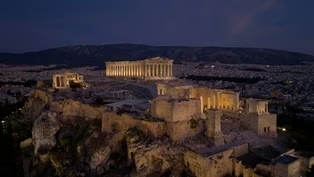
Athens: Birth of Democracy Preview
Video has Closed Captions
Preview: S53 Ep8 | 30s | Archaeologists investigate the dramatic origins of democracy in ancient Greece 2,500 years ago. (30s)
Providing Support for PBS.org
Learn Moreabout PBS online sponsorship

- Science and Nature

Follow lions, leopards and cheetahs day and night In Botswana’s wild Okavango Delta.
 New Episode










Support for PBS provided by:
National Corporate funding for NOVA is provided by Carlisle Companies. Major funding for NOVA is provided by the NOVA Science Trust and PBS viewers.