
Forgotten Harvest addresses food insecurity, a “Faith in Detroit” story
Season 54 Episode 36 | 26m 46sVideo has Closed Captions
Conversations with the presidents of Forgotten Harvest and Mustard Tree Co-op.
Millions of Americans face hunger every day. We’ll find out how Forgotten Harvest is working to reduce food insecurity in metro Detroit. Plus, the president of a non-profit housing cooperative talks about the role faith played in the building’s development and longevity.
Problems playing video? | Closed Captioning Feedback
Problems playing video? | Closed Captioning Feedback
American Black Journal is a local public television program presented by Detroit PBS
Forgotten Harvest addresses food insecurity, a “Faith in Detroit” story
Season 54 Episode 36 | 26m 46sVideo has Closed Captions
Millions of Americans face hunger every day. We’ll find out how Forgotten Harvest is working to reduce food insecurity in metro Detroit. Plus, the president of a non-profit housing cooperative talks about the role faith played in the building’s development and longevity.
Problems playing video? | Closed Captioning Feedback
Where to Watch American Black Journal
American Black Journal is available to stream on pbs.org and the PBS app.
Providing Support for PBS.org
Learn Moreabout PBS online sponsorship- Up next on "American Black Journal," millions of Americans face hunger every day.
We're going to find out how Forgotten Harvest is working to reduce food insecurity in Metro Detroit.
Plus the president of a nonprofit housing cooperative talks about the role faith played in the building's development and longevity.
Stay where you are.
"American Black Journal" starts right now.
- [Narrator 1] Across our Masco family of companies, our goal is to deliver better living possibilities and make positive changes in the neighborhoods where we live, work, and do business.
Masco, a Michigan company since 1929.
Support also provided by the Cynthia and Edsel Ford Fund for Journalism at Detroit PBS.
- [Narrator 2] The DTE Foundation is a proud sponsor of Detroit PBS.
Through our giving, we are committed to meeting the needs of the communities we serve statewide to help ensure a bright and thriving future for all.
Learn more at dtefoundation.com.
- [Narrator 1] Also brought to you by Nissan Foundation and viewers like you.
Thank you.
(upbeat music) - Welcome to "American Black Journal."
I'm your host, Stephen Henderson.
Although the Trump administration has discontinued the government's annual report on food insecurity, the last data released by the US Department of Agriculture in December revealed that almost 48 million people face hunger on any given day.
Forgotten Harvest is a nonprofit that's fighting food insecurity by delivering surplus food to local charities.
Here to talk more about the work of Forgotten Harvest is the organization's president and CEO, Adrian Lewis.
Welcome back to "American Black Journal."
- Thank you, Stephen.
It's a pleasure to be back.
- Yes, no, it's good to have you here.
That number, 48 million people, that's more than four times the population of the state of Michigan.
It's almost the population of the entire state of California.
It's hard to imagine a country as wealthy as this that is struggling as much with making sure people have food.
- I agree, Stephen.
It's unimaginable.
And then if you were to take the proportion of that, that does apply to our state, but more specifically to Wayne Oakland, Macomb County in which we serve, I mean, you're talking close to at least 800,000 individuals that truly are battling some form of food insecurity and hunger.
- Yeah, you know, one of the things I think is important for people to understand when you talk about this is that there is a range of things that can be going on that would qualify as food insecurity, right?
Maybe it's that at the end of every month, you're running out of money and that last week or so is really hard, or maybe it's that you're disrupted by a job loss or a move, some sudden event in your life that brings you into that space.
It's not one thing, it's many different things, and that's why it affects many different kinds of people.
- You poised that just right.
In terms of, it can happen to anyone at any given time, you know?
It's one flat tire away from having to make that difficult decision, or that difficult decision whether you buy medicine or food.
And we all know that food is medicine, right?
In terms of what we're fighting here, not only it's a matter of food insecurity, there's a nutrition security component of that.
And for me to have that lived experience, I truly can relate and many members of my team can relate.
And what we want to do is to make sure that the awareness is there, that we understand that, that there's definitely not a judgment zone.
There's not a prerequisite per se, as to what was gonna provide and how we're gonna provide those that need that hand up.
- Yeah.
Let's talk about how it's getting worse and why.
Of course, the economy is very bad right now.
Every week there's a business that I know and patronize that is announcing that it's going to close and put all the people who work there back into the job market.
Nonprofits, all kinds of entities, are really struggling right now.
But of course then people who are facing food insecurity, it magnifies the problem.
But talk about some of the ways that that's true.
- Yeah.
It's a domino effect, in a sense, that you take our organization specifically, whereas we are really focused on making sure that the awareness is there, but in order for us to do that, we definitely want to make sure we're continuing to get that pipeline of surplus food.
And you add the component of how inventory controls or inventory itself is low, but not only that, you have some of the improved capabilities of AI, which I understand as a business person, but there's not a lot of surplus out there.
And then you take the donations that we typically would have received from USDA, we're about three million pounds less than last year.
So that's equivalent to approximately, the equivalent of four million meals that we typically would have been able to share.
So it's a domino effect.
And, you know, our fuel costs continue to rise.
Having over 50 trucks on the road 6 days a week makes it very difficult.
- Yeah.
So what does that look like in terms of serving the population you're trying to serve?
What does that look like in terms of the stability of Forgotten Harvest and of course of your partners, right?
- Absolutely.
- This is an organization that works mostly through connecting with other organizations.
Some of those organizations are not just struggling.
Some of them are going away, I imagine.
- That is happening.
And Forgotten Harvest's stance is just as it has been the past 36 years.
We are going to continue to do what we do best is getting the food that we do receive to the right place, right time, right quantity.
The quantities are dwindling, or at a standstill, per se, as the need continues to grow.
And then you talk about our distribution partners, which we have currently over 250 plus distribution partners, and if they're limited on their resources, that plays a part in that.
And just as you noted, we are seeing it.
I'm talking to my peers daily on a collaboration perspective.
How do we, again, find ways to have cost cutting measures so that we can have a greater impact throughout Metro Detroit?
- Yeah.
The model is that you're taking food that is surplus food really, food that other people have decided for whatever reason they don't want or need and distributing it to people who don't have food.
But as things get worse in the economy, it seems like there would be fewer people who have that surplus.
How does that affect Forgotten Harvest?
- It affects us tremendously because our model was built on that surplus, right?
And last year, we were able to rescue and distribute from that surplus over 45 million pounds, which is equivalent of about 40 million meals, but that's still about two million pounds less than last year, right?
So just because of reasons we spoke about, that's dwindling.
So we are looking at other measures of what it's going to take to fulfill that gap, at the same time, whether it be helping ourselves to maybe fundraise to be able to have a component of purchasing food to supplement that loss.
But right now, there's some uncertainty around that, because we are at a point that we definitely will do everything we can, but if it's a matter of us not being able to, again, keep up with the pace and the demand, it becomes a real challenge, Stephen.
- I wonder also what you're seeing in terms of the population that's coming to you for food, how that's changing?
The people who weren't in that population a year or two ago who are now, who are they?
- Yeah, you know, I'm a firm believer and the data shows that hunger and food insecurity exists in every single zip code throughout Wayne Oakland, Macomb County, some less than others.
We do see the data increasing in those smaller percentages that were typical.
And we could see that just by way of engaging.
Whereas, we have places that people share, "This is my first time."
And it's not a matter of we're asking.
They're sharing and they're thankful and they're grateful for organizations such as Forgotten Harvest that definitely are there to give a hand up during those times.
- Yeah.
I want to talk a little about the future.
- Yeah.
- Nobody knows what's going to happen in Washington, of course, even over the next two years, let alone over the next four or eight.
But let's presume that things don't change, maybe worst case scenario, that the economy doesn't get better and the support that the federal government is giving to states that they can give to the local communities doesn't get any bigger.
Talk about the pressures that that puts long term on something like Forgotten Harvest and how you solve for that.
- Yeah.
The way I look at it, and I've shared this with my team and my board, it's a matter of we're going to continue to do what we do best.
That's to distribute the food to our neighbors.
But there's also a component that we have to be aware of in terms of access.
Those pressures, we're committed still to innovation.
How do we find innovative ways to meet that demand and meet our neighbors in need where they are?
So innovations such as we have right now, a total of two, soon to be four, mobile markets.
And there's a dignity that we will continue to provide.
We will not ever reduce that level of dignity to make sure that those that need are getting the access and also getting a form of choice, whether it be cultural needs, whether it be different dietary needs.
So how do we have those equitable distributions?
We're going to continue to stay focused on that.
And definitely by awareness, hopefully we will also attract others that may be interested in supporting our great mission and that's what it's going to take.
- You know, during the pandemic, a nonprofit that I started in the neighborhood where I was born, which is about literary arts and community building, all of a sudden needed to pivot to our neighbors are hungry, right, and people all over our area were hungry.
And Forgotten Harvest was able to kind of come in, partner with us, and basically run a food pantry from our little house on the west side in Detroit so that people could come and get food.
And the number of people, I just will never forget how many people showed up to do that.
And I guess I worry that, you know, that was a temporary issue, right?
The pandemic was going to end at some point.
We don't have that same confidence here and I guess that's what really frightens me.
- Yeah.
Well, first of all, hats off to leaders like yourself that did start that nonprofit and was able to collaborate with us, because it's going to take us doing more of that, but more especially how do we do both and, you know?
It shouldn't be a matter of one versus the other in this because we know we are going to continue to feed individuals, but also how do we get to a point that we have the right wraparound services to get to the root cause and talk about those things, whether it be advocacy, whether it be other things, literacy like you spoke on.
We really need to work better and more intentional in those spaces.
So thank you for mentioning that and being a trailblazer in that type of.
- The trailblazing was on the Forgotten Harvest side, right?
It made it possible for us to say we can pivot from what we normally do to try to feed people.
I just worry that how do we keep that going now where things are not, this is not episodic.
- No, it's not.
- This is maybe a structural change.
- Absolutely.
And again, you know, when you're talking Forgotten Harvest being one of those that will be at the table, it's a matter of how do we get the others that?
- Get other people.
Yeah, yeah.
- Because there's no way we could do it by ourselves, - Yeah.
- but we are going to always have the willing capability of being there.
But otherwise, it's not going to move.
We're not going to move the needle.
We've been fighting food insecurity for quite some time and the numbers show that that needle just hasn't moved as it would if all things were equal.
- Yeah, yeah.
Adrian, thanks for being here.
- Thank you for having me.
- Yeah.
We have another installment from the Faith in Detroit Project, which is led by Christ Church Cranbrook.
Detroit PBS is one of several partners in that initiative that lifts up stories of faith and resilience.
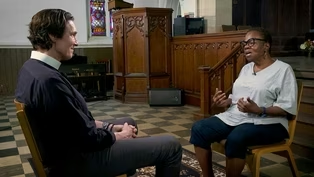
Today we hear from Sheree Walton.
She's the president of the Mustard Tree Co-op, which was founded by the Church of the Messiah.
She sat down with Faith in Detroit Director Father William Danaher to talk about the nonprofit housing cooperative and its surrounding neighborhood.
(soft music) - Sheree, it's so wonderful to be with you.
And I know a bit about your work, but I also have just recently learned that you are the President of the Mustard Tree Co-op, which is a historic co-op in this area.
And I would love to hear a little bit of that story.
- Yes, they tricked me.
It was in transition.
I've been at the co-op off and on probably for the past 35 years or so.
You know, I had to step into Barry's shoes when he moved over here to save the church.
And so it has been a wonderful experience.
When they asked me to run for officer to be the chair, they said, "Oh, it's not hard, and you only meet once a month."
And that was not true, but there were mentors in the building to guide, okay?
And so it is a 23 unit member owned, occupied, sweat equity small business, if you mean, and we call rents carrying charges.
There's no annual association fee, one time fee, and in exchange for that and low rents, you have to do things.
And I think that has taught me to be community more than anything.
Everyone has to be on the committee.
We have quarterly membership meetings.
We have to clean our floor and hallways when your turn comes around.
We do outside cleanups.
We do community building.
We have events for people.
And so many of us that live there, we volunteer in the community, whether it's at cleaners, you know, here at the church, different entities.
And I think that's because we know what it is to work together in sweat equity.
And so Mustard Tree is quirky.
We fight, but we are there for each other.
We struggle with aging building, but we have determination and we fight to hold the legacy of what it is that Messiah and the housing corporation created.
And I think that they tried it down the street, or at least partially at St.
Paul, it didn't work, but it is still going strong today there.
And I look at it as a commitment and an honor because when I look down the street and I see Bridgeview, I look across the street, I see Hamilton House, I see Field Street, I see St.
Paul, and more importantly, I see my church and that green Jesus that got stolen one time.
Ask Pastor Barry about that.
And I couldn't ask for a better community.
- What is amazing to me, because I did a little bit of study of Islandview as a neighborhood, and Islandview originally was the first, as it were, suburb of Detroit.
It was where some of the wealthier citizens put up beautiful, majestic homes, and then would commute into the city for their jobs.
And then in the time in the '70s and early '80s, they began to move even further to the east to Gross Point.
And so Church of the Messiah found itself in this pivotal moment, where they deliberately began to serve the community.
And you are a kind of repository of that history just with what you're telling us today, because that is such a beautiful act that the church did back in the '80s.
Now, God wasn't finished with them once they made that decision, and as God is not finished with us now.
But can you talk a little bit about how that initial move to start that mustard seed development - Mustard tree.
- Mustard tree, excuse me, how it has evolved over the years.
- Well, to me, there is no Islandview as a legacy Detroiter, and I don't mean Islandview the entire thing, but this revitalization.
You know, you have one view, and it's an historical fact that they had these grand homes, but they always had the backstory.
The Boulevard was a sundown street told to me by people who were here before me where blacks had to be off of the Boulevard at dark.
And by the same token, it was the gateway to Belle Isle that allowed all Detroiters to utilize the beauty of Belle Isle.
And it was also in the '80s a contrast, because on one hand, you had these homes, but on the other hand, you had housing in decline, say along Lafayette and along the back street of the Boulevard.
So when I sit here in 2026, and I look at the commitment of a group of very brave, humble, can-do people who rolled up their sleeves, and I look across the street at the housing that has resulted through Christ in action for me, because this is a do church.
It's not where you go and profess God.
It's where we come in and we go out and we mirror him through our actions.
So you have Phil Street, you have St.
Paul Manor, you have Kingsley Arms, and even more excitingly, we are doing new housing.
You know, we have plans for new housing.
And so more than anything, it taught you that there is a relationship with God and that that relationship grows when you help other people.
I remember St.
Christopher House when I first came and I had one of the workshops that I did with community people.
The Boggs were there, Grace Boggs and gosh, her husband.
- Oh, Grace Lee Boggs.
- Yes, and she had did a workshop.
And so I was meeting people that I admired and I saw their dedication and their commitment.
One of the funny things that I like to say is before there was a Detroit Clean Sweep, before there was Motor City Makeover, there were Mustard Tree and Church of Messiah residents who regularly got out and picked a area to clean up because there was a need.
You know, there was a need and you built partnerships like that.
You learned to lead by example.
And one of the things, I think it might have been Marianne Williamson says, "The role of a leader is to hold the space."
And one of the things that is reinforced by being in this community, in this church, in Mustard Tree Co-op is that you hold that space by doing everything that you expect others to do.
- What's amazing to me as well is that so many churches would move to the suburbs with the congregations that they were serving, but Messiah stayed - Yes.
- and actually developed its own vision for community development, as you were saying, decades before anybody else thought to do such things.
And it's wonderful to know that Grace Lee Boggs was, you rubbed shoulders with her, you know, because she.
- Yes, yes.
I didn't even understand the magnitude of that until years later and you're curious and you see a article or a documentary on the Boggs and you go, "Wow."
And they're still doing it.
I mean, this is another thing about community partnerships.
You know, you have many other entities now within Islandview, you know, doing community.
And when I look at how this boulevard is and the housing, and especially my concern is the legacy residents, and there are still areas and people who need more.
And so one of the things that we're fond of saying, at least I am, is "Where's our help?"
- Right.
- Where is the help for the people who always did the best by the community and planted that example on what community is?
This church was the hub of the community for me.
- That's going to do it for us this week.
You can find out more about our guests at americanblackjournal.org, and you can connect with us anytime on social media.
Take care and we'll see you next time.
(upbeat music) - [Narrator 3] This program is made possible in part by Lilly Endowment and Christ Church Cranbrook.
- [Narrator 1] Across our Masco family of companies, our goal is to deliver better living possibilities and make positive changes in the neighborhoods where we live, work, and do business.
Masco, a Michigan company since 1929.
Support also provided by the Cynthia and Edsel Ford Fund for Journalism at Detroit PBS.
- [Narrator 2] The DTE Foundation is a proud sponsor of Detroit PBS.
Through our giving, we are committed to meeting the needs of the communities we serve statewide to help ensure a bright and thriving future for all.
Learn more at dtefoundation.com.
- [Narrator 1] Also brought to you by Nissan Foundation and viewers like you.
Thank you.
(upbeat music)
 New
New"Faith in Detroit" project features Mustard Tree Co-op president and her faith story
Clip: S54 Ep36 | 11m 7s | Faith in Detroit Executive Director Fr. William Danaher sat down with Sheree Walton. (11m 7s)
Providing Support for PBS.org
Learn Moreabout PBS online sponsorship New Episode
- News and Public Affairs

Top journalists deliver compelling original analysis of the hour's headlines.
 New Episode
- News and Public Affairs

Today's top journalists discuss Washington's current political events and public affairs.

 New Episode
 New Episode
 New Episode
 New Episode
 New Episode

 New Episode
 New Episode
 New Episode
Support for PBS provided by:
American Black Journal is a local public television program presented by Detroit PBS